

If you own a duplex, fourplex, or small apartment building in Houston, you already know it does not sell like a single-family house. A buyer for a 2 to 4-unit property has to think about rent rolls, financing rules, and leases that do not end just because the property changes hands. If you want to sell a duplex or fourplex Houston property without months of showings to a limited buyer pool, this guide walks through why multifamily is different and what your real options are.
The short answer: small multifamily properties sell on income and lease terms, not on curb appeal, so the path to a fast sale runs through cap rate math, occupancy status, and a buyer who can close without a traditional bank appraisal holding things up.
A few things about selling multifamily in Houston that most guides skip:
- Lenders treat a 5-plus unit building as commercial financing, but a 2- to 4-unit property still qualifies for some residential-style loans, which actually oddly shrinks your buyer pool.
- A vacant unit next to an occupied one is not a dealbreaker, but it does change how a buyer underwrites the deal.
- Cap rate and net operating income (NOI) matter more to a multifamily buyer than the paint color or the roof age.
- Texas Property Code Chapter 92 tenant protections apply to every leased unit in the building, not just the one you are thinking about. See landlords dealing with tenant problems for how this plays out when you sell.
- A cash sale on a small multifamily property can close before your next mortgage payment is due, since there is no buyer financing to wait on.
Why Small Multifamily Sells Differently Than Single-Family Homes in Houston
A duplex or fourplex sells on the numbers the property produces, not on how it shows. Single-family buyers walk through and picture living there. Multifamily buyers pull out a calculator.
Financing Differences: DSCR and Commercial Loans vs. Conventional Mortgages
A single-family buyer usually qualifies with a conventional mortgage based on their personal income. A 2- to 4-unit property sits in an odd middle zone. It is still technically “residential” under most lending rules, so a buyer can use a conventional loan, an FHA loan if they plan to live in one unit, or a debt-service coverage ratio (DSCR) loan that qualifies based on the property’s rental income instead of the buyer’s paycheck.
That sounds like more options, but it usually means more friction. DSCR lenders want documented leases and often want a minimum occupancy rate before they will fund. FHA lenders want the buyer to occupy a unit, which rules out pure investors. Conventional lenders run debt-to-income calculations on a buyer’s full financial picture, and a fourplex payment is a big number to qualify around. For general home-buying and mortgage information, see the Consumer Financial Protection Bureau’s homeownership resources.
Once a building has five or more units, it moves into commercial financing entirely, with different appraisal standards, shorter loan terms, and higher down payment requirements. A 2- to 4-unit property does not get that classification, so it is stuck between two financing worlds, and that shows up in how long it sits on the market.
Mixed-Occupancy Challenges: Selling When Some Units Are Rented, and Others Are Empty
Mixed occupancy means one or more units are rented, and one or more are vacant, and it changes both your buyer pool and your asking price. A fully vacant duplex appeals to owner-occupant buyers who want to live on one side and rent the other. A fully occupied fourplex appeals to pure investors who want income starting on day one. A building with both creates a smaller, more specific buyer pool, because most buyers have already decided which type of deal they want before they start looking.
Mixed occupancy also complicates the numbers. A buyer underwriting the deal has to estimate what the vacant units will rent for once they are filled, which introduces guesswork the buyer will usually price into the offer as risk. Every occupied unit also carries its own lease, and under Texas Property Code Chapter 92, a lease follows the property when it sells. The new owner steps into the landlord role for whatever term is left on that lease, security deposit and all.
None of this makes a mixed-occupancy building unsellable. It just means the property needs a buyer who is comfortable closing without every unit filled and every lease matching. That buyer is harder to find on the open market and easier to find through a direct cash sale.
Valuing a Multifamily Property: Cap Rate and NOI Basics for Houston Owners
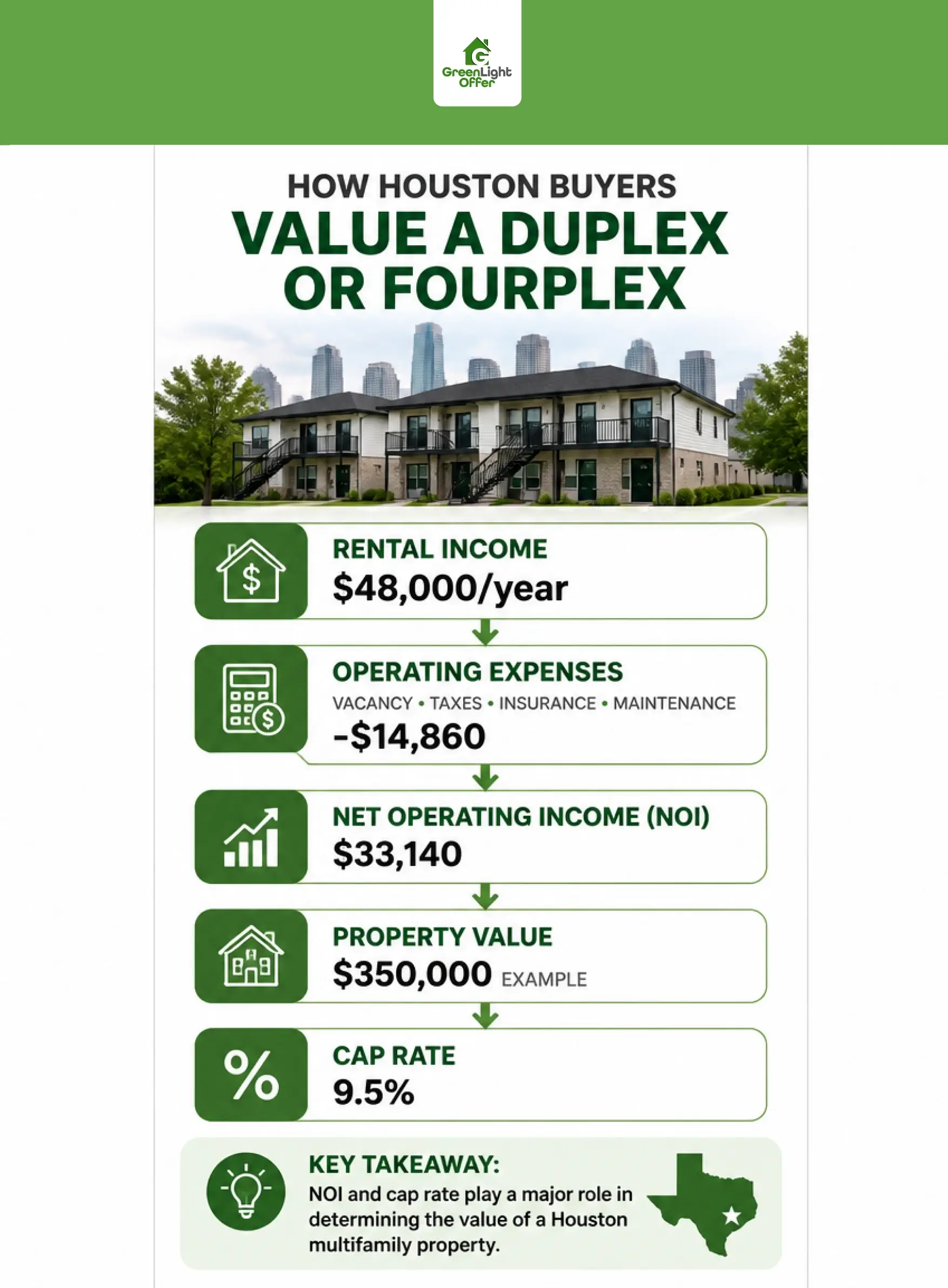
A multifamily property is valued by dividing its net operating income by its purchase price, a ratio called the capitalization rate, or cap rate. This is the single biggest difference between how your duplex gets priced and how your neighbor’s single-family house gets priced.
Net operating income (NOI) is your total rental income minus operating expenses, before the mortgage payment. Operating expenses include property taxes, insurance, maintenance, HOA or deed-restriction fees where they apply, and a vacancy allowance, but not your loan payment. Cap rate is NOI divided by property value, expressed as a percentage. A lower cap rate generally means a lower-risk, higher-demand property. A higher cap rate usually signals more risk, more deferred maintenance, or a less desirable area.
A Simple Cap Rate Example
Here is an illustrative example only, not a valuation of any specific property.
| Line Item | Example Amount |
| Gross annual rental income (4 units) | $48,000 |
| Vacancy allowance (7%) | -$3,360 |
| Property taxes | -$6,500 |
| Insurance | -$2,200 |
| Maintenance and repairs | -$2,800 |
| Net Operating Income (NOI) | $33,140 |
| Example purchase price | $350,000 |
| Cap Rate (NOI ÷ Price) | 9.5% |
This example is for illustration purposes to explain the math, not a quote or projection for your property. Your actual NOI depends on your real leases, your real expenses, and your real occupancy, and a buyer will want to verify all three before making an offer.
Why Traditional Buyers Struggle With 2-4 Unit Properties
Traditional buyers struggle with small multifamily loans because the pool is thinner, the financing is stricter, and the underwriting takes longer than a single-family loan. An owner-occupant buyer needs to qualify for the whole building’s payment while planning to collect rent from units they do not live in, which many lenders view with caution. A pure investor buyer needs DSCR or commercial financing, both of which require more documentation and often a higher down payment than a conventional home loan.
The Smaller Buyer Pool Behind Every Sell Duplex Fourplex Houston Search
Anyone who searches to sell duplex fourplex Houston is running into the same wall: there simply are not as many qualified buyers for a 2- to 4-unit property as there are for a three-bedroom house on the same street. Add an inspection contingency, a financing contingency, and an appraisal contingency, all standard in a traditional sale, and a multifamily deal has three separate points where it can fall apart before closing. Appraisers also have fewer comparable sales to pull from on a small multifamily property, since fewer of them trade hands in any given Houston neighborhood, which can create appraisal-value disputes that stall or kill a financed deal.
When Listing Your Duplex or Fourplex Makes More Sense
Listing makes more sense when your building is fully occupied with strong leases, needs no major repairs, and you have the time to wait for the right investor buyer. A well-maintained, fully leased fourplex in a solid rental corridor, with 90 or more days of flexibility, can attract a competitive bidding process among investors specifically shopping for stabilized income property. If that describes your situation, a traditional listing with an agent experienced in small multifamily sales is a reasonable path, and we would rather tell you that plainly than pretend a cash sale is always the better math.
A cash sale earns its place when time, occupancy uncertainty, deferred maintenance, or lender friction make the traditional path slower or riskier than it is worth to you.
| Factor | Traditional Listing | Cash Sale |
| Typical timeline | Weeks to months, plus buyer financing | Days to a few weeks |
| Buyer financing risk | Present (DSCR, conventional, or commercial loan) | None, no financing contingency |
| Repairs before sale | Often expected or negotiated | Sold as-is |
| Mixed occupancy | Narrows buyer pool further | Not a barrier |
| Commission and fees | Typically 5 to 6 percent to agents | None taken from your proceeds |
| Appraisal risk | Present, fewer comps for small multifamily | Not applicable |
This is an example comparison to illustrate the trade-offs, not a promise of a specific price or timeline for your property.
How a Cash Sale Simplifies a Multifamily Exit in Houston

A cash sale simplifies a multifamily exit because it removes the financing contingency, the appraisal risk, and the need to have every unit filled before you can close. We buy duplexes, fourplexes, and small multifamily properties in whatever occupancy condition they are in today, whether that means fully rented, fully vacant, or somewhere in between.
We need private access to the property a few times before closing, always scheduled around you, and you do not have to leave while we are there. If some units are occupied, we work around existing leases rather than asking you to clear them out first. After we buy a property, we usually resell it on the open market. That happens after your closing and does not affect your sale, your price, or your timeline.
We have bought Houston rental properties from landlords in exactly this position before. Mr. and Mrs. Al Green sold us a rental property they had been renting out, and our team worked through a snag with them along the way, with Chris, Isaac, and Jacob handling the details. That is the kind of hands-on problem-solving a multi-unit property with real tenants and real leases actually needs, not a generic offer that assumes a simple, vacant house.
We have been buying property in Houston for 10 years; we typically buy 15 to 20 homes a month across the metro, and we carry a 4.7-star Google rating and an A+ rating with the Better Business Bureau, where we have been accredited since 2018.
What to Gather Before You Sell Your Duplex or Fourplex
Gather your leases, your rent roll, and your utility setup before you talk to any buyer, cash or traditional. Having this ready speeds up any offer, because it answers the questions a buyer would otherwise have to chase down themselves.
Documents and Records to Gather Before You List or Sell
- A current rent roll showing rent amount, lease start and end date, and security deposit for every unit
- Copies of each active lease, including any addenda
- A record of how utilities are split or metered across units
- Any HOA, deed restriction, or condo association documents that apply to the property
- Recent property tax statements and any homestead exemption status if you occupy one unit
- A list of any known repairs, code violations, or maintenance issues per unit
If any unit has flood history, foundation movement common in Houston’s expansive clay soil, or a MUD or PID assessment on the tax bill, have that documentation ready too. Texas Property Code 5.008 requires a seller’s disclosure on most residential property sales, and a duplex or fourplex you occupy or have occupied falls under those same disclosure rules. If you’re weighing this against selling a rental property fast in Houston as a single-family owner, the disclosure and documentation steps are similar. A buyer who moves fast, like a cash buyer, will still want an accurate picture up front so nothing surprises anyone at the title company.

Frequently Asked Questions About Selling a Duplex or Fourplex in Houston
Can you sell a duplex with tenants in some units and not others?
Yes. A mixed-occupancy duplex, triplex, or fourplex sells to fewer buyers on the open market, but a cash buyer can typically close on the building as it sits, with occupied units staying occupied and vacant units staying vacant, no cleanout or lease termination required before closing.
How is a fourplex valued differently than a single-family home?
A fourplex is valued primarily on net operating income and cap rate, meaning what the building earns after expenses, divided by price. A single-family home is valued mainly by comparable sales of similar houses nearby. This is why two buildings that look alike from the street can have very different asking prices if their leases and expenses differ.
Do you buy a duplex or fourplex that still has a mortgage on it?
Yes. We handle payoff of an existing mortgage at closing as part of the transaction, the same way we would for a single-family property.
Can I sell a fully vacant multifamily property in Houston?
Yes. A fully vacant duplex or fourplex is often easier to sell than a mixed-occupancy one, since there is no existing lease for a buyer to inherit, but it can also mean no rental income to help a traditional buyer qualify for financing. A cash sale removes that financing question entirely.
How fast can we close on a duplex or fourplex?
You choose the closing date, anywhere from 14 to 60 days out, once we send a written offer. We typically respond within about an hour during business hours, and the first conversation runs 5 to 10 minutes with no credit pull and no financial disclosures required just to talk.
Selling a Duplex, Fourplex, or Multifamily Property in Houston: Getting Started
Selling a duplex, fourplex, or small multifamily property in Houston starts with an honest look at your occupancy, your numbers, and how much time you actually have. If your building is stabilized, fully leased, and you can wait for the right investor buyer, listing with an agent experienced in small multifamily is worth considering. If mixed occupancy, deferred maintenance, or a financing-sensitive buyer pool is slowing you down, a direct cash sale skips the appraisal contingency and the wait for someone else’s loan to fund.
We buy Houston duplexes, fourplexes, and small multifamily properties as-is, in any occupancy mix, and we send a written cash offer with the math behind it within 24 hours. There is no obligation to accept it, and no credit pull just to have the conversation. If you are ready to see what your property is worth, get your free cash offer and find out where you stand.
