

If your Houston home caught fire, selling probably was not part of the plan. But once you start pricing out repairs, waiting on an adjuster, and wondering if you even want to rebuild, a fire insurance claim and selling your fire-damaged property can start to feel like the more realistic path. Homeowners in this spot usually have the same question: does selling mean losing the claim money?
Here is the direct answer. You can sell a fire-damaged house in Houston whether your claim is open or already settled. The insurance proceeds get handled through an assignment of the claim or a payoff at closing, not forfeited. The exact mechanics depend on your policy, your mortgage lender, and how far along the claim already is, but selling does not mean walking away from money owed to you.
A few things surprise most homeowners the first time they deal with this:
- Your mortgage lender is legally named on the insurance check, even if you have never missed a payment.
- Actual cash value and replacement cost value are not the same number, and the gap can run into thousands of dollars.
- In most cases, you don’t have to finish an open claim before you close.
- Underinsurance and a disputed cause of the fire are the two most common reasons a claim stalls.
- Selling as-is removes the pressure to finish repairs before you can move forward with your life.
Most sellers want to know how the claim and the sale fit together on a calendar. Here is a realistic range:
| Stage | Typical Timeframe |
| File claim and adjuster inspection | 3 to 10 days after the fire |
| Proof of loss submitted | Within 60 to 91 days, per policy |
| Initial ACV payout issued | 2 to 6 weeks after proof of loss, if uncontested |
| Selling as-is, claim open or settled | 14 to 21 days from accepted offer to closing, with 14 days as the realistic floor since title clearance and any mortgage payoff statement take five to seven business days |
These are general ranges, not a promise for your specific claim or property.
How a Homeowners Fire Claim Works, Start to Finish
A homeowners fire claim moves through four stages: filing the claim, the adjuster inspection, the proof of loss, and the payout. Each stage has its own paperwork and its own waiting period, and skipping one usually delays the next.
You start by calling your insurer and opening a claim, ideally within a day or two of the fire. Most policies set a notice deadline, so waiting weeks to report the loss can put your payout at risk. The insurer assigns a claims adjuster, who inspects the structure, documents the damage room by room, and reviews your policy limits and coverage types.
The Adjuster Inspection and Proof of Loss
The adjuster’s report becomes the basis for your proof of loss, a sworn statement listing the damaged property and its value. You typically have 60 to 91 days to submit this, depending on your carrier and policy language, so read your declarations page early rather than waiting for a reminder.
Once the insurer accepts the proof of loss, it issues a payout. For a total loss or major structural fire, that payout is often split into an initial actual cash value check with a second payment released later, which leads directly into the next question every homeowner asks.
Actual Cash Value (ACV) vs. Replacement Cost Value (RCV): Why This Distinction Changes Your Numbers
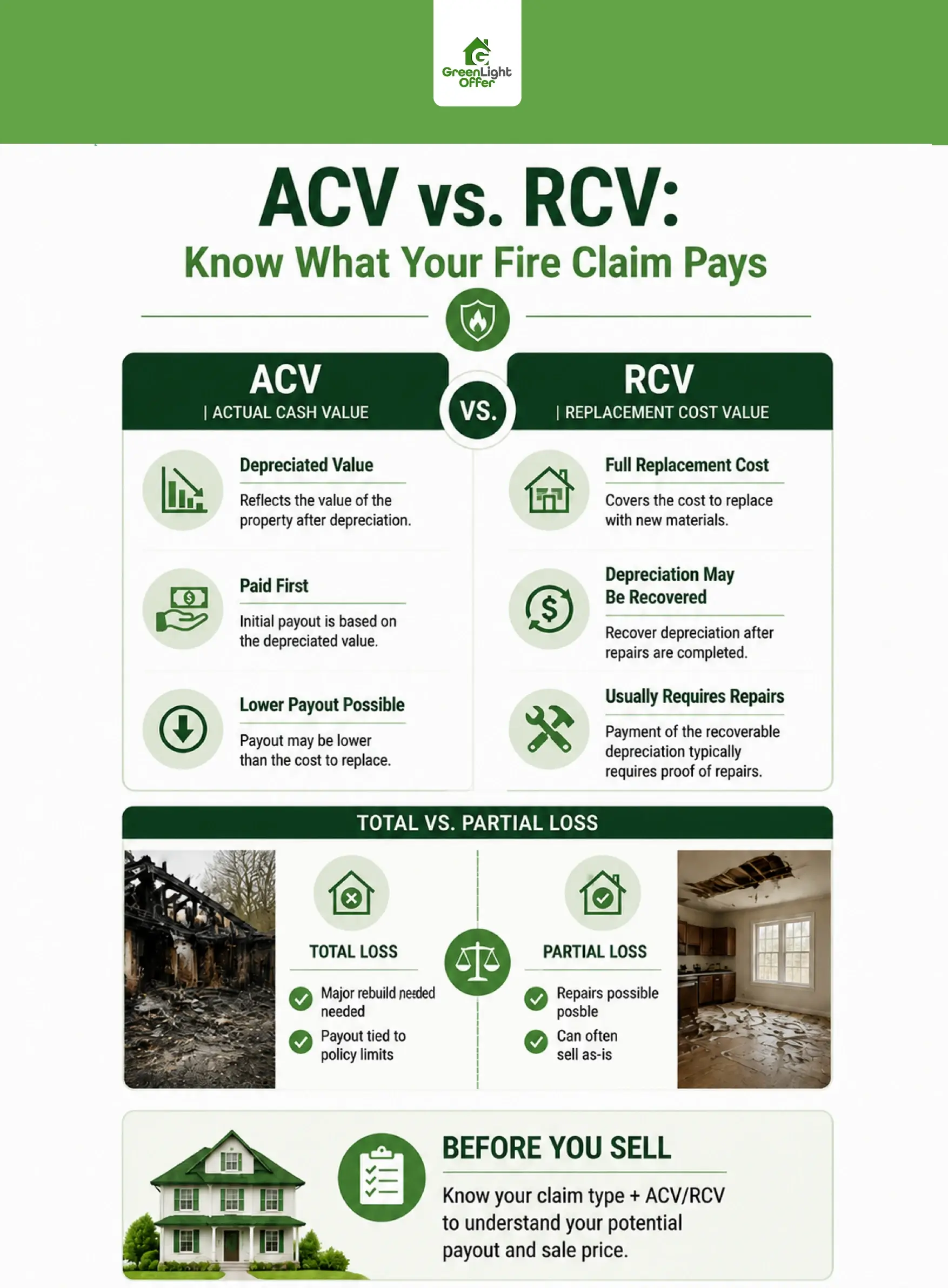
ACV pays what your damaged property is worth today, after depreciation, while RCV pays what it costs to rebuild or replace it new. That gap is often the number that catches homeowners off guard, because someone expecting a full rebuild budget instead receives a depreciated figure.
Most homeowners policies in Texas are written on a replacement cost basis, but insurers still cut the first check at ACV. You receive only the remaining depreciation, called recoverable depreciation, after you complete the repairs and submit receipts. If you sell instead of rebuilding, that second check may not be available at all, which matters when you are deciding whether to repair or sell as-is.
| Factor | Actual Cash Value (ACV) | Replacement Cost Value (RCV) |
| What it pays | Depreciated value of the damaged item | Full cost to replace or rebuild |
| When it is paid | Issued first, right after the claim is approved | Second payment, after repairs are completed |
| Depreciation applied | Yes, based on age and condition | No, once repairs are verified |
| Best fit | Selling as-is or not rebuilding | Homeowners planning a full repair or rebuild |
Why ACV Payouts Come In Lower
Depreciation accounts for the roof’s age, the flooring’s wear, and the years already logged on major systems like HVAC or water heaters. A 15-year-old roof destroyed in a fire will not receive a brand-new roof’s price tag under ACV, even though replacing it costs full retail today.
Total Loss vs. Partial Loss: Why the Distinction Changes Your Options
A fire claim gets treated differently depending on whether the structure is a total loss or has repairable damage. Most policies define a total loss as a property that costs more to rebuild than the coverage limit allows, or one the local building official has deemed unsafe to occupy. That distinction changes both your payout and your selling options.
With a total loss, the payout is usually based on your dwelling coverage limit rather than a room-by-room repair estimate, and the property itself may only be worth land value once the structure is removed. With partial damage, the adjuster’s estimate becomes the ceiling on what you can recover, and the house can often still be sold with the damage disclosed rather than repaired first.
Knowing which category your claim falls into before you talk to a buyer helps you set realistic expectations for both the payout and the sale price.
Can You Sell the House Before the Claim Is Settled?
 Yes, you can sell a house with an open fire insurance claim in most cases, either by settling the claim first or by assigning the remaining proceeds to the buyer at closing. Which route makes sense depends on your timeline, your lender, and how the buyer is set up to handle an open claim.
An assignment of claim lets the buyer step into your position as the named insured for the unpaid portion of the payout, in exchange for a purchase price that reflects the as-is, damaged condition. A settled claim, on the other hand, lets you pocket the payout yourself and sell the repaired or as-is property with a clean title, no assignment paperwork attached.
| Path | How It Works | Typical Timeline Impact |
| Settle first, then sell | You collect the full payout, then sell the house as-is or repaired | Adds the time it takes the insurer to finish adjusting |
| Sell with an open claim | Buyer accepts an assignment of the remaining claim proceeds | Can close faster since you are not waiting on the insurer |
Either path is workable in principle. Because every insurer and every policy handles assignment differently, this is worth a direct conversation about your specific claim before you commit to a buyer or a timeline.
Does Your Payout Go to You or Your Mortgage Lender?
If you still owe money on the house, your insurance payout is made out to both you and your mortgage lender, not to you alone. This comes as a surprise to homeowners who assume the check lands directly in their bank account.
The Mortgagee Clause Explained
Every mortgage includes a mortgagee clause naming the lender as a loss payee on the property insurance. The lender has a financial interest in the house until the loan is paid off, so the insurer protects that interest by including the lender’s name on larger claim checks. For bigger payouts, the lender may hold funds in an escrow account and release them in stages as repairs are verified, or apply the funds toward the loan balance if you choose not to rebuild.
Selling the property resolves this cleanly. The loan gets paid off at closing, the lender’s interest in the insurance funds is settled as part of that payoff, and you are no longer negotiating with two parties over the same claim. The Consumer Financial Protection Bureau’s guidance on how home insurance claims are paid explains how mortgage servicers typically handle insurance settlement checks and release funds when a property has been damaged. If a lien on the property is also part of the picture, that gets settled at the same closing table as the mortgage payoff.
How a Cash Offer Accounts for Fire Damage and an Open Claim

A cash offer on a fire-damaged house is not a guess. A written offer should show the after-repair value (ARV), a repair budget based on the actual damage, and the comparable sales used to support the number, so you can check the math yourself instead of taking a price on faith.
An open insurance claim factors into that repair budget directly. If your claim already covers part of the rebuild cost, that changes the net number you should expect to walk away with, and a buyer who is transparent about their math will show you where the claim value and the repair budget overlap.
This is also where the no-commission structure matters more than usual. After an ACV payout that already came in lower than expected, sellers are often trying to protect what is left. A sale with no agent commissions, no closing costs, and no title policy fees keeps more of that number in your pocket. You also choose your own closing date, anywhere from 14 to 60 days out, which gives you room to let a slow claim catch up if you need it to, or to close quickly if you do not.
Common Reasons Claims Get Delayed or Disputed
Claims stall most often over three issues: underinsurance, a disputed cause of the fire, and coverage gaps for code-required upgrades. Knowing which one applies to you helps you push back or plan around the delay instead of just waiting.
- Underinsurance: your policy limit is lower than the actual rebuild cost, so the payout falls short no matter how the claim is calculated.
Underinsurance often triggers something called a coinsurance penalty. If your dwelling coverage is below a set percentage of the home’s replacement value, usually 80 percent, the insurer pays only a proportional share of the claim, even for damage well under your policy limit. A $300,000 replacement cost with only $200,000 in coverage, for example, can mean the payout on a $50,000 repair is reduced, not paid in full. This is worth checking on your declarations page before you assume your coverage limit is the number you will actually receive.
- Disputed cause: if the insurer suspects electrical failure, arson, or a pre-existing issue rather than accidental fire, it can delay or deny portions of the claim pending investigation.
- Code-upgrade gaps: older homes rebuilt to current Houston building code often cost more than the original structure, and standard policies do not always cover that difference unless you carry ordinance-or-law coverage. If a fire also triggers a code violations notice from the city, that adds another layer to sort out before a traditional sale.
Any of these can push a claim from weeks into months. If you are not in a position to wait that out, selling as-is with the claim still open is often the faster route back to moving forward. If your claim seems stuck without explanation, the Texas Department of Insurance’s complaint process is the direct way to report a slow or unresponsive carrier.
Selling As-Is With an Open or Settled Claim: What a Cash Buyer Needs From You
Selling a fire-damaged house as-is means the buyer needs your claim documentation, not a repaired structure. A buyer who understands fire claims will want to see the adjuster’s report, the proof of loss, and your policy’s declarations page. That documentation lets them price the offer accurately instead of guessing at the damage. Our Sell My House page walks through the same three-step process for any as-is sale, fire damage or otherwise.
Sellers also have a mandatory disclosure obligation under Texas Property Code, Section 5.008, which requires disclosing known material defects, including prior fire damage, to any buyer. A disclosure like this belongs in the purchase agreement from the start, not as a surprise late in the process. If you want the specifics on timelines for a fire-specific sale, see how to sell a fire-damaged house fast in Houston.
Sellers under pressure often come to us after other buyers have stalled out. Ms. Yates needed a fast sale after several other buyers could not get it done, and we closed within a couple of days. You can read her story and others on our testimonials page. That same responsiveness applies whether the holdup is a slow buyer or a slow insurance claim.
When Repairing and Listing Traditionally Might Make More Sense
If your fire damage is limited, your insurance payout fully covers the repair cost, and you have the time and desire to rebuild, listing the repaired home traditionally can net you more than an as-is cash sale. A fully restored home in a strong Houston pocket often draws a stronger price than a damaged one, and it is the honest answer even though it does not point toward a quick cash sale.
The trade-off is time and risk. Contractor schedules in Houston can run long after a widespread weather or fire season, costs can exceed the original estimate, and you carry the mortgage, insurance, and taxes the entire time the house sits unfinished. If your claim is small, your timeline is flexible, and you want top dollar, repairing first is a reasonable plan. If any of those three is not true for you, selling as-is is usually the more realistic choice.

Frequently Asked Questions About Fire Insurance Claim Selling House Houston
These are the questions we hear most often from Houston sellers dealing with a fire claim. For everything else, our full FAQ page covers the rest of our process.
Can I sell my house with an open fire insurance claim?
Yes. Most sales with an open claim use an assignment of the remaining claim proceeds, letting the buyer collect the rest of the payout after closing in exchange for a price that reflects the damage.
What’s the difference between ACV and RCV for a fire claim?
ACV pays the depreciated value of what was damaged, and RCV pays the full cost to replace it new. Insurers typically issue the ACV amount first and the RCV difference later, once repairs are completed and documented.
Does my mortgage lender control my fire insurance payout?
The lender is named on the check for larger claims because of the mortgagee clause in your loan, and it can hold funds in escrow for repairs. Selling the house and paying off the loan at closing resolves this without an ongoing escrow arrangement.
Do I have to finish repairs before I can sell a fire-damaged house?
No. You can sell as-is with the damage still present, using the disclosure required under Texas Property Code 5.008 to inform the buyer, and structure the sale around whatever stage your claim has reached.
How long does a fire insurance claim take to settle in Texas?
Timelines vary by insurer and by how contested the claim is, but straightforward claims often settle in a few weeks while disputed or underinsured claims can take several months. Contacting the Texas Department of Insurance is a reasonable step if your claim seems stuck without explanation.
Selling Your House After a Fire Insurance Claim: The Bottom Line
A fire insurance claim does not lock you into rebuilding before you can sell. Whether your claim is open or settled, ACV or RCV, and whether your lender is holding funds in escrow or not, there is a path to closing that does not require you to finish repairs first. The right path depends on your specific policy and your timeline, and it is worth reading your declarations page and talking to your adjuster before you decide.
We’ve been buying Houston houses since 2016, and you can read more about how we got started on our About Us page or meet the team who will actually work your file. If you want to talk through your specific claim and property, we can walk you through how a sale with an open or settled fire claim would actually work for your house.
Get your free cash offer, and you’ll have a written cash offer within 24 hours, with no obligation and no credit pull.
