

The Power of All-Cash Offers in Today’s Housing Market
All cash offers on homes are purchases made without mortgage financing, where the buyer pays the entire amount upfront using liquid funds. They typically close faster, involve fewer contingencies, and provide more certainty for sellers.
| Quick Facts About All-Cash Offers |
|---|
| ✓ Account for nearly 39% of home sales in 2024 |
| ✓ Close in as little as 1-2 weeks (vs. 43-47 days with financing) |
| ✓ Eliminate financing fall-through risks |
| ✓ Often come at 10-11% below asking price |
| ✓ Require proof of funds instead of mortgage pre-approval |
In today’s competitive real estate market, cash offers have become increasingly common. According to recent data, nearly 39% of single-family home and condo sales in 2024 were made with cash—the highest share recorded since 2013. This surge is being driven by several factors, including high mortgage rates, tight inventory, and buyers with substantial equity from previous home sales.
For sellers facing urgent situations like foreclosure, divorce, or unexpected expenses, an all-cash offer can be particularly attractive. The appeal is clear: no financing contingencies, dramatically faster closings, and the elimination of appraisal concerns that might derail a traditional sale.
For buyers, making an all-cash offer provides significant competitive advantages. With no lender involvement, cash buyers can often negotiate better prices (studies show an average 10% discount), skip mortgage-related fees, and close on properties much faster than those using financing.
All Cash Offers on Homes: Definition, Trends & Buyer Profiles
When you hear “all cash offers on homes,” we’re talking about buyers who purchase properties using their available funds—no mortgage needed. The entire purchase price is paid upfront at closing, which means no lender approval, no underwriting process, and far fewer contingencies than typically come with financed purchases.
Cash transactions have become remarkably common in today’s real estate landscape. In January 2024, all-cash buyers accounted for 32% of home sales—the highest share we’ve seen since June 2014. By some measures, nearly 39% of single-family home and condo sales in 2024 were completed with cash, making this the highest share recorded since 2013.
As Jessica Lautz, Deputy Chief Economist at the National Association of REALTORS®, puts it: “Cash is king in today’s market. The share of all-cash buyers has reached its highest level in nearly a decade, which speaks volumes about the current state of the housing market.”
What might surprise you is that this trend isn’t limited to wealthy investors. While it’s true that 64% of investors purchased homes with cash in early 2024, many everyday buyers are going the cash route too. About 26% of repeat homebuyers made all-cash purchases in 2023 (up significantly from just 10% in 2003), and even 6% of first-time buyers managed to pay cash (compared to 4% in 2003).
One fascinating pattern we’re seeing: cash buyers tend to move much farther than those using financing. All cash offers on homes often come from buyers who relocated a median of 60 miles, with 29% moving more than 500 miles away. Compare that to financed buyers, who moved a median of just 18 miles, with only 16% relocating more than 500 miles. This suggests cash buyers often have different motivations driving their purchases.
Why Are All Cash Offers on Homes Surging in 2025?
Several key factors are fueling the dramatic increase in cash purchases this year:
High mortgage rates have made financing much more expensive. With 30-year fixed rates hovering above 6.5% (compared to under 3% in 2021), financing costs have skyrocketed. On a $450,000 mortgage at 7%, you’d pay approximately $418,527 in interest over 30 years—a substantial expense that cash buyers simply avoid altogether.
Record home equity has given existing homeowners unprecedented purchasing power. Many homeowners have watched their property values climb significantly over the past decade, creating a substantial pool of equity. When these folks decide to downsize or relocate, they can often use these proceeds to make cash purchases.
The competitive advantage of cash in tight markets cannot be overstated. In areas with limited inventory (like many parts of Houston), cash offers stand out because they typically close faster and present far less risk to sellers, making them attractive even when priced below competing financed offers.
Some buyers view real estate as a safe haven during economic uncertainty and are moving their money from volatile investments into tangible assets like housing. This wealth-preservation strategy has become increasingly common in unpredictable economic times.
Demographic shifts are playing a major role too. Baby Boomers and members of the Silent Generation, who’ve had decades to build wealth, are particularly active as cash buyers. Over 50% of older Baby Boomers and Silent Generation buyers pay cash, compared to just 6-7% of Millennials.
Making All Cash Offers on Homes: Buyer Profiles
The world of cash buyers is surprisingly diverse. Here’s who’s making all cash offers on homes in Houston and beyond:
iBuyers and Direct Buyers like Greenlight Offer specialize in quick, hassle-free transactions. We provide offers within 24-48 hours, purchase properties “as-is” without requiring repairs, close on your timeline (often in just 14 days), and eliminate traditional sales hassles like showings and staging. For Houston homeowners facing time constraints or properties needing work, we offer a convenient solution without the uncertainty of traditional listings.
Real Estate Investors and Flippers make up a significant portion of the cash market. They typically focus on properties they can improve and resell at a profit, often targeting distressed homes or those needing significant updates. These buyers make decisions based on potential return on investment and frequently negotiate below market value to account for renovation costs. In early 2024, the areas with the highest share of all-cash investor purchases included Portland-South Portland, ME (81.3%), Albuquerque, NM (81.2%), and Toledo, OH (80.5%).
Equity-Rich Homeowners represent a growing segment of cash buyers. These are regular folks who have accumulated substantial equity in their current homes. They often sell their existing property first to fund the cash purchase, may be downsizing to a smaller, less expensive home, and use cash to gain an edge in competitive markets. As one Houston real estate agent shared with us, “I’m seeing more and more repeat buyers coming to the table with cash. They’ve built up equity in their previous homes and are using that to fund their next purchase, especially when downsizing.”
Retirees and Relocators frequently choose the cash route. Retirees often sell larger family homes to purchase smaller properties outright, while buyers from expensive coastal markets can sell there and buy with cash in more affordable areas like Houston. Those moving for work may use employer relocation benefits or home sale proceeds, and international buyers frequently use cash for U.S. property purchases. This helps explain why cash buyers move significantly farther distances than financed buyers—they’re often coming from entirely different regions.
For more insights on cash buying trends, check out the latest stats on all-cash sales or learn more about Cash Home Buyers in Texas.
Cash vs Financed Sale: Step-by-Step Process, Timeline & Costs
When it comes to buying a home, the path you take—cash or financing—makes a world of difference. Let’s walk through what makes all cash offers on homes so different from traditional mortgage purchases.
The Cash Purchase Process
Buying a home with cash strips away many of the complexities that come with mortgage financing. The journey starts when a buyer makes an offer with proof they actually have the money—not just a lender’s promise to provide it later.
Step 1: Make an Offer
Rather than showing a pre-approval letter, cash buyers provide actual proof of funds—typically a recent bank statement or a certified financial statement from their institution. This shows sellers you mean business! Cash buyers also tend to put more skin in the game upfront, with earnest money deposits often running 3-5% of the purchase price (compared to just 1-2% for financed offers).
Step 2: Sign the Contract
Here’s where cash offers really shine. The purchase agreement is refreshingly straightforward—no financing contingencies to worry about, no appraisal requirements from a lender. While smart cash buyers usually keep the inspection contingency, many choose to purchase “as-is” to make their offers even more attractive.
Step 3: Due Diligence
Even without a lender requiring it, most cash buyers still opt for a home inspection—after all, you’re making a significant investment! The title search proceeds as normal to ensure clean ownership, and property surveys happen if needed in your area.
Step 4: Title and Escrow
This step remains similar to financed purchases—opening an escrow account, completing the title work, and preparing closing documents. The difference? It all happens much faster without a lender’s involvement.
Step 5: Close the Deal
After a final walkthrough to make sure everything’s as expected, you’ll sign the closing documents and transfer funds from your account to escrow. The deed gets recorded, and voilà—you’re a homeowner!
Step 6: Transfer Ownership
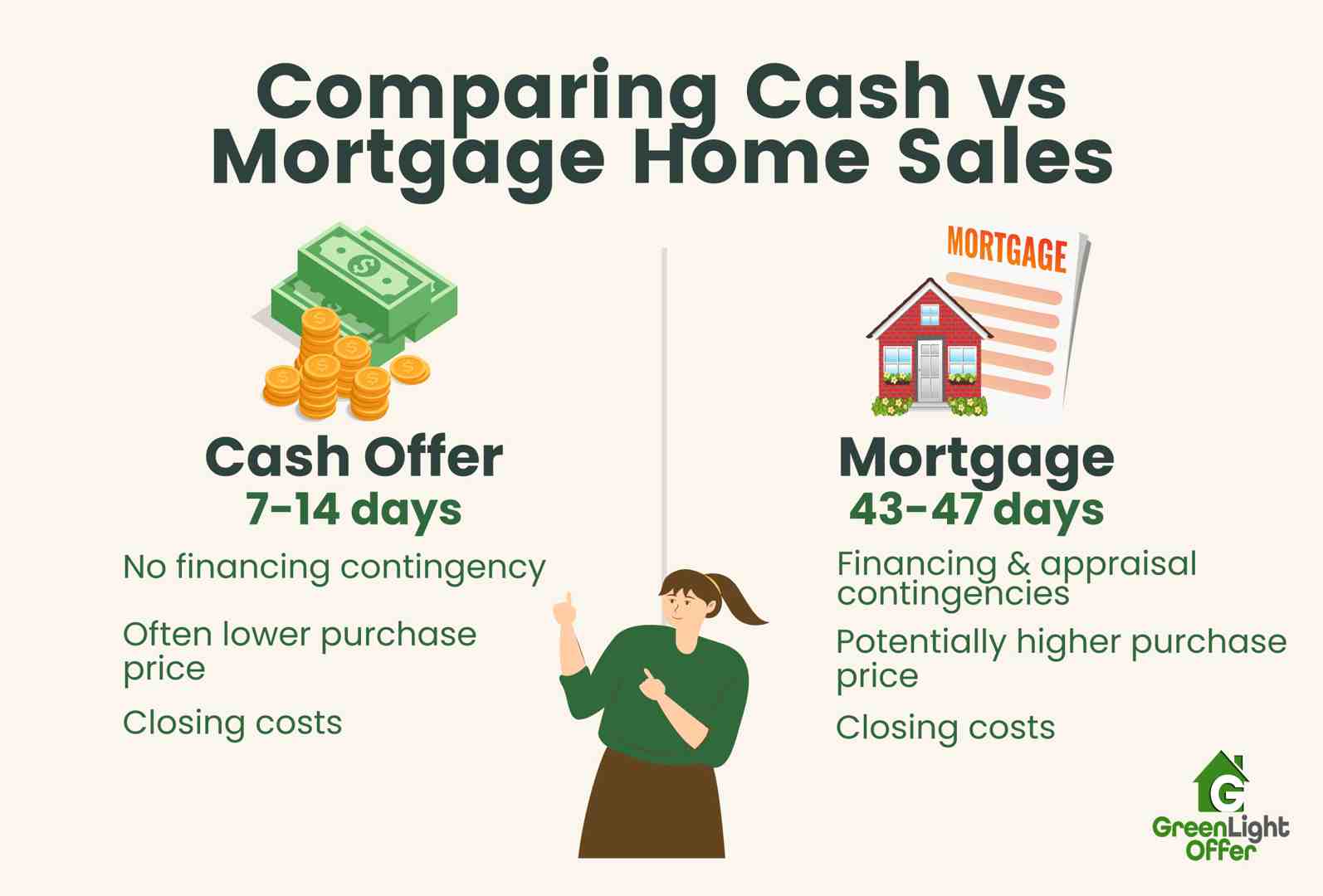
Keys in hand, the property is officially yours. The entire process typically wraps up in just 14 days—a dramatic difference from the 43-47 days average for mortgage-financed purchases.
Comparison: Cash vs. Mortgage Purchase Process
| Aspect | Cash Purchase | Mortgage Purchase |
|---|---|---|
| Timeline | 7-14 days | 43-47 days (average) |
| Proof Required | Proof of funds letter | Pre-approval + underwriting |
| Contingencies | Minimal (often just inspection) | Financing, appraisal, inspection |
| Appraisal | Optional (buyer’s choice) | Required by lender |
| Closing Costs | Lower (no lender fees) | Higher (includes origination fees, points) |
| Risk of Deal Failure | Very low (approximately 1%) | Higher (10-15% fall through) |
| Price Negotiation | Often 10-11% below asking | Typically closer to asking price |
As one Houston real estate agent shared with me recently, “I always tell my sellers that while a cash offer might come in lower than competing financed offers, the peace of mind is worth its weight in gold. When you know the deal is almost certainly going to close—and quickly—that’s incredibly valuable, especially if you’re in a time crunch or your home has quirks that might raise eyebrows during an appraisal.”
Closing Costs in Cash Transactions
While cash buyers sidestep many financing-related fees, they don’t escape closing costs entirely. Here’s what to expect when buying with cash:
You’ll still pay for title insurance, title search fees, escrow fees, and recording fees. Depending on your location, transfer taxes might apply, along with pro-rated property taxes and HOA transfer fees if you’re buying in a managed community.
The good news? You completely avoid loan origination fees, mortgage insurance, lender’s title insurance, appraisal fees, credit report fees, and application fees. These savings typically amount to 1-2% of the purchase price—on a $300,000 home, that’s a cool $3,000-$6,000 you get to keep in your pocket.
The streamlined process and cost savings explain why so many buyers choose to make all cash offers on homes when they have the means. At Greenlight Offer, we see how these simplified transactions bring relief to both buyers and sellers in the Houston market.
Diving Deeper: Pros, Risks, Tax Implications & Negotiation Strategies
The Benefits of All Cash Offers on Homes
When it comes to selling your home, an all cash offer on a home can feel like striking gold. Let’s explore why these offers are so appealing to sellers:
Speed and certainty are perhaps the biggest advantages. While traditional mortgage-backed sales typically drag on for 43-47 days, cash transactions can wrap up in as little as two weeks. This quick timeline is a game-changer if you’re relocating for work, facing financial challenges, or managing an inherited property.
John McReynolds, who recently worked with Greenlight Offer, shared his experience: “We had been trying to sell our house to an individual for nearly 6 months. We kept encountering delay after delay. After we finally pulled the plug on the first deal, a friend told us about Greenlight. We got ahold of Sean, and he made us a fair offer on our house. After experiencing delay after frustrating delay, it was so refreshing to have the deal closed in less than two weeks, with zero hassle on our part. Sean and Ashley were a pleasure to work with. Thanks so much, guys!”
Another major benefit is eliminating financing risks entirely. About 10% of mortgage-backed deals fall through due to loan denials, low appraisals, or changes in the buyer’s financial situation. With cash, once you accept the offer, you can breathe easy knowing the deal is almost certainly going to close.
The simplicity of cash sales also can’t be overstated. You’ll bypass lender requirements, skip the appraisal contingency, deal with fewer parties, and enjoy streamlined paperwork. For many sellers, this stress reduction alone is worth its weight in gold.
Many cash buyers, especially investors and companies like Greenlight Offer, will purchase properties “as-is.” This means no repairs, no updates, no staging, and no negotiating after inspections. For homes needing work or sellers wanting a truly hassle-free experience, this convenience goes far beyond just the dollar amount offered.
Potential Drawbacks and Risks
Despite the clear advantages, there are some considerations both parties should weigh carefully:
For sellers, the most significant drawback is potentially receiving a lower sale price. Research from UC San Diego’s Rady School of Management found that all cash offers on homes typically come in about 10% below what mortgage buyers pay. This “cash discount” exists because sellers value the certainty and speed, and cash buyers factor these advantages into their offers.
By considering only cash offers, you’re also limiting your buyer pool significantly. This could mean fewer competing offers and less opportunity for bidding wars that might drive up your price.
From the buyer’s perspective, tying up substantial liquidity in a single, non-liquid asset can limit financial flexibility. Having so much money locked in your home means less available for other investments, emergencies, or opportunities.
Cash buyers also miss out on mortgage interest tax deductions. On a $300,000 mortgage at today’s rates, a buyer would pay approximately $422,157 in interest over 30 years—much of which could potentially be tax-deductible.
Without a lender-required appraisal, cash buyers might also risk overpaying. While this provides flexibility in competitive situations, it removes a valuable third-party valuation that might protect against paying too much.
Tax Implications of Cash Home Purchases
The tax considerations of cash purchases deserve careful attention:
When you buy with cash, you forfeit the mortgage interest deduction, which allows homeowners to deduct interest paid on up to $750,000 of mortgage debt (for homes purchased after December 15, 2017). For high-income earners especially, this can be a significant lost tax benefit.
All homeowners, regardless of how they purchased, still face property taxes. In Texas, these can be substantial, though homestead exemptions provide some relief for primary residences.
When eventually selling a primary residence, owners may exclude up to $250,000 ($500,000 for married couples filing jointly) of capital gains from taxation if they’ve lived in the home for at least two of the five years before selling. This applies whether you purchased with cash or financing.
Large cash transactions also face greater scrutiny from tax authorities. Buyers should be prepared to document the source of funds used for the purchase to avoid unnecessary complications.
Negotiation Strategies for Cash Offers
Smart negotiation can maximize the benefits of all cash offers on homes for both parties:
As a cash buyer, don’t be shy about leveraging your advantages. Emphasize the certainty, speed, and simplicity you bring to the table. Many sellers will accept a somewhat lower price for these benefits, especially if they’re facing time constraints or challenges with their property.
Consider using an escalation clause in competitive situations. This automatically increases your offer up to a specified limit if competing offers come in. As a cash buyer already offering a streamlined transaction, this can make your offer particularly attractive.
Flexibility on timing can also strengthen your position. Offering seller-friendly terms like rent-back options (allowing sellers to stay in the home after closing) or adjusting closing dates to match seller needs can make your offer stand out even more than the cash aspect alone.
For sellers weighing cash offers, creating competition is key. Even with a strong cash offer in hand, continue marketing your property and let cash buyers know there’s competition. Setting an offer deadline can encourage buyers to put their best foot forward initially.
Look beyond just the price when evaluating offers. Consider the complete package: timeline, contingencies (or lack thereof), post-closing arrangements, and any personal property inclusions. Sometimes a slightly lower cash offer with better terms is the smarter choice.
Finally, always verify proof of funds before accepting a cash offer. Request recent bank statements, verify the exact amount and source of funds, and consider requiring a larger earnest money deposit than you might with financed offers.

Frequently Asked Questions about All Cash Offers on Homes
Do cash offers always mean a lower purchase price?
Not necessarily, though research does suggest it’s often the case. A fascinating study from UC San Diego’s Rady School of Management found that all cash offers on homes typically come in about 10% lower than mortgage-backed purchases. But real life is never quite so simple!
The “cash discount” varies tremendously depending on several factors. In red-hot markets with bidding wars, cash buyers might actually need to offer above asking price to edge out the competition. The property’s condition plays a huge role too—homes needing major TLC might see deeper discounts from cash buyers willing to take on renovation projects.
Seller circumstances matter enormously. Someone facing foreclosure or who needs to relocate immediately might happily accept a lower cash offer for the peace of mind and quick closing. As one Houston seller told us, “Getting 7% less but closing in less than two weeks instead of four months was absolutely worth it during my divorce—I needed to move on with my life.”
The buyer’s motivation shapes pricing too. Investors hunting for rental properties or flips typically seek discounts, while someone buying their forever home with cash might pay full market value to secure their dream house.
Here in Houston’s diverse neighborhoods, we’ve seen the cash discount vary from practically nothing in desirable areas to significant savings in neighborhoods with more challenging properties.
How do sellers verify a buyer’s proof of funds?
When considering all cash offers on homes, verification is absolutely crucial. After all, a cash offer is only as good as the actual cash behind it! Smart sellers follow a simple verification process to ensure buyers can actually deliver.
First, request proper documentation. This typically includes recent bank statements (usually from the past 30-60 days), investment account statements showing liquid assets, or an official letter from a financial institution confirming available funds. Some buyers provide certified financial statements prepared by their accountant.
When reviewing these documents, pay close attention to the details. Make sure the buyer’s name matches the offer, check that statements are recent, verify the funds are actually available (not just the account value), and confirm the money is liquid—not tied up in investments that would take time to convert.
“I always recommend my sellers ask for a substantial earnest money deposit from cash buyers,” shares a veteran Houston real estate agent. “Someone with real cash should be comfortable putting 3-5% down to show they’re serious.” This deposit provides both reassurance and some protection if the deal falls through.
Working with professionals adds an extra layer of security. A trusted real estate agent, title company representative, or attorney can help verify documentation and spot potential red flags. At Greenlight Offer, we provide complete transparency with our proof of funds to give sellers total confidence in our ability to close quickly.
What closing costs are involved in a cash sale?
While cash sales eliminate many financing headaches, they don’t magically make all closing costs disappear. Both buyers and sellers still have financial responsibilities at closing, though typically fewer than in financed transactions.
For sellers in a cash deal, expect to pay:
- Real estate agent commissions (if using an agent)
- Title insurance (seller’s policy)
- Property taxes (prorated to the closing date)
- HOA fees (prorated if applicable)
- Attorney fees (if using an attorney)
- Transfer taxes or deed recording fees
- Any agreed-upon concessions to the buyer
Cash buyers typically handle:
- Title search fees ($300-$600)
- Title insurance (buyer’s policy, around $1,000 on a $250,000 home in Texas)
- Escrow fees ($300-$700)
- Recording fees ($125-$250)
- Home inspection (optional but recommended, $300-$500)
- Survey (if required, $400-$700)
- Property taxes (prorated from closing date)
- HOA transfer fees (if applicable)
The good news? Cash buyers save approximately 1-2% of the purchase price by avoiding typical financing costs like loan origination fees, mortgage insurance, credit report fees, appraisal fees, and underwriting charges. On a $300,000 home, that’s $3,000-$6,000 in savings!
When working with Greenlight Offer in Houston, sellers often save even more, as we cover many standard closing costs and don’t charge commissions. As one recent seller shared, “I was shocked by how little I paid at closing compared to when I sold my previous home with a conventional buyer.”
How long does a cash sale typically take to close?
Speed is perhaps the most celebrated advantage of all cash offers on homes. While traditional mortgage-backed purchases lumber along for 43-47 days on average, cash sales zip to the finish line in just 14 days from accepted offer to closing. In truly urgent situations, we’ve even closed deals in less than two weeks when all parties were prepared and motivated.
A typical cash sale timeline looks something like this:
- Day 1: Offer accepted, escrow opened
- Days 2-3: Home inspection (if requested)
- Days 3-5: Title search conducted
- Days 5-7: Closing documents prepared
- Days 7-14: Closing appointment, funds transferred, deed recorded
Real life can sometimes throw curveballs that extend this timeline. Title issues needing resolution, inspection findings requiring negotiation, scheduling conflicts for document signing, or backups at the local recording office can all add a few days to the process.
“Working with Mr. Sean and his team was a great success and opportunity. We had a bad tenant in our house, who we couldn’t remove,” explains Queen Baldwin, a Houston homeowner. “Sean and his team took care of all the necessary paperwork to get rid of the house tenant. We were able to also sell him the house and have peace of mind. Thank you.”
In Houston, we’ve helped homeowners close in as little as 14 days when circumstances demanded it—situations like pending foreclosure, urgent medical needs, or job relocations. This speed, combined with certainty, remains one of the most compelling reasons sellers accept all cash offers on homes.
Take the Next Step with Greenlight Offer’s All Cash Offers on Homes
All cash offers on homes have transformed the real estate landscape, now representing nearly 39% of all home sales in 2024. Whether you’re weighing a cash offer for your property or considering making an all-cash purchase yourself, understanding these transactions can make all the difference in your experience.
Here in Houston and surrounding communities, Greenlight Offer has built our reputation on providing fair, transparent all cash offers on homes for sellers who value speed, certainty, and convenience above all else. We’ve eliminated the traditional headaches of home selling—no repairs needed, no intrusive showings or open houses, no exhausting cleaning or staging, no commissions or hidden fees, and absolutely no financing contingencies to worry about.
We work with homeowners navigating all kinds of challenging situations—from foreclosure and divorce to inheritance and unexpected relocation—providing a compassionate, stress-free solution when traditional selling just doesn’t fit your needs.
If you own a home in Houston, Pasadena, Baytown, or anywhere in the greater Houston area and are considering your options, we’d love to help you explore possibilities with Greenlight Offer. Within just 24 hours, we can provide a no-obligation cash offer custom specifically to your property and situation, empowering you to move forward on your own terms and timeline.
Whether you ultimately choose a cash sale or traditional listing, the best decision is an informed one that truly addresses your specific needs and goals.
