

Understanding Foreclosure House Sales: What Every Houston Homeowner Should Know
A foreclosure house saleoccurs when a lender takes legal action to sell a property after the homeowner fails to make mortgage payments, typically after 3-6 months of missed payments. These sales can happen through court-ordered auctions, power of sale proceedings, or as bank-owned (REO) properties listed on the market.
Quick Facts About Foreclosure House Sales:
- Timeline: Process typically takes 90-180 days from first missed payment.
- Types: Judicial sales, power of sale, sheriff auctions, and REO listings.
- For Buyers: Properties often sell 20-30% below market value but come “as-is”.
- For Sellers: Can damage credit for 7 years and result in complete loss of equity.
- Prevention: Multiple options exist, including loan modification, short sales, and cash buyers.
Canada’s mortgage delinquency rate has remained remarkably low at just 0.15%, thanks to pandemic-era savings and a strong labor market. However, foreclosures still occur due to job loss, medical bills, divorce, or overwhelming household debt.
For homeowners facing this situation, the stress can feel overwhelming. The good news is that multiple options exist to either avoid foreclosure entirely or minimize its impact.
For investors and buyers, foreclosure house sales represent opportunities to acquire properties at below-market prices, though they come with unique risks and challenges that require careful navigation.
What Is a Foreclosure & Why Properties End Up There
A foreclosure house sale is the legal process a lender uses to recover an unpaid mortgage by selling the property. While it sounds simple, the human stories behind foreclosure are rarely so clear-cut.
Why it happens
- Job loss or reduced income.
- Medical bills or other sudden expenses.
- Death, divorce, or other household changes.
- Rising interest rates on adjustable-rate mortgages.
- Natural-disaster damage that insurance or savings can’t fully cover.
Foreclosure is always the lender’s last resort because it costs them time and money. Most banks will first offer repayment plans, forbearance, or loan modifications.
Canada vs. United States
In Canada, lenders rely on either judicial foreclosure (court-supervised, common in BC, Alberta, Quebec) or power of sale (non-judicial, faster, used in Ontario and the Maritimes). The U.S. follows a similar split: about half the states allow non-judicial (trustee) sales; the rest require court action.
Canada’s mortgage-delinquency rate is just 0.15%, but foreclosures still occur for the reasons above.
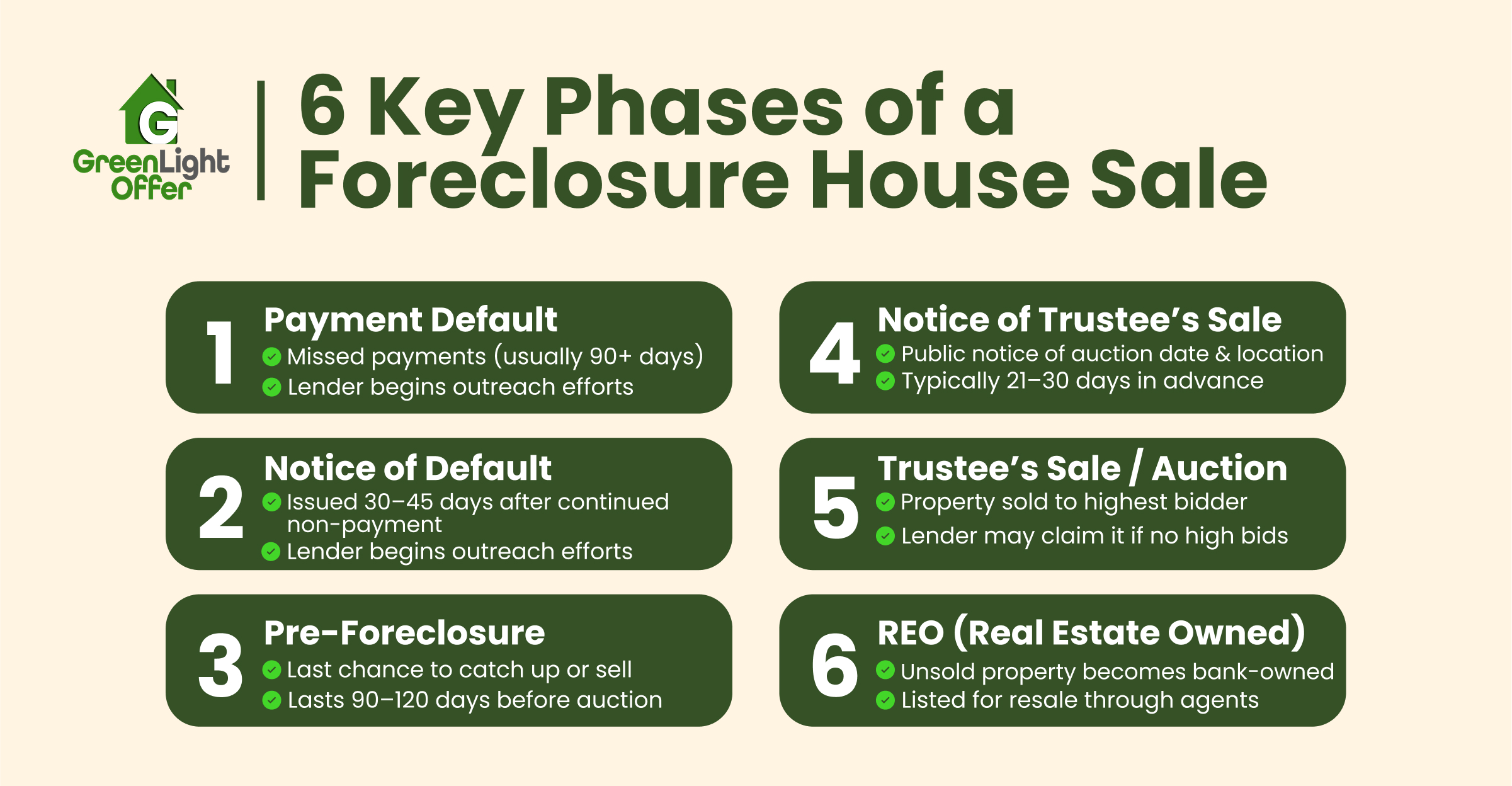
6 Phases of a Foreclosure House Sale
- Payment default (30–90 days)
- Notice of default / demand letter
- Pre-foreclosure window (30–120 days to cure)
- Notice of trustee’s or sheriff’s sale
- Auction day
- REO (bank-owned) if no bidder steps up
Different provinces or states add their own rules, some allow a brief right of redemption, others permit deficiency judgments, and timelines can stretch from three months to more than a year.
Core Takeaway
Foreclosure starts with missed payments but is driven by larger life events. Understanding that chain of events, and the legal framework in your province or state, helps both owners and buyers make better decisions.
The Foreclosure House Sale Timeline: Step-by-Step
A typical foreclosure house sale takes 90–180 days from the first missed payment to the final transfer, though court backlogs or provincial rules can stretch it further.
Early stage (0–90 days)
Late fees start immediately. Lenders make phone calls and send letters because it’s cheaper to help you catch up than to foreclose.
Notice periods (Day 90–150)
U.S. owners receive a Notice of Default; Canadians get a formal demand letter. This creates a public record and starts the clock on pre-foreclosure options.
Auction prep (30 days before sale)
You’ll see postings at the courthouse, in newspapers, or online with the date, time, and opening bid.
Sale day
Highest cash bidder wins. If no one bids more than the lender’s credit bid, the property becomes REO.
| Phase | U.S. | Canada |
|---|---|---|
| Default to notice | ~90 days | Up to 6 months |
| Pre-foreclosure window | 30–120 days | 35 days (power of sale) |
| Court involvement | Some states | Judicial provinces |
| Right of redemption | Select states | Limited |
Foreclosure House Sale Types
- Judicial sale – court-supervised, slower, more oversight.
- Power of sale / non-judicial – faster, strictly statutory.
- Sheriff auction – public bidding at courthouse.
- Bank-owned (REO) – listed like a normal MLS property.
- Pre-foreclosure deal – owner sells before auction.
For auction strategies, Auction.com offers helpful resources.
How to Buy a Foreclosure House Sale Like a Pro
Scoring a good deal at a foreclosure house sale boils down to three pillars: money, research, and discipline.
1. Line up the money first
Most auctions demand cash or certified funds on the spot. If you don’t have liquid capital, secure a hard-money lender well in advance. Remember the 70% rule: never pay more than 70 % of after-repair value (ARV) minus repairs.
2. Build your intel pipeline
- County records list upcoming sales.
- MLS filters tag REO listings; set automated alerts.
- Networking with attorneys and agents frequently surfaces off-market opportunities.
- Tools like Houseful.ca help Canadian buyers track distressed inventory.
3. Master the auction routine
Before auction day, drive by the property (no trespassing), confirm sale details, and write down your absolute max bid. Bring multiple certified checks—most counties require a 10 % deposit immediately and the balance within 24–48 hours.
Expect surprises. You’re buying “as-is,” possibly with occupants still inside. Winning only matters if the numbers still work after you open up the door.
Risks, Hidden Costs & Smart Due Diligence
Buying “as-is” means inheriting every problem the house collected on its way to foreclosure.
Common physical nightmares
- Missing HVAC, stripped copper plumbing, or DIY electrical work
- Water damage and mold (Houston humidity speeds growth)
- Roof or foundation issues hidden behind fresh paint
Legal and financial landmines
- Surviving tax or HOA liens
- Unpaid code-violation fines
- Vacant-property insurance premiums
Crunch the numbers conservatively
Example: ARV $280k
Repairs $45k
Holding + closing $40k
Profit target $25k
Max offer ≈ $170k (70 % rule plus contingency).
Even seasoned investors budget 20 % extra for the unknown.
Quick due-diligence checklist
- Order a preliminary title report.
- Search local code-violation databases.
- Drive the neighborhood at different times of day.
- Price out security, utilities, and vacancy insurance before closing.
Success isn’t about finding the cheapest house; it’s about controlling the risks you can see—and padding the budget for the ones you can’t.
Financing & Closing a Foreclosure Purchase
Getting the money together to buy a foreclosure house sale is often the biggest hurdle for new investors. Most auction sales require cash or certified funds at closing, which can catch first-time buyers off guard. Traditional mortgage financing usually isn’t available for auction purchases because of tight timing and the “as-is” condition of these properties.
Cash and Hard Money Options
The most successful foreclosure investors use either cash or hard money loans for auction purchases. Cash gives you a huge advantage – no financing delays, no appraisal headaches, and the ability to close quickly.
Hard money lenders fill the gap for investors who don’t have large cash reserves. These short-term loans are secured by the property itself and typically charge higher interest rates (usually 8-15%) but approve and fund much faster than traditional banks.
Renovation Loan Programs
For bank-owned (REO) properties listed through real estate agents, you have more financing options since these sales work more like traditional real estate transactions.
FHA 203(k) loans are fantastic for owner-occupants who want to buy and renovate a foreclosed home. These loans combine the purchase price and renovation costs into one mortgage. The catch is you must live in the property.
Conventional renovation loans like Fannie Mae’s HomeStyle program offer similar benefits but work for both owner-occupants and investors. VA renovation loans provide excellent benefits for eligible veterans, often with no down payment required.
Mortgage Options for Foreclosure House Sales
While auction purchases typically demand cash, REO properties and pre-foreclosure sales often qualify for traditional financing options. The key is understanding how lenders view these transactions differently.
Getting pre-approved before you start shopping is absolutely critical. Lenders may have stricter requirements for distressed properties. Appraisal challenges are common with foreclosed properties. The home may appraise below your purchase price due to condition issues.
Inspection contingencies aren’t available for auction properties, but REO properties may allow limited inspection periods. Lender overlays can trip up buyers who aren’t prepared. Some lenders add extra requirements beyond standard loan program guidelines.
For detailed information about financing options when facing foreclosure, check out our pre-foreclosure vs foreclosure comparison guide.
Closing Day & Taking Possession
Closing on a foreclosure house sale involves several extra steps compared to buying a regular home.
Court confirmation is required for judicial foreclosure sales, and this process can take several weeks after the auction. Insurance binders need to be arranged immediately. Locksmith and security should be your first call after closing. Change all locks immediately and consider boarding windows if the property will sit vacant.
Post-sale cleanup often reveals surprises you couldn’t see during your exterior-only inspection. Budget for immediate debris removal. The utility companies will need to transfer service to your name, and properties with previous disconnections may require security deposits.
How Homeowners Can Avoid a Foreclosure House Sale
Time is your best friend. The earlier you act, the more solutions you keep on the table.
Talk to your lender
- Loan modification lowers the payment by adjusting rate or term.
- Forbearance pauses payments for a set period.
Refinance while you still can
If you have equity and decent credit, a new loan at a lower rate may solve the cash-flow crunch—provided you start before missed payments pile up.
Exit strategies that hurt less than foreclosure
- Short sale – sell for less than you owe with lender approval.
- Deed-in-lieu – hand the property back voluntarily.
- Chapter 13 bankruptcy – court-approved plan lets you catch up over 3–5 years.
For in-depth tactics, see How Can I Stop Foreclosure?
Selling fast for cash
Traditional listings take months you may not have. Greenlight Offer can provide a no-obligation cash offer within 24 hours and close in as little as a week, no repairs, fees, or showings. That preserves remaining equity and spares your credit the seven-year hit of a completed foreclosure.
Learn more at Can I Sell My House to Avoid Foreclosure?

Frequently Asked Questions About Foreclosure House Sales
What hidden costs surprise most buyers?
Unexpected repairs (foundation, electrical, mold), eviction expenses, and surviving liens can add tens of thousands. Seasoned investors pad repair budgets by 20–30 %.
Can I use a traditional mortgage to buy at auction?
No. Auctions require cash or certified funds. Many investors use hard-money financing to close, then refinance after repairs.
How long does a foreclosure stay on my credit report?
Seven years from the first missed payment that led to foreclosure. The impact is heaviest in the first two years and fades over time. Selling before the foreclosure completes minimizes long-term credit damage.
Facing a Foreclosure House Sale? Greenlight Offer Gives You Better Options
Navigating foreclosure house sales can feel overwhelming, but it doesn’t have to be. Whether you’re a homeowner facing financial difficulties or an investor seeking opportunities, understanding this process puts you in control of your situation.
If you’re worried about losing your home, foreclosure isn’t inevitable. You have options at every stage of the process. The key is acting quickly – the sooner you reach out for help, the more alternatives remain available. From working with your lender on payment modifications to exploring cash sale options, there are ways to protect your credit and preserve your equity.
For investors and buyers, foreclosed properties can offer excellent opportunities to build wealth. But success requires patience, preparation, and realistic expectations. The “as-is” nature of these sales means surprises are common, so conservative budgeting is your best friend. Remember the 70% rule, always inspect what you can, and never bid more than you can afford to lose.
Here in Houston, we understand the unique challenges our neighbors face. Rising costs, job changes, medical bills, and life’s unexpected turns can put any family at risk. That’s why we started Greenlight Offer eight years ago – to give Houston-area homeowners a better option when traditional selling isn’t fast enough.
Our approach is straightforward and honest. We provide cash offers within 24 hours, buy homes in any condition, and let you choose your closing date. Whether you’re in Houston, Pearland, Sugar Land, The Woodlands, Katy, or anywhere in between, we know your local market and can help you avoid the stress of a foreclosure house sale entirely.
What makes us different is that we actually care about your situation. We’re not just buying houses – we’re helping families transition to their next chapter with dignity and financial stability. No repairs, no fees, no commissions, and no pressure. Just a fair offer and the flexibility to close when it works for you.
Don’t let foreclosure steal your options or your peace of mind. If you’re facing financial pressure or simply need to sell quickly, we’re here to help. Contact us today for a confidential conversation about your situation and find how we can help you avoid foreclosure sale while protecting your financial future.
The bottom line: foreclosure doesn’t have to be the end of your story. With the right knowledge and support, you can take control of your situation and move forward with confidence. Whether you’re buying or selling, acting quickly and getting expert guidance makes all the difference in achieving the outcome you want.
