
Navigating How to Sell a Probate House in Houston
How to sell a probate house involves a court-supervised legal process where an executor or administrator settles the deceased’s estate, pays debts, and distributes assets to heirs. Here’s the basic path:
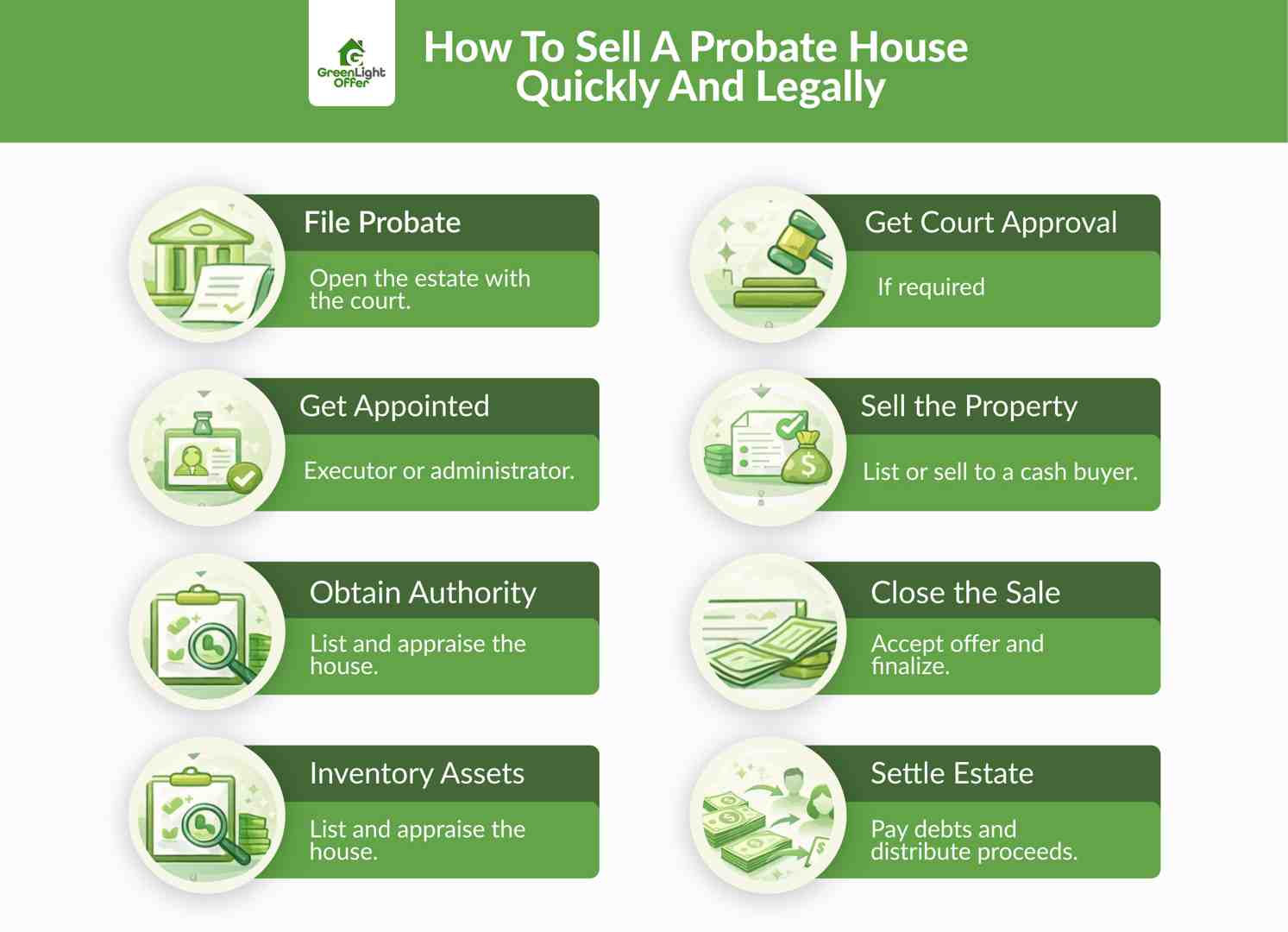
- File a petition with the Texas probate court to open the estate.
- Get appointed as executor (if named in a will) or administrator (if no will exists).
- Obtain Letters Testamentary or Letters of Administration to prove your authority.
- Inventory and appraise the property and other estate assets.
- Get court approval to sell the property (in some cases).
- List and market the home, or sell directly to a cash buyer.
- Accept an offer and complete the sale.
- Pay estate debts and distribute remaining proceeds to beneficiaries.
Selling a house through probate is a formal process that can be lengthy and complex due to legal requirements and potential delays. The person in charge must act in the estate’s best interest, which often means selling the property for fair market value.
If there’s a will, the executor named in the document manages the sale. Without a will, the court appoints an administrator, and Texas intestacy laws determine who inherits. Either way, the person in charge must act in the estate’s best interest and ensure the property sells for fair market value.
Many Houston families find the traditional sales process adds stress, especially if the inherited home needs work or sits vacant. However, there is a faster, more direct alternative to a traditional market sale. Selling directly to a professional cash home buyer offers a streamlined path that can provide certainty and speed.
Understanding Probate: The First Step in How to Sell a Probate House
Probate is the legal process that occurs after someone passes away. It’s how a court makes sure the deceased person’s debts are paid and their assets are distributed to the right people. When a house is part of these assets, it enters what’s known as a “probate sale.” This entire process is supervised by the court, adding layers of complexity not found in typical home sales.
What Makes a Probate Sale Different from a Regular Home Sale?
A probate sale stands apart from a traditional home sale in several key ways. The most significant difference is the constant oversight of the probate court. This means longer timelines, specific legal requirements, and often, properties sold “as-is.” Unlike a regular sale where the seller makes all the decisions, a probate sale requires court approval for many steps, including the final sale.
| Feature | Probate Sale | Regular Home Sale |
|---|---|---|
| Timeline | Often takes 3 months to over a year | Typically 30-60 days |
| Court Oversight | Required for many steps, including sale approval | Not required |
| Condition | Usually sold “as-is,” no contingencies | Seller often makes repairs, offers contingencies |
| Pricing | Must be near appraised value, court-approved | Seller sets price, market dictates |
| Flexibility | Limited by court rules, beneficiary input | High flexibility for seller |
| Competition | Can involve court-supervised overbidding | Standard negotiation |
Testate vs. Intestate: How a Will Impacts the Probate Process
The presence or absence of a will significantly impacts the probate process in Texas.
If the deceased left a valid will, they are considered “testate.” The will usually names an executor, who is the person responsible for managing the estate. If the will grants the executor the “power of sale,” they might have more flexibility in selling the property without constant court approval. However, even with a will, the executor must still ensure they are acting in the best interest of the estate and its beneficiaries.
If there is no valid will, the person is considered “intestate.” In this case, a Texas probate court will appoint an administrator, usually the closest relative, to manage the estate. Texas intestacy laws then dictate how assets, including the house, are distributed among heirs. This often means more court involvement and a stricter process for selling the property. You can find more information on handling inherited property at our Inherited Property guide.
Key Parties and Their Roles in a Probate Sale
Several key individuals and entities are involved when you sell a probate house:
- Executor/Administrator: This is the person appointed to manage the deceased’s estate. An executor is named in a will, while an administrator is appointed by the court if there’s no will. Their primary role is a “fiduciary duty,” meaning they must act in the best financial interest of the estate and its beneficiaries. This includes ensuring the property sells for the best possible price.
- Beneficiaries/Heirs: These are the individuals who are legally entitled to inherit assets from the estate. They often have a say in the sale process, and their agreement (or disagreement) can impact the timeline.
- Probate Court: This is the legal body that oversees the entire probate process, ensuring all laws are followed, debts are paid, and assets are properly distributed. The judge often has the final say on whether an offer is accepted or rejected.
- Probate Attorney: Given the legal complexities, a probate attorney is often essential. They guide the executor/administrator through court filings, legal notices, property transfers, and other requirements.
The Traditional Path: Steps to Sell a Probate House on the Market
Selling a probate house through traditional real estate channels in Houston involves several formal steps, often requiring significant time and coordination from the estate.
Step 1: Starting the Probate Process in Texas Courts
The first formal step is to file a petition with the appropriate Texas probate court. This officially opens the estate. If a will exists, the court will validate it. Then, either an executor (named in the will) or an administrator (appointed by the court if there’s no will) is formally granted authority.
This authority comes in the form of “Letters Testamentary” or “Letters of Administration,” which are crucial documents proving the representative’s power to act on behalf of the estate. Following this, creditors must be officially notified of the death, allowing them to make claims against the estate. For more information on probate laws in Texas, you can refer to resources from the Texas Attorney General.
Step 2: Preparing the Property and Setting a Price
Once the probate process is underway, the property needs to be evaluated. An appraisal is typically conducted to determine the fair market value of the home, often as of the date of death. This “date-of-death value” is important for tax purposes.
After appraisal, the executor or administrator faces the task of preparing the house for sale. This can involve extensive cleaning, decluttering, and potentially significant repairs, though many probate homes are sold “as-is” if the estate lacks funds or the ability to manage renovations.
Step 3: Listing and Attempting to Sell a Probate House on the Open Market
Listing a probate house on the open market means working with a real estate agent to market the property, conduct showings, and receive offers. Unlike a traditional sale, accepted offers for a probate property often require court confirmation.
This can lead to a process where other interested buyers can “overbid” the accepted offer in court, potentially driving up the price but also adding uncertainty and delay. There may also be minimum bid requirements set by the court to ensure the estate gets a fair value.
Step 4: Closing the Sale and Distributing Proceeds
After an offer is confirmed by the court, the contract is executed. The proceeds from the sale first go towards paying off any outstanding debts of the estate, including funeral costs, legal fees, and creditor claims. Final taxes for the deceased must also be filed.
Only after all these obligations are met are the net proceeds distributed to the beneficiaries according to the will or Texas intestacy laws. A final accounting is submitted to the court, and eventually, the estate is formally closed.
Common Challenges and Delays When You Sell a Probate House in Houston
Selling an inherited home through probate can be fraught with unexpected problems, causing significant emotional stress and financial strain for families in Houston. The legal obstacles and administrative problems can feel overwhelming during an already difficult time.
Why Probate Sales Take So Long
One of the biggest frustrations with probate sales is the extended timeline. Court backlogs are common, and there are mandatory notice periods for creditors and heirs. Creditor claim windows alone can add months to the process.
If beneficiaries dispute the will or the sale terms, or if there are title issues, the delays can stretch even further. It’s somewhat common for a probate sale to take a year or longer to complete. In Texas, while you have up to four years to initiate the probate process, the sale itself can still be a lengthy affair.
The Financial Burden of an Inherited House
While waiting for the probate process to unfold, the inherited house continues to incur costs. These “holding costs” can be a significant financial burden on the estate or the heirs. We’re talking about mortgage payments, property taxes, homeowner’s insurance, utilities, and ongoing maintenance.
If the house needs repairs, these costs can quickly mount. For example, if a roof needs fixing, or the HVAC unit gives out, the estate must cover these expenses. Texas has the seventh-highest property taxes in the country, which means holding onto an additional property can quickly become expensive.
When Heirs Disagree
“Oftentimes, particularly [with] multiple siblings, the biggest challenge is making sure that all parties are on the same page when it comes to price, timing, access to the property, etc.” says New York-based real estate agent Stephen Hines.
This sentiment rings true for Houston families as well. Disagreements among heirs over the selling price, whether to make repairs, or even the sentimental value of the property can lead to significant communication breakdowns and legal disputes. Our team at Greenlight Offer has seen these challenges and works to provide solutions that bring all parties to a fair resolution.
Selling a House ‘As Is’ on the Open Market
While selling a probate house “as-is” might seem like a way to avoid repair costs, it comes with its own set of problems on the open market. Many traditional buyers are hesitant to purchase homes that need significant work. This can lead to lower offers from less reputable buyers or “house flippers” who aren’t always transparent.
Buyers often include inspection contingencies, and if problems are found, they might demand repairs or back out, causing further delays. Financing issues can also arise if the property’s condition makes it difficult for a buyer to secure a traditional mortgage.
The Greenlight Offer Solution: How to Sell a Probate House Fast in Houston
We understand that navigating the sale of a probate house in Houston is often overwhelming. That’s why Greenlight Offer provides a straightforward, stress-free alternative to the traditional, challenging process. Our solution is designed to help you sell a probate house quickly and efficiently, allowing you to move forward without prolonged legal battles or financial burdens.
Why Choose Greenlight Offer for Your Probate House Sale
We are local Houston experts with decades of experience in the Greater Houston real estate market, including Pasadena, Baytown, Katy, Sugar Land, Pearland, and Galveston. We pride ourselves on offering the highest possible fair cash offers for probate properties. Unlike some cash buyers, we don’t engage in lowballing or hidden tactics.
We believe in transparency and providing a fair deal that genuinely helps families. Our deep understanding of the local market ensures you get a competitive offer. Learn more about how our process works on our How It Works page.
A True ‘As-Is’ Sale: No Repairs, No Cleaning, No Hassle
With Greenlight Offer, you truly sell your house “as-is.” This means no need for you to clean out the property, make any repairs, or even worry about updating an outdated interior. We buy houses in any condition – whether they have fire damage, flood damage, foundation issues, or simply haven’t been updated in decades.
We handle all necessary repairs and cleaning after closing, saving you time, effort, and money. The only type of residential property we do not purchase is mobile homes.
Certainty and Speed: Close in as Little as 14 Days
We provide unparalleled certainty and speed. Once you accept our offer, we can close in as little as 14 days, fitting your timeline. This eliminates the uncertainty of the open market, where sales can fall through due to buyer financing issues or last-minute inspection demands.
We handle all the paperwork from start to finish, ensuring a smooth and efficient closing process. This allows you to avoid the lengthy timelines common in traditional probate sales.
No Fees or Commissions: The Offer You Get Is the Cash You Receive
When you sell your probate house to Greenlight Offer, the offer you receive is the exact cash you will receive at closing. We do not charge any agent commissions, and we cover all closing costs. There are absolutely no hidden fees. This transparent approach means you can budget effectively and know precisely what to expect.
Real Houston Testimonials: Why Sellers Trust Greenlight Offer
Our reputation in Houston is built on trust and transparency. We are proud of the positive feedback we consistently receive from families we’ve helped. Our clients often highlight how professional and responsive our team is, making the process of selling a home easy and stress-free.
Homeowners appreciate that we take the time to answer all their questions, providing clarity and peace of mind during what can be a difficult time. This commitment to fair, efficient, and compassionate service is why Houston sellers trust Greenlight Offer.

Frequently Asked Questions About How to Sell a Probate House in Texas
How long do I have to start probate in Texas?
In Texas, you generally have up to four years from the date of the deceased’s passing to initiate the probate process. However, starting sooner can help you avoid potential complications, delays, and accumulating holding costs on the property.
Can an executor sell a house below market value in Texas?
An executor has a fiduciary duty to act in the best interest of the estate and its beneficiaries. Selling a property significantly below fair market value could be challenged by heirs, potentially leading to legal disputes. Our fair cash offers help ensure a proper valuation.
Do all heirs have to agree to sell a property in Texas?
If the will explicitly grants the executor the “power of sale,” unanimous consent from all heirs may not be strictly required. However, if the will is unclear or there’s no will, court approval or agreement from all beneficiaries is often necessary, especially for major assets like a house.
What types of properties does Greenlight Offer buy?
We buy single-family homes, townhomes, and condos in any condition across the Greater Houston area, including all the cities we serve. We do not, however, purchase mobile homes.
How quickly can I get a cash offer and close with Greenlight Offer?
You can receive a no-obligation cash offer from Greenlight Offer within 24 hours of contacting us. Once you accept, we can typically close the sale in as little as 14 days, depending on your specific needs and timeline.
A Simpler Way of How to Sell a Probate House in Houston
Learning how to sell a probate house the traditional way presents unique challenges, from court delays and unexpected costs to potential family disagreements. These hurdles can add significant stress for Houston families during an already difficult time.
Greenlight Offer provides a clear, straightforward alternative. As local Houston experts specializing in probate, we offer a fair cash price for your property ‘as-is,’ eliminating the uncertainty and delays of a market sale. Our process is designed to be compassionate and professional, allowing you to close on your timeline without repairs, fees, or commissions, so you can settle the estate and move forward.
Ready to sell your probate house in Houston? Get a no-obligation cash offer today or contact us to speak with our local team.
