


Understanding How to Sell Probate House Fast Houston TX
How to sell probate house fast Houston TX is a challenge many Houston families face, especially after losing a loved one or dealing with urgent financial needs. If you’re in a hurry and just want the fastest path, here’s what you need to know right away.
Quick Answer: How to Sell Probate House Fast Houston TX
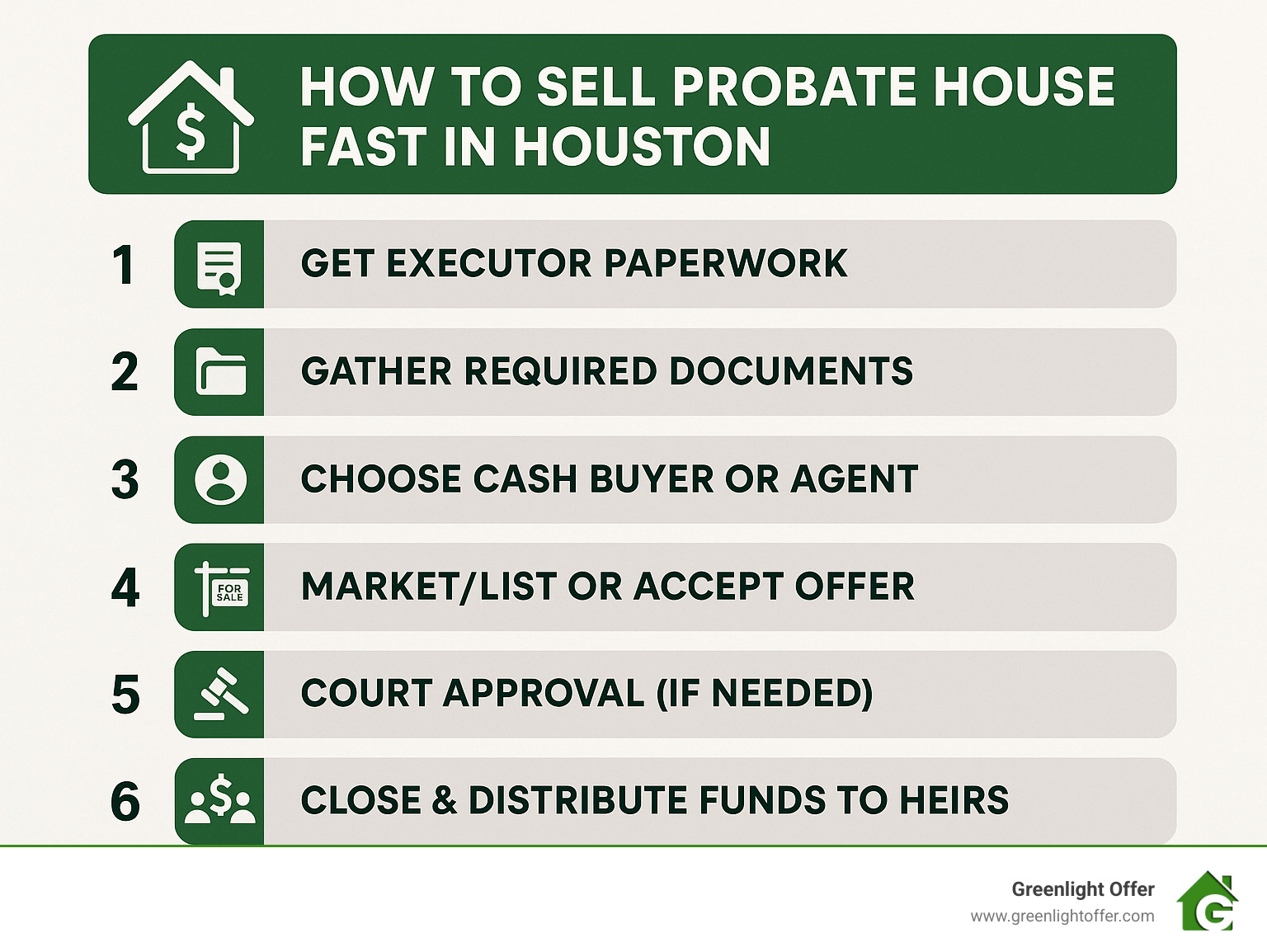
- Get appointed as the executor or administrator by the probate court.
- Gather key documents: will, death certificate, deed, mortgage info.
- Choose your sale method:
- Cash buyer for fastest sale (often 14–30 days, as-is, no repairs).
- MLS agent for maximum price (can take months).
- List property or accept cash offer.
- Seek court approval for sale (if required).
- Close with a title company – pay debts, distribute funds to heirs.
Selling a probate house in Houston can feel overwhelming. The process involves court paperwork, family emotions, time pressure, and sometimes a house that needs repairs. As one Houston seller put it:
“The last thing anyone wants is to make poor decisions that waste time and money.”
But you have more options (and more speed) than you might think! Texas laws allow for fast sales, sometimes in just two weeks, especially if you work with experienced cash buyers or probate specialists.
Whether you want to avoid delays, skip repairs, or get cash quickly, this guide will walk you through every step and shortcut. Let’s make an emotional and complicated process as simple as possible.
How to Sell Probate House Fast Houston TX: Step-by-Step Overview
Selling a probate property in Houston doesn’t have to be a drawn-out ordeal. While the typical Texas probate process might take 6-9 months, I’ve seen many families wrap things up much faster with the right approach. Let’s walk through the key steps that can help you move forward:
Step 1 – Confirm Authority with Letters Testamentary
Before you can list that Houston property, you need legal permission to do so. This comes in the form of Letters Testamentary (if there’s a will) or Letters of Administration (if there isn’t).
Getting these crucial documents requires a visit to the Harris County Probate Court (or your local county court). You’ll need to bring the original will (if one exists), a death certificate, and be prepared to pay filing fees. After a hearing, the judge will officially appoint you as the estate representative.
As one Houston probate attorney told me recently, “Those Letters Testamentary are basically your license to act on behalf of the estate. Without them, your hands are tied.”
Texas gives you four years from the date of death to file for probate, but if you’re looking to sell quickly, you’ll want to start this process immediately. The good news? Once you’re appointed, you can begin preparing the property for sale even before other probate matters are settled.
Step 2 – Choose Sale Strategy: Agent vs Cash Buyer vs FSBO
Your sales approach dramatically impacts your timeline. Here are the three main paths, each with distinct advantages:
| Strategy | Timeline | Pros | Cons |
|---|---|---|---|
| Cash Buyer | 14-30 days | No repairs needed, fastest closing, no commissions | Lower offer (typically 50-70% of market value) |
| Real Estate Agent | 30-90+ days | Maximum exposure, potentially higher price | 5-6% commission, repairs often needed, longer timeline |
| FSBO with Flat-Fee MLS | 30-60+ days | Save on commission, control the process | Time-intensive, requires market knowledge, slower than cash buyers |
For sheer speed, cash buyers win hands down. I recently spoke with a Houston executor who shared, “When my mother needed nursing home care quickly, we sold her house to a cash buyer who closed in just 14 days. The timing was exactly what our family needed.”
If your property is in good shape and you can wait a bit longer, a real estate agent might fetch a higher price. For something in between, a flat-fee MLS service can get your listing up within 48 hours while saving you thousands in commission.
Step 3 – Gather Required Docs & Disclosures
Selling a probate property requires more paperwork than a typical home sale. Here’s what you’ll need to round up:
You’ll need the death certificate (certified copy), the will (if one exists), your Letters Testamentary or Administration, the property deed, any mortgage payoff information, a Texas Seller’s Disclosure Notice, HOA documents (if applicable), property tax records, the title insurance policy, and your photo ID.
The Seller’s Disclosure deserves special attention. While executors sometimes have limited knowledge about the property, providing as much information as possible helps prevent future headaches and legal complications.
Pro tip from a Houston probate specialist: “Create a digital folder with all these documents that you can easily share with attorneys, the court, and potential buyers. This simple organization can literally save weeks of back-and-forth.”
Step 4 – Price & Prep for a Fast Sale
Pricing correctly is crucial for a quick sale. In Texas probate cases, courts typically require the property to sell for at least 90% of its appraised value.
For accurate pricing, consider getting a Comparative Market Analysis (CMA) from a local real estate agent or investing in a professional appraisal ($300-500). Research recent sales in the neighborhood and factor in the property’s condition.
When it comes to preparation, focus on cost-effective improvements:
- Remove personal belongings (an estate sale can help with contents)
- Give the place a thorough cleaning
- Fix obvious safety issues
- Handle small repairs with high visual impact
- Tidy up the yard for better curb appeal
If you’re selling to a cash buyer, don’t stress about extensive repairs. As one Houston investor puts it, “We buy probate houses completely as-is. Families can leave whatever they don’t want, and we handle the cleanout ourselves.”
Step 5 – Market or Solicit Cash Offers
Houston’s real estate market remains resilient, with strong demand in many neighborhoods. Your marketing approach will depend on your chosen sale strategy.
With an agent or MLS listing, you’ll benefit from professional photography, virtual tours, and featured placement on real estate websites. Open houses can also generate interest when appropriate.
For cash buyers, submit your property details to several reputable companies for comparison. Always verify their credentials and funding capabilities before proceeding. Be clear about your timeline and any special circumstances.
Traditional buyers typically provide a 10% deposit for probate sales in Texas. Cash buyers usually skip this step since they’re purchasing with their own funds and can move forward immediately.
Step 6 – Obtain Court Confirmation & Manage Overbids
Many Texas probate sales require court confirmation, which adds time but is manageable with proper planning:
Once you accept an offer, your attorney files a Report of Sale with the court. A confirmation hearing gets scheduled (usually 2-4 weeks out) where the judge reviews the terms. Interestingly, at this hearing, other buyers can submit overbids (which must exceed the current offer by at least 5% plus $500). If this happens, a mini-auction takes place right in the courtroom, with the highest bidder winning.
Work closely with your attorney to prepare all documentation well in advance. The county clerk’s office can provide specific local requirements.
Some probate situations qualify for independent administration, giving the executor freedom to sell without court confirmation – a significant time-saver if your case qualifies.
Step 7 – Close, Pay Debts & Distribute Proceeds
The final step brings everything together at closing:
Partner with a title company experienced in probate sales (they’ll handle most paperwork). From the proceeds, you’ll need to pay off any mortgages, liens, or judgments against the property. Next come estate debts like medical bills and credit cards, followed by final expenses such as funeral costs and probate fees.
Only after all debts are settled can you distribute the remaining proceeds according to the will or Texas intestate succession laws. As executor, you’re personally responsible for ensuring all debts are paid before distributing assets to heirs – a responsibility not to be taken lightly.
Cash buyers often work with title companies specializing in probate transactions, which can further accelerate your closing timeline and reduce stress during an already difficult time.
Key Legal Questions Answered
When selling a probate house in Houston, several legal questions commonly arise. Let’s address the most important ones to help you steer the process confidently.
First, let’s clarify what probate actually means. Probate is the legal process of validating a will and administering a deceased person’s estate. In Texas, this involves filing the will with the probate court, appointing an executor, inventorying assets, paying debts, and distributing remaining assets to beneficiaries.
How to Sell Probate House Fast Houston TX Before Probate Is Complete
Good news – you don’t have to wait for the entire probate process to finish before selling a house in Texas. Once you’re appointed as executor or administrator, you can begin marketing the property right away.
“Once you’re appointed as executor, you can begin the selling process immediately,” explains a Houston probate attorney I recently spoke with. “This alone can save you months of waiting time.”
To sell before probate completes, you’ll need to handle a few specifics. The court may require the final sale to receive confirmation, and proceeds typically need to be held in escrow until debts are settled. But the actual listing and buyer-finding process can happen much earlier.
For the fastest possible timeline, work with a title company that specializes in probate sales. Having your documentation prepared in advance and a buyer ready before court confirmation is scheduled can trim weeks off your timeline. Cash buyers are particularly valuable here, as they can often close within days of receiving court approval.
Do All Heirs Need to Agree & How to Resolve Disputes?
Family dynamics can complicate probate sales. If you’re the appointed executor with full authority in Texas, you generally don’t need unanimous heir agreement to sell the property. That said, getting everyone on the same page prevents headaches and potential legal challenges down the road.
We recently worked with a Houston family where five siblings inherited equal shares of their childhood home. “My experience with Greenlight Offer was more than expected from the company. The staff was very helpful and patient with me and my five siblings throughout the whole process of selling our late mother’s home. We were treated like humans with feelings and not a transaction (sale). It was very emotional for us. My siblings and I highly recommend Greenlight Offer. Also, another family member used Greenlight Offer to sale his. He’s very satisfied.” said Barbara Bullard.
When disagreements arise between heirs, start with open communication. A family meeting can address concerns and explore options. If tensions run high, professional mediation offers a neutral ground for resolution. Some families find success with buyout arrangements, where one heir purchases the others’ interests.
As a goodwill gesture, consider having all heirs sign a consent form, even when not legally required. This transparency can prevent disputes later. Only as a last resort should you consider a partition action, where a court forces the sale through litigation.
What Happens When the Property Has a Mortgage or Liens?
Debts don’t disappear when someone passes away. Mortgages, reverse mortgages, tax liens, and judgments must all be addressed during the probate sale process.
For standard mortgages, you have options. The loan must either be paid off at closing or assumed by a qualified heir. Fortunately, federal law protects inheritors from “due-on-sale” clauses for properties with 1-4 units, giving you breathing room to make arrangements. Many families simply continue making mortgage payments while the property moves through probate.
Reverse mortgages create a tighter timeline. Heirs typically have just 30 days to decide whether to keep or sell the property. If you want to keep the home, you’ll need to pay off the full loan balance. When selling, proceeds first go toward satisfying the reverse mortgage before any distribution to heirs.
Tax liens and judgments require special attention. Your title company will identify these during the title search, and they must be settled before any proceeds can go to heirs. In some cases, negotiated payoffs may be possible.
For underwater properties (worth less than what’s owed), heirs have several options. They can refuse the inheritance (allowing foreclosure without credit impact), negotiate a short sale with the lender, or consider a deed in lieu of foreclosure.
The transfer-on-death deed (TODD) is worth mentioning as a planning tool that can help families avoid some of these probate complications altogether. While it won’t help with an estate already in probate, it’s valuable knowledge for future planning.
When dealing with multiple heirs, affidavits of heirship or small estate affidavits might simplify the process in certain situations. Each county in Texas has slightly different requirements, so checking with the specific county clerk’s office handling your case is always wise.
Speed Hacks: Prepare a Probate Home in 10 Days or Less
When you’re facing the challenge of selling a probate house in Houston, time often feels like your enemy. But with the right approach, you can transform a cluttered property into a marketable home in just 10 days or less. I’ve seen families accomplish this change many times, and it’s all about focusing on what truly matters.
The quick clean-out strategy is your first priority. Instead of getting overwhelmed by decades of possessions, break it down into manageable categories: items to keep, donate, sell, or trash. Many Houston families find relief in hiring a junk removal service (typically $250-$1,000) that can clear everything in a single day.
For valuable items, you don’t need to delay your sale timeline. Fast-track estate sales can be organized on short notice, and online platforms make it even easier to liquidate items quickly. Many Houston estate sale companies specialize in rapid turnarounds for probate situations.
Don’t overlook the essential service transfers that protect your investment. Changing locks immediately addresses both security and liability concerns, you never know who might have a key to the property. Keep utilities on during the sale process (in the estate’s name), and update the homeowner’s insurance to specifically cover a vacant property. One Houston executor learned this lesson the hard way when a small water leak caused $20,000 in damage while the house sat empty for months.
A vacant property needs regular attention. A quick weekly check can prevent small issues from becoming costly disasters. As we say in Houston, “Our weather doesn’t wait for probate to finish!”
Using “As-Is” Cash Buyers to Cut 75% Off the Timeline
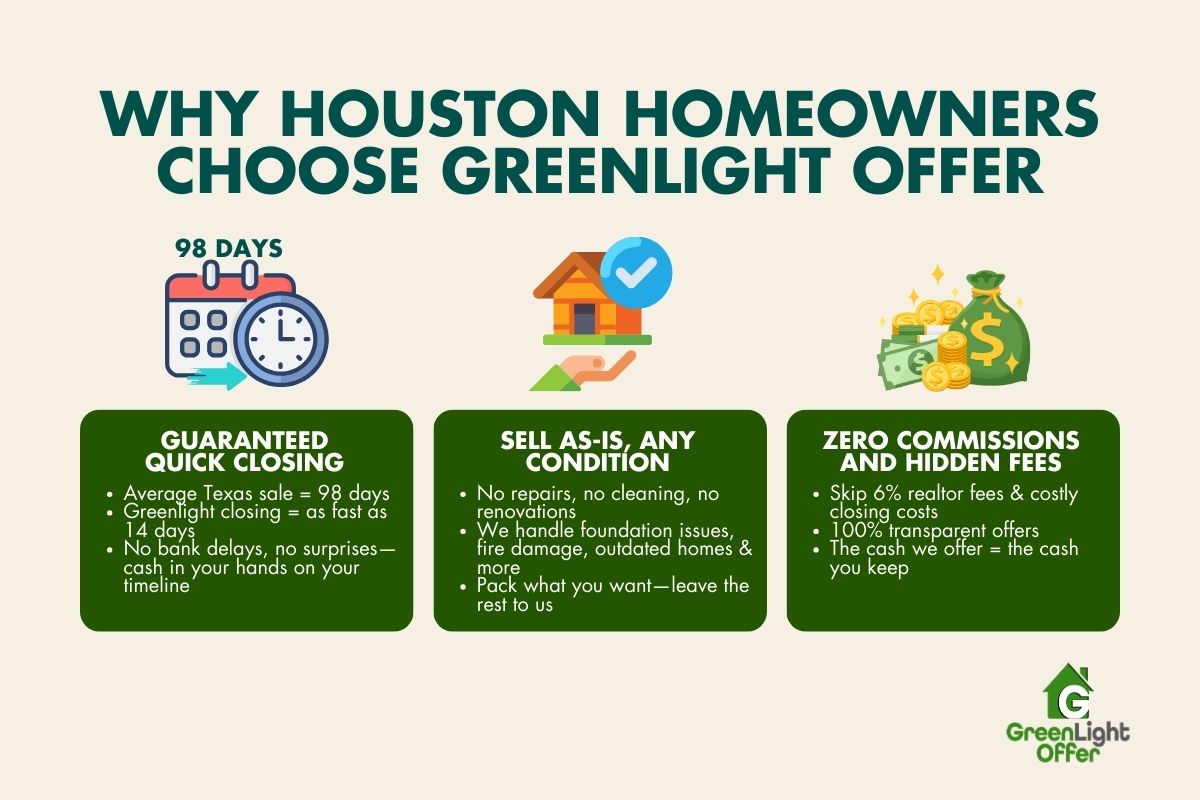
The most dramatic time-saving strategy is working with cash buyers who purchase properties “as-is.” This approach can slash your timeline from the traditional 3-6 months down to just 14-30 days, a reduction of up to 75%.
The math makes sense for many families. While cash offers typically range from 50-70% of retail value, the savings add up quickly. You’ll avoid repairs, staging, multiple showings, financing contingencies, and months of holding costs. Plus, cash buyers offer flexibility that traditional buyers can’t match.
For properties needing significant work, this approach is particularly valuable. One family I worked with inherited a house with foundation issues, outdated electrical systems, and a leaky roof. Traditional buyers wanted $60,000 in repairs before closing. The cash buyer simply said, “We’ll handle all that, you don’t need to fix a thing.”
Low-Budget Upgrades That Boost Curb Appeal Fast
If you’re selling on the open market and want to maximize value without major renovations, focus on first impressions. Buyers make up their minds in the first 30 seconds of seeing a house, so curb appeal investments almost always pay off in faster sales and better offers.
Fresh paint delivers the biggest bang for your buck. A newly painted front door ($50 for supplies) instantly refreshes the entire façade. Choose a color that complements the home but adds a touch of personality, deep blue and red doors are particularly appealing to Houston buyers right now.
Professional cleaning transforms a property more than you might expect. For $200-$400, a deep cleaning service can make dated features look well-maintained rather than neglected. Add carpet cleaning ($100-$300) and window washing ($150-$300) for a home that feels move-in ready.
Lighting improvements are often overlooked but make a dramatic difference, especially for evening showings. Replace outdated exterior fixtures ($50-$150 each), add solar path lights ($20-$100), and ensure all bulbs work and match in color temperature. Good lighting doesn’t just improve aesthetics, it also addresses safety concerns for potential buyers.
Speaking of safety, quick repairs to loose railings, uneven walkways, or overgrown shrubs blocking windows not only make the property more appealing but also reduce liability concerns during showings.
These strategic improvements typically cost $500-$2,000 total but can increase perceived value by $5,000-$15,000 and significantly reduce time on market. As one Houston agent put it, “In probate sales, you’re not aiming for perfection – you’re aiming for ‘clean, safe, and maintained.’ That’s what gets properties sold quickly.”
Tax & Cost Implications You Must Know
Selling a probate house comes with financial considerations that can significantly impact your bottom line. Understanding these before you start can save you thousands and help set realistic expectations.
One of the biggest tax advantages when selling inherited property is the “stepped-up basis” benefit. This might sound complicated, but it’s actually a huge win for heirs. Instead of using the original purchase price to calculate capital gains tax, you get to use the property’s value at the time of death.
Here’s what this means in real dollars: If your mom bought her Houston home for $50,000 decades ago, and it was worth $300,000 when she passed away, your new tax basis is $300,000. Sell it for $310,000, and you’ll only pay capital gains tax on that $10,000 difference – not the $260,000 difference from the original purchase price. That’s a significant tax savings!
For most families, estate taxes won’t be a concern. The 2024 federal exemption sits at a generous $13.8 million per person, and Texas doesn’t impose state inheritance or estate taxes at all. One less thing to worry about during an already difficult time.
What many executors don’t anticipate are the property tax changes that occur after transfer. Those homestead or senior exemptions the deceased benefited from? They typically disappear, potentially increasing your annual tax burden while you own the property. With Houston’s average property tax rate of 1.74%, this can add up quickly.
The longer you hold onto the property, the more holding costs accumulate:
- Monthly property taxes
- Insurance (which jumps higher for vacant homes)
- Utility bills
- Regular maintenance
- HOA dues (if applicable)
- Ongoing mortgage payments
These expenses can easily reach $1,000-$2,500 monthly for an average Houston home – money that comes directly out of the estate’s pocket.
When you finally sell, traditional selling costs take another bite:
- Real estate commissions (5-6%)
- Closing costs (1-3%)
- Repair expenses (often substantial for inherited homes)
- Staging and preparation ($1,000-$5,000)
Cash buyers eliminate most of these expenses but typically offer less than full market value – a tradeoff of price for speed and convenience.
Sample Net Sheet on a $300K Houston Probate Sale
Let’s look at real numbers to see how different selling approaches affect what ends up in your pocket:
If you go the traditional sale route with a $300,000 sale price:
- You’ll pay around $18,000 in real estate commissions (6%)
- Expect about $6,000 in seller closing costs (2%)
- Budget $15,000 for repairs and preparation
- Three months of holding costs will run approximately $7,500
- Your final take-home: $253,500
Compare that to a cash sale at $240,000 (80% of market value):
- No real estate commission
- No seller closing costs (often covered by the buyer)
- Zero repair expenses
- Just one month of holding costs at $2,500
- Your final take-home: $237,500
The difference? About $16,000 more with the traditional sale, but with significantly more time invested, stress endured, and work required. For many grieving families juggling multiple responsibilities, the cash option’s simplicity and speed outweigh the somewhat lower net proceeds.
Your specific situation – the property’s condition, your timeline, family dynamics, and financial needs – will ultimately determine which approach makes the most sense for your Houston probate property.

Frequently Asked Questions About How to Sell Probate House Fast Houston TX
How long does a Houston probate sale usually take?
The timeline for a probate house sale in Houston varies based on several factors:
- Standard Probate Process: 6-9 months from start to finish
- Simplified Probate: 3-6 months if you qualify for independent administration
- Cash Sale After Executor Appointment: As little as 14-30 days
- Traditional Sale After Executor Appointment: 30-90 days plus closing
Factors that can extend the timeline include contested wills, multiple heirs with disagreements, complex assets, or outstanding debts against the estate.
As one probate attorney in Houston explained: “The court process itself takes time, but once you have authority as executor, you can often move forward with the sale while other aspects of probate continue.”
Can I live in the house during probate?
Yes, you can live in a probate house under certain circumstances:
- If you were already living there with the deceased, you can typically continue to stay
- If you’re an heir or beneficiary, you need permission from the executor
- If you’re the executor, you can live there but must maintain it properly
However, if you live in the property, you should:
- Pay fair market rent to the estate (if you’re not the sole heir)
- Keep the property in good condition
- Be prepared to vacate when the house sells
- Document any expenses you cover for maintenance
One important consideration: If you’re living in the house and also serving as executor, keep detailed records of all expenses and improvements to avoid potential conflicts with other heirs.
Which documents must I hand to the buyer at closing?
At closing, the executor or administrator must provide:
- Court Documents:
- Letters Testamentary or Letters of Administration
- Court order approving the sale (if required)
- Death certificate (certified copy)
- Property Documents:
- Deed (executor’s deed transferring ownership)
- Property survey (if available)
- Home warranty information (if applicable)
- Manuals for appliances or systems remaining with the house
- Keys, garage door openers, and access codes
- Disclosure Documents:
- Seller’s Disclosure Notice (even if selling as-is)
- Lead-based paint disclosure (for homes built before 1978)
- HOA documents (if applicable)
- Known defect documentation
The title company handling the closing will provide a specific checklist based on your situation. Having these documents organized in advance can prevent delays at closing.
Ready to Take Action? Here’s How to Sell Probate House Fast Houston TX the Easy Way
Selling a probate house in Houston doesn’t have to be the overwhelming journey many people fear. With the right approach and knowledge, you can significantly reduce both the timeline and stress involved.
Throughout this guide, we’ve walked through the essential steps to help you steer this challenging process during what’s often an emotionally difficult time. The key takeaways to remember:
Get your legal authority established quickly through the probate court. This foundational step open ups your ability to move forward with the sale.
Choose your sales strategy thoughtfully based on your specific timeline and financial needs. Whether you need the absolute fastest sale or maximum dollar value, there’s a path that’s right for your situation.
Prepare the property appropriately for your chosen method. Sometimes this means a deep clean and fresh paint, while other times it means simply clearing out personal belongings and selling completely as-is.
Understand the tax and cost implications before making decisions. What seems like the highest offer isn’t always the best net result after considering all expenses.
Keep all heirs informed throughout the process. Regular, transparent communication prevents misunderstandings and conflicts that could delay the sale.
For those seeking the absolute fastest solution with minimal hassle, working with a reputable cash buyer like Greenlight Offer can transform what’s typically a months-long process into just days. We provide fair cash offers within 24 hours, can close in as little as 14 days after court approval, and purchase properties completely as-is – no repairs, cleaning, or staging required.
The emotional weight of handling a loved one’s estate is challenging enough without adding unnecessary complications to the property sale. By following the strategies outlined in this guide, you can honor your loved one’s legacy while efficiently transitioning their property to its next chapter.
Ready to explore your options for a fast, hassle-free how to sell probate house fast houston tx solution? Learn more about fast Houston offers and how we can help you steer this process with both efficiency and compassion.
