

Selling a house during a divorce in Texas means dealing with the mortgage first, not last. Your name can come off the deed the day you sign the divorce property decree, but it does not come off the mortgage unless someone takes a separate action with the lender. That gap between the decree and the loan causes more stress than almost anything else in a divorce house sale.
You have three real options for the mortgage: refinance the loan into one spouse’s name, assume the existing loan if the lender allows it, or sell the house and pay the loan off at closing. Each option has its own timeline, its own credit requirement, and its own risk if it falls through.
A few things about mortgages and divorce surprise most Houston homeowners:
- The lender was never part of your divorce case, so the decree does not bind the loan servicer.
- Refinancing removes a name from the loan, but it does not remove that name from the deed. The two need separate paperwork.
- A missed payment after the divorce still shows up on both credit reports, no matter what the decree says about who pays.
- FHA and VA loans allow assumption more often than conventional loans, because conventional loans almost always carry a due-on-sale clause.
- Selling the house is the only option that clears the mortgage in full, on a single day, for both spouses.
Why the Mortgage Doesn’t Automatically Change With the Divorce Decree
The mortgage does not change with the divorce decree because your lender was never a party to your divorce case. A Texas divorce decree is an agreement between you, your spouse, and the court. Your mortgage is a separate contract between you, your spouse, and the lender. Signing the decree divides property and debt between spouses, but it does not instruct the mortgage company to remove anyone from the loan.
This means both spouses usually stay on the hook for the full mortgage payment until one of three things happens: the loan gets refinanced into one name, the loan gets paid off, or the lender formally approves an assumption. Nothing in the decree itself, including how Texas community property law divides the house, changes what shows up on the note.

Joint and Several Liability on a Texas Mortgage
Joint and several liability means the lender can collect the full payment from either spouse, regardless of what the decree says. If your decree awards the house to your ex-spouse and states they are responsible for the mortgage, that agreement is enforceable between the two of you. It is not enforceable against the lender. If your ex-spouse stops paying, your lender can still come after you, and it can still report a late payment on your credit.
Refinance, Assume, or Sell: Comparing Your Three Mortgage Options at a Glance
Refinancing, loan assumption, and selling the house each solve the mortgage problem differently, and the table below lays out the trade-offs side by side. This is a general comparison, not a promise of your own timeline or outcome.
| Option | Who Stays on the Loan | Typical Timeline | Best For | Main Risk |
| Refinance | One spouse, on a new loan | 30 to 45 days | A spouse who wants to keep the house and can qualify alone | Rejection if income or credit does not support it |
| Loan Assumption | One spouse, on the existing loan | 30 to 60 days, lender-dependent | FHA or VA loans with a spouse who can qualify | Most conventional lenders will not allow it |
| Sell and Pay Off | Neither spouse, loan is closed | 14 to 45 days, faster with a cash buyer | Couples who cannot or do not want to keep the house | Needs a payoff statement and a clear title before closing |
Option 1: Refinance Into One Spouse’s Name
Refinancing into one spouse’s name replaces the joint loan with a brand new loan held by that spouse alone. The original mortgage gets paid off by the new one, and the spouse whose name comes off the note is no longer responsible for the debt.
The lender treats this like any other refinance application. That spouse has to qualify on their own income, credit, and debt-to-income ratio, without counting the other spouse’s paycheck. The lender orders a new appraisal, checks the current loan balance, and issues new terms based on today’s rate, not the rate on the original loan.
This works well when one spouse is keeping the house and has the income to support the payment alone. It runs into trouble when the qualifying spouse’s income was based on two paychecks, or when a recent job change or self-employment history complicates the underwriting.
Qualifying to Refinance a Divorce House Sale in Texas on One Income
Qualifying to refinance on one income usually means the debt-to-income ratio has to work without your former spouse’s earnings in the math. Lenders typically want to see documented, stable income and enough equity in the house to support the new loan amount. If alimony or child support is part of your income, most lenders will count it, but they usually need it documented in the decree and typically need to see a history of receiving it, often six months or more.
Option 2: Loan Assumption
Loan assumption lets one spouse take over the exact existing mortgage, but almost all conventional loans block this with a due-on-sale clause. That clause lets the lender demand full payoff the moment ownership changes hands outside of specific exceptions, and a straightforward loan assumption after divorce is not one of those built-in exceptions for most conventional loans. The CFPB’s guidance on mortgage assumption walks through which loan types typically allow it.
Government-backed loans are more flexible. FHA and VA loans are assumable with lender approval, and the assuming spouse still has to qualify on credit and income. The process is not automatic. It requires an application to the loan servicer, an underwriting review, and formal release of liability for the spouse coming off the loan.
FHA and VA Loan Assumption Rules in Texas
FHA and VA loans allow a qualified assuming spouse to take over the existing loan balance and interest rate, which can be valuable if that rate is lower than what is available today. The assuming spouse applies directly with the current loan servicer, not a new lender, and must meet that servicer’s credit and income standards. The outgoing spouse should get a formal release of liability in writing. Without it, that spouse can remain legally responsible for the loan even after the assumption closes. For VA-backed mortgages, the U.S. Department of Veterans Affairs explains that VA loans can be assumable, subject to the applicable qualification and approval requirements.
Option 3: Sell and Pay Off the Mortgage at Closing
Selling the house and paying off the loan at closing removes both spouses from the mortgage the same day the sale closes. Instead of one spouse taking on new debt, the property itself resolves the loan. The title company orders a payoff statement from the lender, pays the loan in full out of the sale proceeds, and clears the lien from the title before the deed transfers.
Selling and Paying Off the Mortgage: How Closing Actually Works
The title commitment shows the existing mortgage as a lien against the property. At closing, the title company contacts the lender for a payoff statement, which lists the exact amount needed to satisfy the loan through that specific date. That amount comes off the top of the sale proceeds before either spouse sees a net-to-seller figure. Other liens, like a home equity line or a contractor’s lien, get paid off the same way, in the order the title commitment lists them.
What Happens If Neither Spouse Can Qualify to Refinance
If neither spouse can qualify to refinance on their own, selling the house becomes the practical way to get both names off the loan. This is one of the most common reasons Houston couples choose to sell during a divorce instead of one spouse keeping the house, a pattern we see often in our work on selling a house fast during a divorce in Houston. A refinance denial is not a reflection of anyone’s financial responsibility. It usually just means the household’s income, on its own, no longer supports the loan amount that two incomes originally qualified for.
When this happens, continuing to co-own the house and hoping the other spouse keeps paying is a real risk, not a solution. Selling closes the loan and divides the proceeds according to the decree, without either spouse depending on the other’s future payment history.
Credit Score Risk of Staying on a Joint Mortgage After Divorce
Staying on a joint mortgage after divorce can leave both spouses responsible for the loan, even if only one continues living in the home. If your ex-spouse misses a payment, the delinquency can affect both borrowers’ credit histories because the mortgage remains in both names. A divorce decree may assign responsibility for making the payments, but it does not automatically remove either spouse from the mortgage contract.
The risk can continue even if your ex-spouse makes the mortgage payments on time. You may still have a large monthly debt listed in your name, which can affect your ability to qualify for another mortgage or other credit. Before agreeing to remain on the loan, consider whether the mortgage can be refinanced, assumed, or paid off through the sale of the property.
A single 30-day late payment can hurt both borrowers’ credit, even if you have made every payment on time yourself, because the late payment can be reported on the joint mortgage.
If missed payments continue, the situation can eventually progress toward foreclosure, which is why resolving the mortgage as part of the divorce settlement can help protect both spouses financially.
How a Cash Sale Simplifies the Mortgage Decision During a Texas Divorce
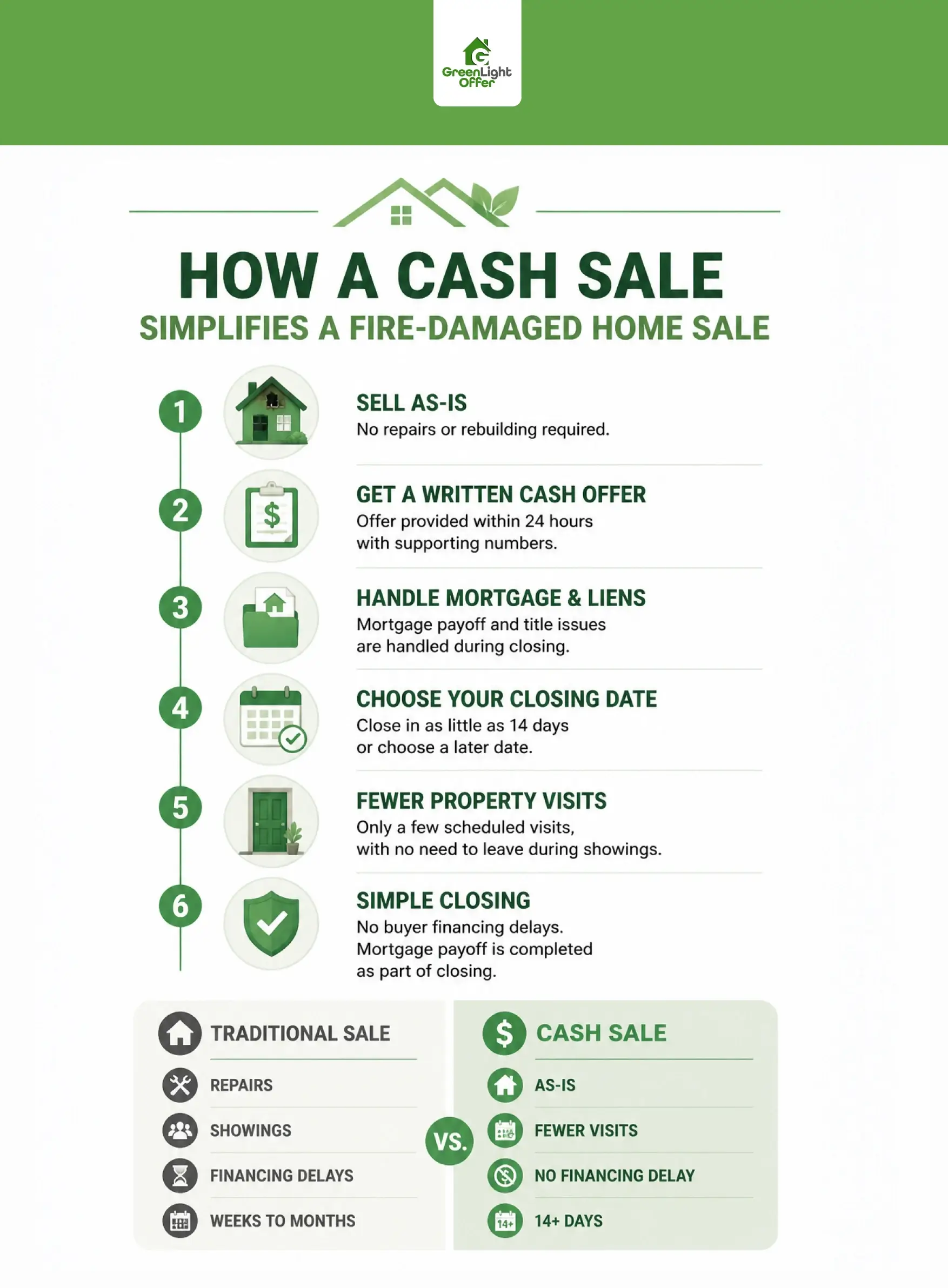
A cash sale simplifies the mortgage decision because the payoff happens in a single closing, with no buyer’s financing contingency and no appraisal gap to negotiate around. We buy houses directly, so there is no waiting on a buyer’s mortgage approval and no risk of a deal falling through during underwriting. Sean Zavary, founder of Greenlight Offer, has said he did not build the company to close deals. He built it to help families get through situations like this the way he would want his own family treated.
When you sell to Greenlight Offer, we send a written cash offer within 24 hours that includes the after-repair value, the repair budget, and the comparable sales we used, so you can check the math yourself. We pay all closing costs and title policy fees, and we handle the mortgage payoff directly with your title company. You pick the closing date, anywhere from 14 to 60 days out, which gives you room to coordinate with your decree deadline instead of racing a buyer’s loan timeline. You can read more about our process on our Sell My House page.
We do need private access to the property a few times before closing, always scheduled around you, and you do not have to leave while we are there. That is different from a traditional listing, where you typically leave the house for each showing and have less control over the schedule.
You can hear directly from past sellers on our testimonials page, or learn more about our team and how we work with sellers across the Houston metro area, including Houston homeowners specifically.

Deciding What to Do With Your Mortgage During a Texas Divorce
Deciding what to do with your mortgage during a Texas divorce comes down to who can qualify, how much time you have, and how much risk you are willing to carry with a joint loan. Refinancing works when one spouse can qualify alone. Assumption works on a smaller number of FHA and VA loans. Selling and paying off the mortgage at closing is the option that resolves the debt cleanly for both spouses, on one day, without depending on anyone’s future payments.
If you are weighing these options and want to see what a cash sale would net you after the mortgage payoff. We will send a written, no-obligation cash offer within 24 hours, with no credit pull and no pressure to accept it. You can also read more on our divorce and property FAQs, or browse our blog for more on selling during a divorce in Texas.

Frequently Asked Questions About Mortgage and Divorce House Sales in Texas
Does divorce automatically remove my name from the mortgage in Texas?
No. A Texas divorce decree divides property and debt between spouses, but it does not instruct your lender to remove a name from the mortgage. Your name stays on the loan until it is refinanced, assumed, or paid off.
Can I refinance a house during a divorce in Texas?
Yes, and many couples do. The spouse keeping the house applies to refinance in their name alone, based on their own income and credit. The new loan pays off the joint mortgage, and the other spouse’s name comes off the debt once the refinance closes.
What happens if my ex-spouse stops paying the mortgage after the divorce?
If your name is still on the loan, your lender can still hold you responsible for the payment, and a missed payment can still appear on your credit report, even if your decree assigned that responsibility to your ex-spouse.
Can I sell a house during a divorce if we still owe money on the mortgage?
Yes. Most house sales, divorce or otherwise, involve paying off an existing mortgage at closing. The title company pays the loan balance out of the sale proceeds before dividing the remaining net-to-seller funds between spouses according to the decree.
Is loan assumption possible with a conventional mortgage?
It is rare. Most conventional mortgages include a due-on-sale clause that requires the loan to be paid in full if ownership changes. FHA and VA loans are more commonly assumable, subject to the lender’s approval and the assuming spouse’s qualification.
Mortgage Divorce House Sale Texas: What’s Best?
When you’re selling a house during a Texas divorce, resolving the mortgage is just as important as dividing the property itself. Refinancing may work if one spouse can comfortably qualify alone, while loan assumption can be an option for certain FHA or VA loans. But when neither spouse wants or is able to carry the mortgage alone, selling the home and paying off the loan at closing can provide a clean break for both parties and reduce the risk of staying financially tied to an ex-spouse. It can also give both spouses a clearer understanding of what they will receive from the sale after the mortgage and other liens are paid.
If you’re unsure which option makes the most sense for your situation, understanding your potential net proceeds is a good place to start. Get a cash offer from us to see what your home could net after the mortgage payoff, with a written offer delivered within 24 hours, no credit pull, and no pressure to accept. This can help you understand your options and make a more informed decision about what to do with the property during your divorce.
