

If you and your spouse are getting divorced in Texas, one question tends to surface fast: should you sell the house before or after divorce finalized status changes on the calendar? That single date can change your tax bill, your legal footing, and how much control you keep over the sale.
In most cases, selling while you are still legally married and filing a joint tax return gives you access to the larger $500,000 capital gains exclusion, while selling after the decree usually limits each of you to $250,000 on your own return. Taxes are only part of the decision, though. Your decree deadline, your need for cash now, and how well you and your spouse can still cooperate all carry real weight too. Our guide to selling a house during a divorce in Houston covers the basics of a divorce sale; this article goes deeper into the specific before-or-after timing question.
A few things are worth knowing before you set a closing date:
- The $500,000 exclusion generally requires that you still be legally married on the date the sale closes, not just still living under the same roof.
- Texas is a community property state, so a home bought during the marriage is usually owned by both spouses no matter whose name is on the deed.
- A pending divorce does not freeze a home sale by itself. Texas law does not require a final decree before you list or sell, though a specific decree term or a temporary court order might.
- The two-of-five-year use test that unlocks the exclusion can get complicated fast when one spouse moved out months or years before the sale.
- Waiting for the decree before you sell often means paying two mortgage payments, two insurance bills, and ongoing upkeep the entire time.
The Core Tax Question: $500,000 Married Exclusion vs. $250,000 Single Exclusion
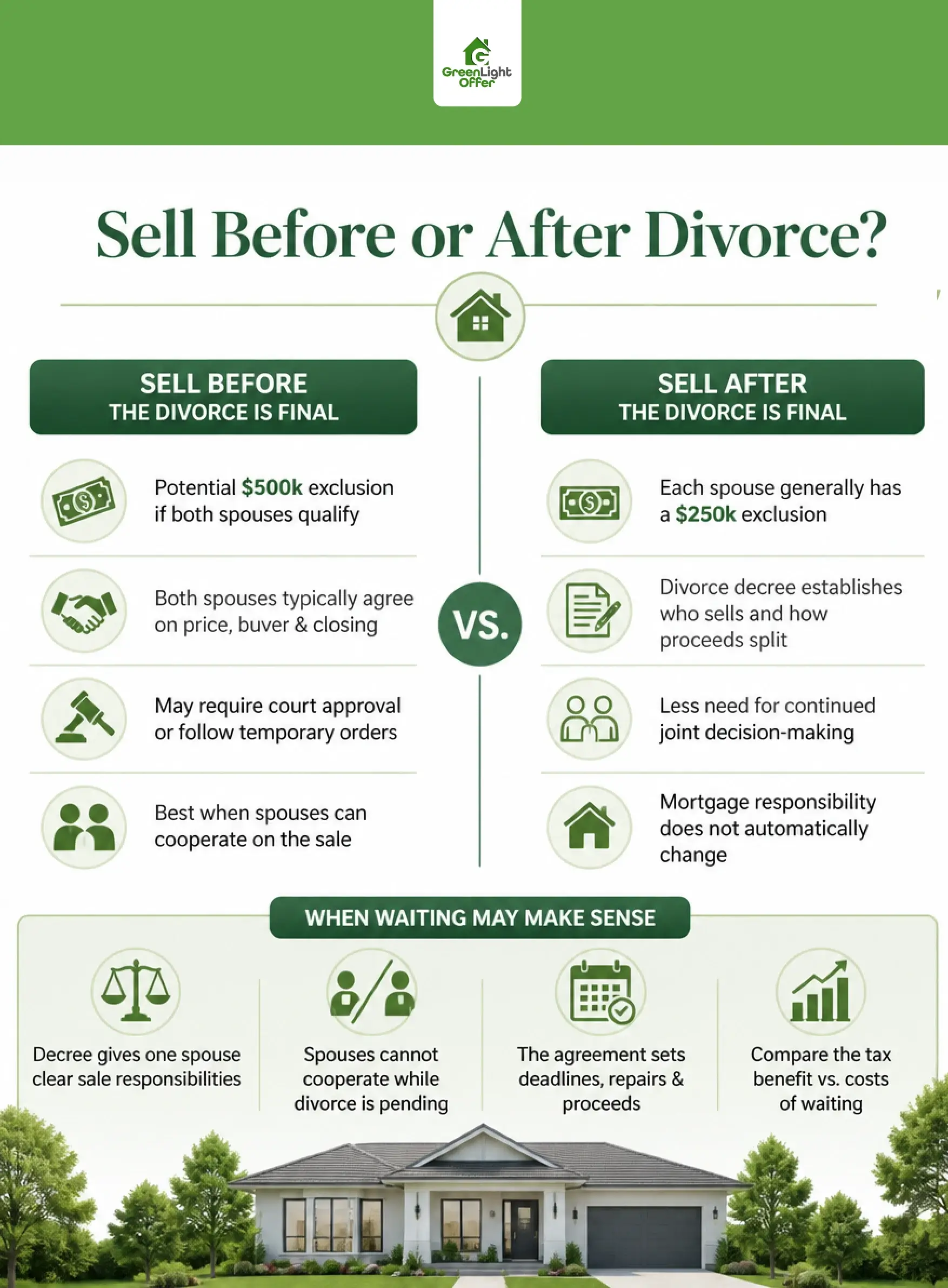
The core tax question comes down to timing. Sell while you are still married and file a joint return, and you can typically exclude up to $500,000 in capital gains on the sale of your home. Sell after the divorce is final, and each of you is generally limited to a $250,000 exclusion on your own individual return.
This exclusion comes from IRS Topic No. 701, Sale of Home, under Internal Revenue Code Section 121. To qualify, you generally must have owned and used the home as your main home for at least two of the five years before the sale. A married couple filing jointly can combine two individual exclusions into the full $500,000, as long as at least one spouse meets the ownership test and both meet the use test.
IRC Section 121 and the Two-of-Five-Year Test
The two-of-five-year test asks two separate questions: did you own the home for at least two years, and did you live in it as your main home for at least two years, within the five years before closing. Both tests use the same five-year window, but the years do not have to be consecutive. This test matters most in a divorce when one spouse has already moved into a separate home while the other stays behind.
| Scenario | Filing Status at Sale | Exclusion Available | Key Requirement |
| Sell before the divorce is final | Married filing jointly | Up to $500,000 | Both spouses generally must meet the ownership and use test, and the sale must close before the decree |
| Sell after the divorce is final | Single or head of household | Up to $250,000 per spouse | Each spouse files separately and must independently meet the ownership and use test |
Scenario A: Selling While Still Married (Before the Decree)
Selling before the decree means you and your spouse are still filing as a married couple, which is what unlocks the larger $500,000 exclusion if you both meet the requirements. It also means both of you are still legal owners with a say in the price, the buyer, and the closing date, since Texas community property generally requires both spouses to agree to a sale.
This path tends to work best when you and your spouse can still make joint decisions without a judge stepping in. If your case is contested, a family court may need to approve the sale terms, or a temporary order may already spell out who handles the listing or the closing. A divorce attorney can tell you whether your case has that kind of restriction.
Our full guide to selling a house during a divorce walks through how both spouses typically need to sign off on a sale, and what documents a title company will ask for when one party is mid-divorce.

Scenario B: Selling After the Decree Is Final
Selling after the decree is final means you and your ex-spouse each file taxes separately, so each of you is generally capped at a $250,000 exclusion rather than sharing one $500,000 exclusion. The decree itself usually spells out how the home is handled: who keeps it, whether it gets sold, and how the proceeds are split.
This path can feel cleaner because the legal relationship is already settled, and there is no need for continued joint decision-making about price or repairs. The tradeoff is the smaller individual exclusion, and often a longer stretch of carrying two households on one income before the sale closes.
If a mortgage is still attached to the home, the decree does not automatically remove either name from that loan. Our companion article on handling the mortgage during a Texas divorce sale breaks down refinancing, loan assumption, and paying the balance off at closing.
When Selling After Divorce May Make More Sense
The smaller individual exclusion is not automatically a reason to rush the sale before the divorce is final. Waiting can make sense when the divorce agreement gives one spouse clear responsibility for preparing and selling the property, or when the parties cannot realistically cooperate on the transaction while the case is pending.
For example, a spouse may agree to remain in the home temporarily while the other spouse relocates. The decree can establish a deadline for listing the property, identify who handles repairs and showings, and explain how the eventual proceeds are divided. That structure can reduce uncertainty even if the sale happens after the marriage has legally ended.
The key is to compare the potential tax difference with the actual cost of waiting. If keeping the house for several additional months means continuing to pay the mortgage, insurance, taxes, utilities, repairs, and other expenses, the additional carrying costs may reduce or even outweigh the potential tax benefit of waiting.
In other words, the question is not simply “Which date gives me the bigger exclusion?” It is “How much does waiting cost, and what do I gain by waiting?”
Does It Matter Who’s Still Living in the House?
Yes, it matters. The two-of-five-year use test normally requires you to have lived in the home yourself, so a spouse who moved out early can run into trouble qualifying on their own.
The tax code has a specific carve-out for this exact situation. Under Section 121, time that your former spouse spends living in the home can count as your own use, but only if a divorce or separation instrument gives your former spouse the right to live there. Without that kind of provision in your decree or settlement, the spouse who moved out risks losing the exclusion entirely.
The Special Rule for a Spouse Who Moved Out
This rule exists so that a spouse is not penalized simply for leaving the marital home during a separation. If your settlement grants your ex the right to occupy the house, and you otherwise meet the ownership test, you may still qualify for your share of the exclusion even though you have not personally lived there in years. This is a detail worth raising with a CPA or tax attorney before you finalize a decree, not after.
Non-Tax Factors That Can Outweigh the Tax Math
The tax math is not the only factor, and sometimes it is not even the deciding one. A tight decree deadline, an urgent need for housing funds, or ongoing tension over shared ownership can outweigh a bigger exclusion on paper.
- Decree deadlines: some decrees set a hard date to sell or refinance, which can force a timeline regardless of the tax picture.
- Need for cash now: if one spouse needs funds to secure new housing, waiting months for a decree to finalize is not always realistic.
- Ongoing conflict: continued co-ownership after a difficult divorce can create friction over maintenance, showings, or price negotiations.
- Liens or judgments: unresolved liens on the property can complicate a sale either way, and are worth clearing up early.
- Where you land next: a spouse relocating for work or family often has a shorter runway than the tax calendar allows.
When Waiting Costs More Than It Saves
Every month spent waiting for a decree is another month of mortgage interest, property taxes, insurance, and upkeep on a house neither of you may want anymore. If there is a lien on the property or a pending relocation for a new job, those carrying costs can erase more value than the larger exclusion saves in taxes. If a move is already on the horizon, our job relocation resource covers what a fast, flexible sale can look like when timing matters more than maximizing every dollar.

A Simple Decision Framework
A simple framework can help you weigh the timing question without getting lost in tax code language. Start with your equity, then layer in your expected tax bracket, your timeline pressure, and how well you and your spouse can still work together.
| Factor | Question to Ask | Leans Toward |
| Equity | How much profit will the sale generate? | High equity favors selling before the decree, to use the larger exclusion |
| Tax bracket | Will your income jump after filing single? | A higher expected bracket favors selling while still married |
| Timeline pressure | Does the decree set a sale deadline? | A tight deadline can decide the timing regardless of the tax math |
| Cooperation | Can you and your spouse agree on price and terms? | Low cooperation may push the decision toward court involvement or waiting |
This framework is meant to organize the conversation, not replace one with a professional. A CPA can run the numbers on your specific equity and income, and comparing that against a traditional listing on our Sell My House page can help you see the full range of options side by side.
Why a Flexible Closing Timeline Gives You More Control Either Way
A flexible closing date matters because it lets you time the sale around your decree, instead of your decree timing you. Whichever scenario fits your situation, control over the calendar reduces one more source of stress.
We buy houses directly, so there is no waiting on a buyer’s mortgage approval and no long stretch of a house sitting on the market while you and your spouse are trying to move forward. You choose the closing date, from 14 days out to 60 days out, which means you can close before a decree deadline or hold off until the paperwork is final, whichever fits your timing. We do still need private access to the property a few times before closing, always scheduled around you. We have been buying homes in the Houston area for over 10 years and currently hold a 4.7-star Google rating.
| Path | Typical Timeline | Who Controls the Date |
| Traditional listing | 30 to 90-plus days to find a buyer, plus 30 to 45 days to close | The buyer’s financing and negotiations |
| Cash sale with a set closing date | 14 to 60 days, seller’s choice | You choose the date |

Frequently Asked Questions About Selling a House During a Texas Divorce
These are the questions we hear most often. You can find more general answers on our FAQ page.
Can I sell my house before my divorce is final in Texas?
Yes. Texas law does not require a final decree before you sell a home, though both spouses generally need to agree to the sale since Texas is a community property state. A temporary court order tied to your specific case could add restrictions, so check with your attorney first.
Do I lose the $500,000 exclusion if I sell after divorce?
You do not lose it entirely, but you generally move from one shared $500,000 exclusion to two separate $250,000 exclusions, one per spouse, since you will each file individual tax returns after the divorce is final.
What is the capital gains exclusion for divorced homeowners?
Divorced homeowners are generally treated the same as any single filer, which means a $250,000 exclusion on capital gains from the sale of a main home, as long as the ownership and use tests are met.
Does it matter whose name is on the deed during a Texas divorce?
Not as much as people expect. Texas community property law generally treats a home bought during the marriage as jointly owned, regardless of whose name appears on the deed, unless it was separate property before the marriage or covered by a valid agreement.
Can one spouse force the sale of the house during a divorce?
Generally, no, not without a court order. A judge can order a sale as part of dividing the community property, but one spouse typically cannot list or sell a jointly owned home unilaterally while a divorce is pending.
Should I talk to a tax professional before deciding when to sell?
Yes. This article explains the general framework, but your specific income, other capital gains, and state of residence can all change the numbers. A CPA or tax attorney can run your actual figures before you set a closing date.
Timing Your Home Sale Around Your Texas Divorce
There is no single right answer to whether you should sell your house before or after the divorce is finalized; the status changes for you. The larger exclusion often favors selling while you are still married, but a tight decree deadline, an urgent need for cash, or ongoing conflict with your spouse can outweigh that tax advantage. Run the numbers with a CPA, read your decree closely, and decide based on your full situation rather than the tax savings alone.
If you decide a fast, flexible sale fits your timeline better than a traditional listing, we can send you a written cash offer within 24 hours, with no obligation and no credit pull. You choose the closing date, and we handle the rest. Learn more about our team and our approach, or visit our homepage to see how we work with Houston-area families going through a divorce. When you are ready, get your free cash offer and take the next step on your own timeline.
Community property rules referenced in this article are governed by Texas Family Code, Title 1, Subtitle B, Chapter 3. Federal tax figures referenced are current as of this writing and can change, so confirm current thresholds with the IRS or a tax professional before relying on them.
