
A yellow notice on the door, or a letter from Houston Public Works, can turn any homeowner’s week upside down. If your house has entered the condemned property process in Houston, you probably have two questions right now: what happens next, and how much time do you actually have? This guide explains the dangerous-building process, the hearing and compliance stages, and where selling may fit if repairing the property is not realistic.
The Houston condemned property process runs through Public Works code enforcement under Chapter 10, Article IX of the city’s ordinances, one of several situations covered under our broader look at code violations in Houston. It moves through a written notice, a hearing before a hearing officer, a compliance order with a repair deadline, and, if nothing changes, escalation toward receivership or demolition. You keep the right to repair, appeal, or sell the property at every stage until a specific deadline actually passes.
A few things surprise most owners once they look into this more closely.
- The standard compliance period runs up to 90 days when you present a repair plan at the hearing, longer than the shorter window many owners assume applies.
- Condemnation is a legal process, not an automatic loss of ownership. You still hold title unless a court or the city takes further action.
- You can sell a condemned house at any point before demolition, though the pool of buyers narrows mostly to cash and investor buyers.
- The same ordinance lets the city choose repair, removal, or full demolition, so a dangerous building order does not always end with a bulldozer.
- If the city ends up doing the work itself, the cost usually comes back to you as a lien on the property, not a bill you can simply set aside.
The Legal Basis: Chapter 10, Article IX and Texas Local Government Code 214
Houston’s dangerous building process rests on two layers of law working together: the city’s own Chapter 10, Article IX ordinance, and Texas Local Government Code Section 214.001, the state law that gives Houston the authority to act on a substandard building at all.
Chapter 10 spells out how Houston’s code enforcement branch identifies, cites, and processes a property once it crosses from an ordinary violation into a dangerous building designation. Texas Local Government Code Section 214.001 sits above that local ordinance. It requires the city to give the owner proper written notice and a public hearing before ordering the repair, removal, or demolition of a substandard structure, and for larger cities like Houston, it also requires courts to expedite any related judicial review.
That two-layer structure matters for one practical reason. The city cannot simply show up and tear a house down. State law requires due process first, which is why the notice and hearing steps below exist. If your citation is still tied to a narrower issue, such as unpermitted work or a structural problem, it helps to understand the types of code violations that lead to this stage before it ever reaches condemnation. As Houston home buyers ourselves, we track these ordinance details closely, since they shape what a property is actually worth to a buyer at each stage.
What Counts as a “Substandard” Building Under Chapter 10
A building becomes substandard under Chapter 10 when a structural, electrical, plumbing, or fire-safety condition creates a real danger to the people inside it or to the surrounding neighborhood. That is a higher bar than a routine maintenance citation. Peeling paint or an overgrown yard is a property maintenance issue. A collapsing roof, exposed wiring, or a foundation that has shifted enough to threaten the structure is the kind of finding that pushes a property toward the dangerous building track described in this guide.
Step-by-Step: How the Dangerous Building Process Works
The dangerous building process in Houston moves through six predictable steps, from the first notice to a final compliance decision.
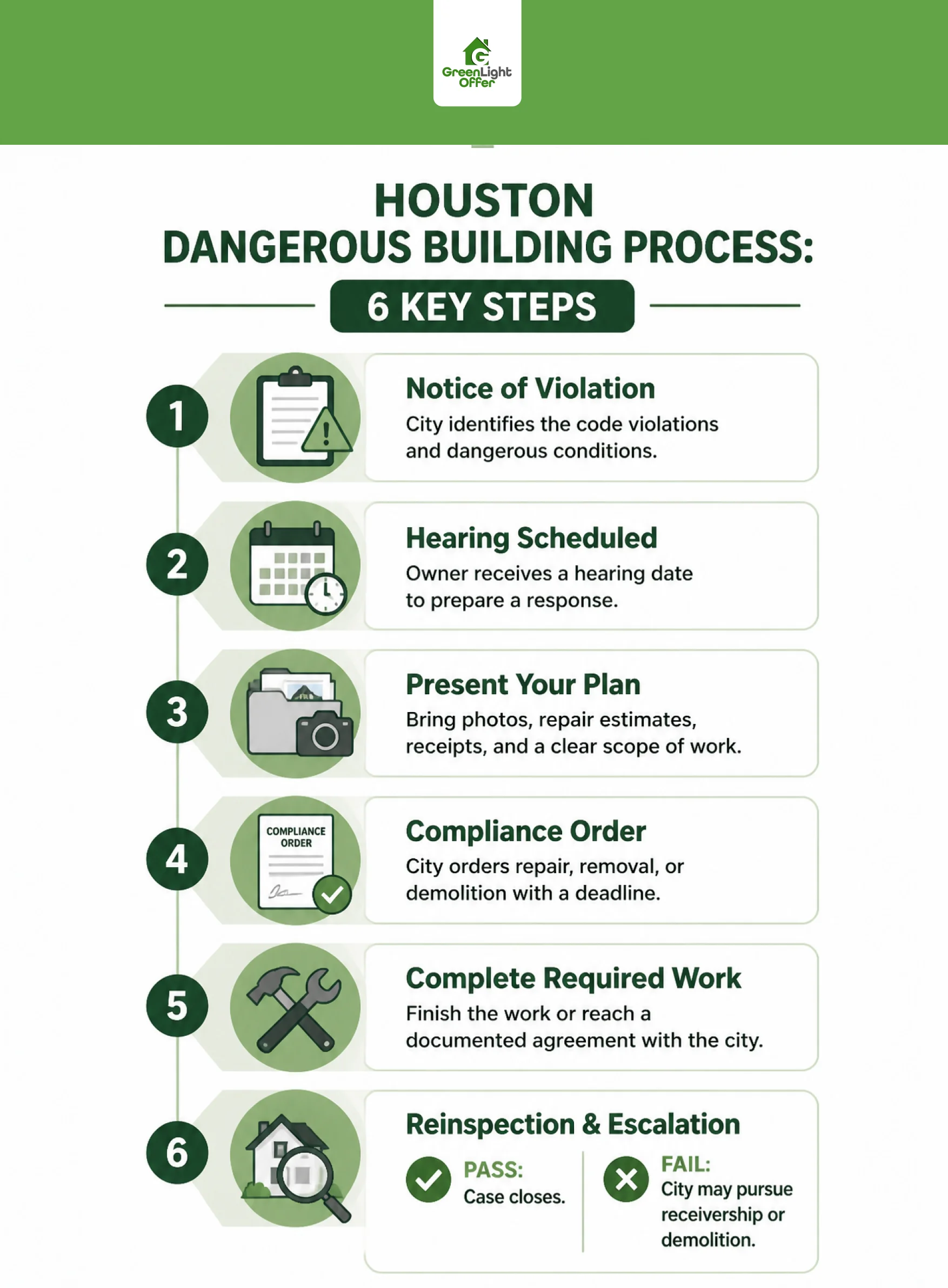
- Notice of Violation. Houston Public Works sends written notice naming the specific code sections violated and the condition that triggered the dangerous building designation.
- Scheduling a Hearing. The city sets a hearing date before a hearing officer or the Building and Standards Commission, giving the owner time to prepare a response and gather documentation.
- The Hearing Itself. You or your representative can present evidence, a contractor estimate, or a scope-of-work plan showing exactly how you intend to fix the property. Bring dated photos, any prior repair receipts, and a written timeline. A hearing officer with a specific plan in front of them has far more room to work with than one hearing a general promise to fix things eventually.
- The Compliance Order. The hearing officer issues a written order requiring repair, removal, or demolition, along with a compliance deadline tied to what was presented at the hearing.
- The Compliance Period. You have a set window, covered in the next section, to complete the required work or reach a documented agreement with the city.
- Reinspection and Escalation. Public Works reinspects at the deadline. If the property passes, the case closes. If it does not, the city can move toward receivership or demolition.
What Should You Do After Receiving a Dangerous Building Notice?
The first few days after receiving a dangerous building notice are important because the paperwork tells you what the city believes is wrong and what happens next. Do not assume that fixing one visible problem will automatically close the case.
Start by gathering the notice, inspection reports, photographs, prior citations, open permits, and any previous repair records connected to the property. You can also review the City of Houston’s dangerous-building records and Public Works resources to understand what types of notices, hearing documents, orders, and lien records may be associated with the case. Check the hearing date and every deadline listed in the documents. If the property has already been inspected by a contractor, keep those estimates and written findings together as well.
Next, determine whether the property is realistically repairable within the available timeframe. A contractor can help identify the scope of work, while a real estate attorney can help you understand the legal effect of the order if the case is already moving toward enforcement.
If you intend to repair the property, prepare a written scope of work and realistic timeline before the hearing. If repairing it is not financially or practically realistic, use the same information to evaluate a sale before the compliance deadline becomes the immediate problem.
How Long Do You Have to Comply With a Houston Dangerous Building Order?
Under Houston’s dangerous-building process, the order can require compliance within a specified period, with the maximum compliance period generally limited to 90 days when a Scope of Work Plan is not presented at the hearing. If the work cannot reasonably be completed within 90 days, the owner can present a Scope of Work Plan explaining why additional time is needed and identifying the amount of time requested. The exact deadline depends on the order issued in the individual case, so owners should rely on their order and the city’s current guidance rather than treating 90 days as a universal deadline.
The 90-day rule comes from Texas Local Government Code Section 214.001(j) and the City of Houston’s dangerous-building guidance. Houston specifically states that a Scope of Work Plan should be presented at the hearing when the work will require more than 90 days. The plan should explain why the work cannot be completed within 90 days and identify the additional time requested. Because the compliance period is established by the order in the individual case, owners should not assume that attending the hearing automatically guarantees an extension.
| Scenario | What the Owner Should Know |
| No Scope of Work Plan presented | The order’s compliance period is generally subject to the 90-day maximum under Section 214.001(j). |
| Work will require more than 90 days | Present a Scope of Work Plan at the hearing explaining why additional time is necessary and how long the work is expected to take. |
| Compliance deadline is approaching | Follow the specific order and current city instructions rather than assuming an automatic extension. |
| Order has expired without compliance | The city may take further enforcement action, including corrective work and assessment of costs as provided by law. |
These timeframes are general guidance, not a guarantee for your specific order. Confirm your exact deadline against the Houston Permitting Center’s dangerous building guide or with a real estate attorney before making any decisions based on it.
Extensions are not automatic, and they are not indefinite either. A hearing officer who grants extra time usually expects proof of progress along the way, such as a signed contractor agreement or a permit pulled for the repair work. Showing nothing changed between the hearing and a follow-up inspection tends to close off further flexibility, even if the original order technically allowed more time.
What Happens If You Don’t Comply With a Houston Dangerous Building Order?
Missing a Houston dangerous-building deadline can lead to additional enforcement action, including corrective work, demolition in appropriate circumstances, and a lien for qualifying city costs. The exact consequence depends on the order and the property’s circumstances, so owners should not assume that every expired order immediately results in demolition or receivership. Houston’s current guidance states that when an order expires without compliance, the city is required to take necessary corrective action and impose a lien for expenses incurred to achieve compliance in the circumstances described by the guidance.
- Receivership. A court-appointed receiver can take over repairs or the sale of the property when the owner will not or cannot act within the ordered timeline. The receiver’s costs and fees typically come out of the property’s value first, ahead of whatever the owner ultimately recovers.
- Demolition. The city can demolish an unsafe structure and bill the owner directly for the cost of that work.
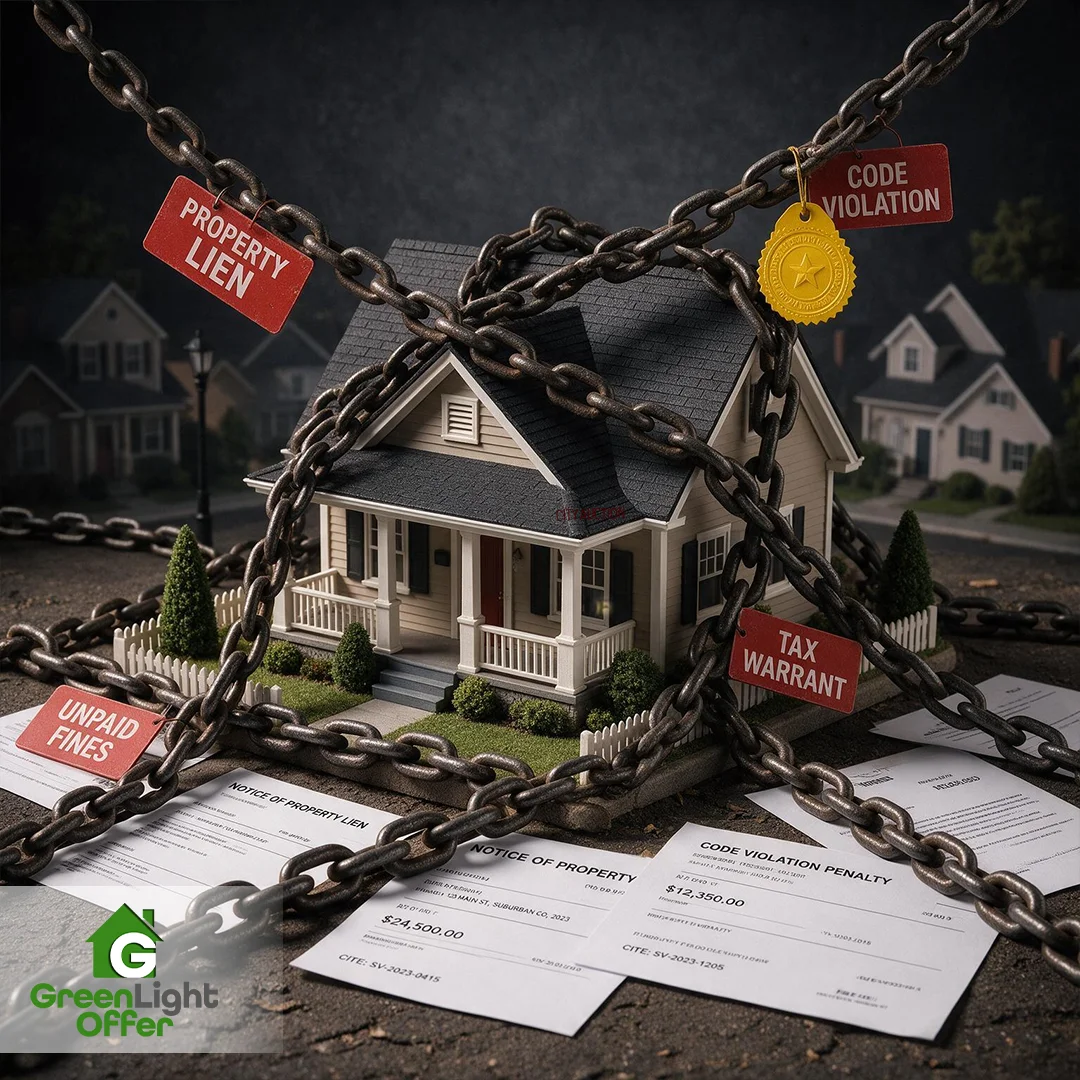
- A municipal lien. Unpaid city costs attach to the property as a lien, and understanding how those city costs can turn into a lien is worth doing before a case gets that far.
- Criminal penalty exposure. Chapter 10 also allows citations to carry separate fines apart from the civil compliance order itself.
- Compounding debt. Falling behind on a property in this condition can stack on top of a mortgage, taxes, or other liens on the property, and none of it tends to improve on its own timeline.
Why Houston Homes Get Condemned in the First Place
A condemned or dangerous building designation in Houston almost always traces back to one of a handful of patterns. Long-term vacancy lets small problems turn into structural ones. Fire or storm damage that never gets properly repaired is a common trigger, and so is unpermitted construction that created an unsafe condition rather than just an unpermitted one. Absentee ownership plays a role too. Owners who move away, inherit a property they cannot maintain, or simply stop responding to city notices are often furthest along in the process by the time they realize how serious it has become.
Can You Sell a Condemned or Dangerous-Building House in Houston?
Yes, you can sell a condemned or dangerous-building house in Houston at any point before demolition, though most traditional, financed buyers will not be able to close on it.
Mortgage lenders require a property to meet minimum safety and habitability standards before they will fund a loan against it, and a house under a dangerous building order fails that test by definition. Why lenders walk away from a cited property goes deeper into that mechanism if you want the full picture. That leaves cash and investor buyers as the realistic pool once a property reaches this stage, which is also why timing matters. The earlier you look at your options, the more of that pool is still available to you.
We buy Houston houses in exactly this condition, mid-process, cited, or already under a compliance order. It is the same patience one longtime Houston homeowner told us mattered most when she sold a house her family had owned for decades. She said our team was sympathetic to everything her family was dealing with, and that steadiness is not something we reserve for the easy files.
For a broader look at how our home buying process works, especially if you are still weighing your options beyond just this property, that page walks through it step by step.
A cash sale on a condemned property still involves real steps. We review the citation and any hearing order, confirm what the compliance deadline actually requires, and account for that condition in a written cash offer. There is no repair estimate for you to chase down first, and no financing contingency that can fall apart once an appraiser sees the order. That is the practical difference between selling to a cash buyer and waiting on a financed buyer who may not qualify once the condition of the house comes to light.
Certificate of Compliance vs. Selling As-Is: A Side-by-Side Look
Getting a certificate of compliance means repairing the property until it passes reinspection, while selling as-is means transferring the property in its current condition to a buyer who accepts that risk.
The Repair-to-Certificate Path
This path clears the violation permanently and can open the property back up to financed buyers later. It also costs the most upfront, since Houston’s code enforcement generally requires bringing the cited system up to current code, not just patching the specific defect that was flagged. Expect permitting fees, contractor costs, and a reinspection fee before the city issues a certificate of compliance.
The Sell-As-Is Path
This path skips repairs, permitting, and reinspection entirely. The buyer takes on the property, and by extension the compliance deadline, as part of the purchase. It typically nets a lower gross price than a fully repaired home would fetch, but it also removes the carrying costs, contractor risk, and waiting that come with the repair path.
| Factor | Repair-to-Certificate Path | Sell-As-Is Path |
| Upfront cost | Contractor, permitting, and reinspection fees | None |
| Timeline | Weeks to months, depending on scope | Days to a few weeks |
| Certainty | Depends on contractor availability and reinspection results | Higher once an offer is accepted |
| Buyer pool afterward | Opens back up to financed buyers | Limited mostly to cash and investor buyers |
| Best fit | Owners with time, funds, and a manageable repair scope | Owners short on time, funds, or facing a near-term deadline |
If your property has real equity, a manageable repair scope, and enough time before the compliance deadline, finishing the repair-to-certificate path and listing traditionally can put more money in your pocket. A cash sale is the right tool when the deadline is close, the repair scope is large, or you simply need the process to be over.

Frequently Asked Questions About Condemned Properties in Houston
Who declares a building dangerous in Houston?
Houston Public Works handles the dangerous-building enforcement process, including inspections, notices, administrative hearings, and orders. A property is processed under the dangerous-building provisions of Chapter 10, Article IX, with the applicable hearing and order determining what action the owner must take. Public Works also maintains records for dangerous-building hearings, administrative orders, notices, and lien reviews.
Can I still live in a condemned house while I sell it?
It depends on the specific order. Some dangerous building orders allow continued occupancy while the compliance process plays out, while others require the property to be vacated for safety reasons. Check the exact language of your notice or ask the hearing officer directly, since this varies case by case.
Does condemnation show up on the title?
A dangerous building order itself is a city administrative action, not automatically a recorded document, but any resulting lien for unpaid city costs will show up in a title search. That is why title companies flag properties in this situation closely during any sale, and why resolving or disclosing the lien before closing matters more than the underlying order itself.
How does a condemned property affect a title commitment?
A title company reviewing the property will typically flag any recorded municipal lien tied to the case, along with open permits or unresolved code citations found in county or city records. None of that necessarily stops a cash sale, but it does mean the title company will want those items addressed, disclosed, or accounted for in the closing figures before issuing a clear commitment.
Is a dangerous-building order the same as an eviction?
No. A dangerous building order addresses the physical condition of the structure, not who is allowed to live there. An eviction is a separate legal process between a landlord and a tenant and follows its own timeline entirely.
Sell Your Condemned or Cited Houston Property, As-Is
The Houston condemned property process gives you more room to act than most owners assume, especially during the early notice and hearing stages. Once you understand the timeline, you can decide whether repairing toward a certificate of compliance or selling as-is fits your situation better.
We have been buying Houston houses since 2016; we are BBB accredited with an A+ rating, and sellers rate us 4.7 stars on Google. If you would rather skip the compliance deadline altogether, we buy condemned and cited Houston properties as-is, and we will walk you through exactly where your property stands in the process before you decide anything. You can also read more seller stories or check our full FAQ page for other situations we have handled. Get your free cash offer, and you will have a written cash offer within 24 hours, with no obligation and no credit pull.
