
A code violation notice on your Houston property comes with a deadline and a dollar sign attached, and neither one goes away by itself. If you are staring at a citation for code violations in Houston right now, you probably want two things: a straight answer on what this could cost you, and a clear picture of what happens if you do not act in time.
Houston code violation penalties depend on the ordinance and type of violation involved. Some Houston ordinances treat each day that a violation continues as a separate offense, while other enforcement actions follow different penalty and hearing procedures. An unpaid violation can also lead to additional city action, including abatement costs or, in situations authorized by law, a lien against the property. The exact consequences depend on the citation and the legal authority being used in the case.
Here is what most homeowners do not realize until they are already dealing with a citation:
- The fine amount depends on the violation type and how the city classifies it, so there is no single flat rate you can plan around.
- Some Houston ordinances treat each day a violation continues as a separate offense, but the penalty structure depends on the specific violation and ordinance involved.
- Certain city abatement expenses and civil penalties can result in a lien against the property when the applicable law allows it. The lien rules and priority can depend on the type of enforcement action involved.
- Municipal abatement liens are treated differently than a mortgage, tax, mechanic’s, or HOA lien, and they carry their own priority rules.
- You can still sell a house with an open fine or lien, but the path looks different depending on whether your buyer is financing the purchase or paying cash.
How Much Are Houston Code Violation Fines, Exactly?
There is no single fixed amount for Houston code violation fines, because penalties depend on the specific violation and the ordinance section that applies. Houston Chapter 10 contains different penalty provisions, including sections where each day a violation continues may constitute a separate offense. Because the applicable penalty can vary by violation, homeowners should check the specific ordinance and citation rather than rely on one general fine amount.
What stays consistent is the structure. A citation gives you a correction deadline. If the property is not brought into compliance by that date, the fine clock generally keeps running, and in many cases it runs per day rather than as a one-time charge. That is why two homeowners with what looks like the same violation can end up owing very different amounts, simply because one corrected it in a week and the other let it sit for months.
Fine amounts and escalation timelines vary by violation type and by case. If you have an active citation, confirm the current figures directly with Houston Public Works rather than relying on an estimate from any article, including this one.
Why Houston Code Enforcement Fines Compound So Quickly
Houston code enforcement penalties vary by the ordinance and enforcement procedure involved. Some violations can carry penalties for each day the violation continues, while administrative citations follow procedures that specify the penalty, costs, hearing rights, and payment deadlines. Because the rules are not identical for every violation, homeowners should look at the actual citation and applicable ordinance rather than assume that every fine automatically increases each day.
Delays can still increase the overall financial exposure when a violation remains unresolved. Depending on the case, a homeowner may face additional penalties, administrative costs, contractor expenses, city-performed abatement costs, or other enforcement consequences. The safest approach is to confirm the current requirements and amounts with the city handling the citation.
How Daily Fines Accumulate the Longer You Wait
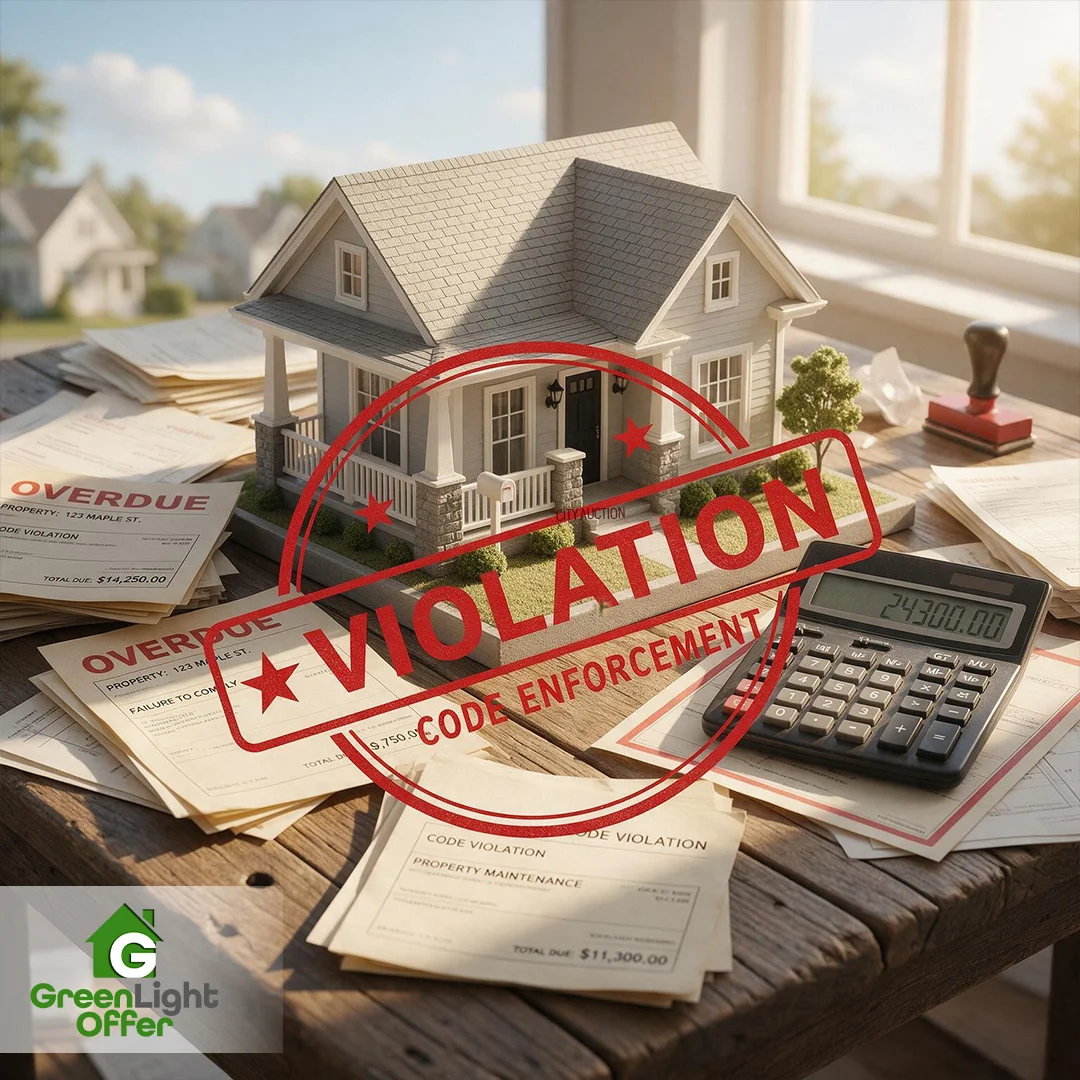
Whether a Houston code violation penalty continues to accrue depends on the specific ordinance and enforcement method used for the case. Houston’s code includes violations where each continuing day can constitute a separate offense, but the city’s administrative citation process also requires the citation or summons to state the applicable penalty, costs, and fees.
That means homeowners should not assume that every citation works like a daily running bill. The amount, correction requirements, hearing process, and consequences for leaving the violation unresolved can vary by case. Check the citation and the applicable Houston ordinance for the rules that actually apply to your property.
Waiting can still increase your total exposure because unresolved violations may lead to additional enforcement, city abatement work, administrative costs, or other expenses depending on the circumstances. Acting early gives you a better chance to understand the amount at issue and determine how to resolve the underlying condition.
A few things tend to slow down correction and let fines run longer than they need to:
- Waiting on contractor availability, which in Houston can mean a multi-week backlog for licensed trades
- Discovering the fix requires a permit, which adds its own timeline before work can even start
- Underestimating the scope, then having a reinspection fail and restart part of the clock
- Financial strain that delays starting the repair at all
From Fine to Lien: How the Escalation Works
A code violation does not automatically become a property lien simply because a fine remains unpaid. The escalation depends on the type of violation and the legal authority involved. In certain cases, the city may perform or order abatement work and recover those costs through a lien, while Texas law also authorizes liens for certain civil penalties, repair, removal, or demolition expenses involving substandard buildings.
| Stage | What Happens | Typical Trigger |
| 1. Citation issued | Inspector documents the violation and sets a correction deadline | Complaint, routine inspection, or permit audit |
| 2. Correction window | Fines may begin accruing if the deadline passes uncorrected | No repair, no permit pulled, or failed reinspection |
| 3. Formal notice and hearing | City escalates under Chapter 10 and, for substandard buildings, LG 214.001 | Continued noncompliance past the correction window |
| 4. Abatement action | City may correct the condition itself and bill the owner for the cost | Owner does not comply after formal notice |
| 5. Lien filed | Unpaid fines and abatement costs are recorded as a lien against the property | Costs remain unpaid after the city’s demand |
For substandard buildings, this escalation runs alongside Texas Local Government Code §214.001, which gives the city its legal authority to act. If a citation on your property has escalated toward a dangerous building determination, our guide to the dangerous building process walks through that separate, more serious track in detail.
Municipal Abatement Liens vs. Other Property Liens in Houston
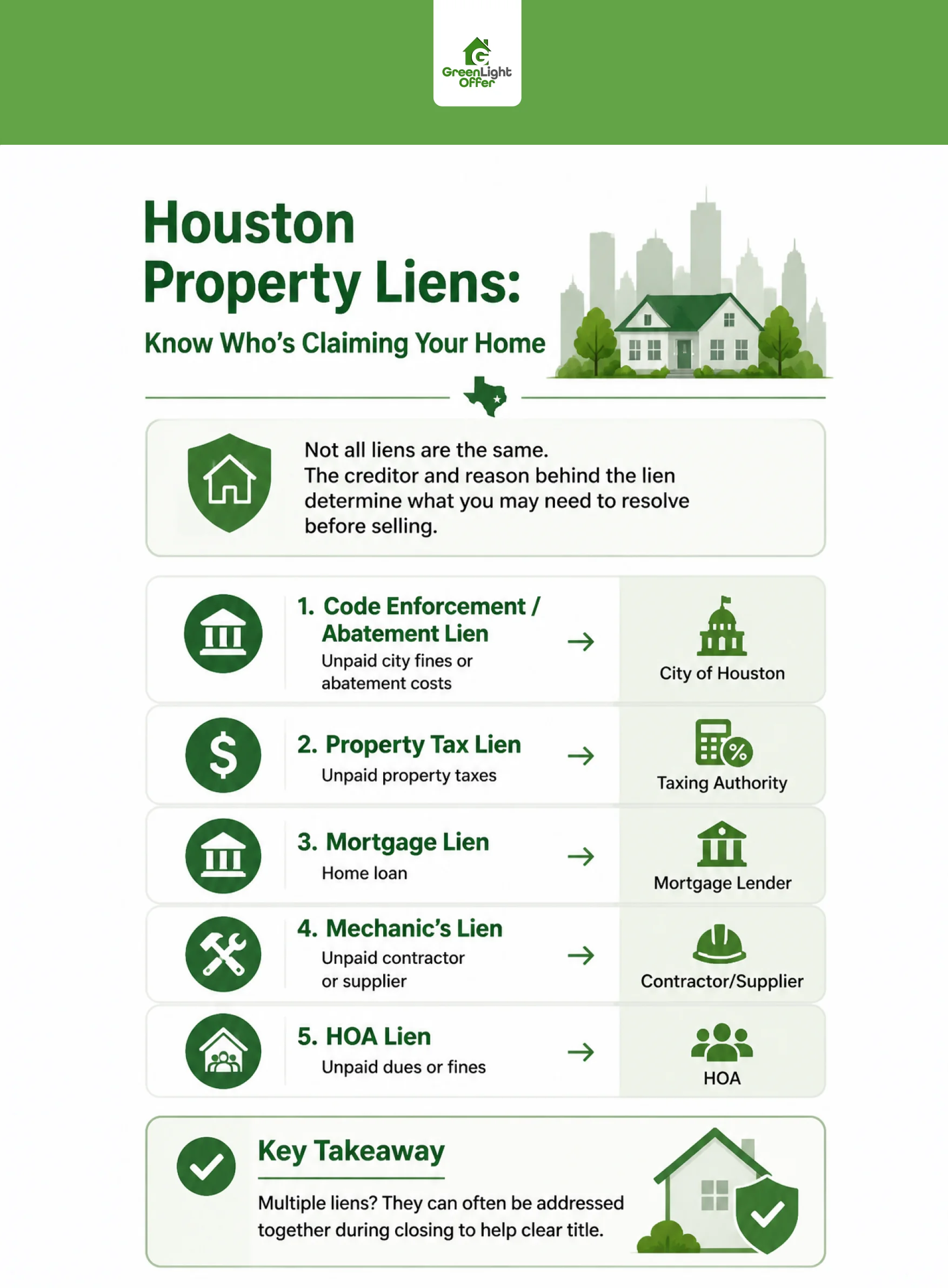
A municipal abatement lien is created by the city government for unpaid code enforcement costs, which sets it apart from a tax lien, a mortgage lien, a mechanic’s lien, or an HOA lien, each of which comes from a different creditor with its own rules.
| Lien Type | What Creates It | Who Holds It | Where to Learn More |
| Code enforcement / abatement lien | Unpaid fines or city-performed abatement work | City of Houston | This page |
| Property tax lien | Unpaid county or city property taxes | Harris County or local taxing authority | Liens on a Houston property |
| Mortgage lien | The loan used to purchase or refinance the home | Your mortgage lender | Liens on a Houston property |
| Mechanic’s lien | Unpaid contractor or supplier for work done on the home | The contractor or supplier | Liens on a Houston property |
| HOA lien | Unpaid homeowners association dues or fines | Your HOA | Liens on a Houston property |
Every one of these liens has to be resolved before you can convey clear title, so if your property has more than one, they typically get addressed together during closing rather than in isolation. For a full breakdown of tax, mortgage, mechanic’s, and HOA liens, see our page on liens against a Houston property, since a municipal abatement lien is only one piece of that picture.
Do Code Violation Liens Have to Be Paid at Closing?
A recorded municipal lien generally needs to be addressed as part of the sale because the lien remains attached to the property until it is paid or otherwise released. The City of Houston states that its property liens remain with the property and must be settled before the transfer or sale of the property.
In practice, the title company and closing process determine how the recorded lien is handled, including the payoff amount and release documentation. The amount can potentially be paid from the seller’s proceeds at closing if the transaction provides enough funds to satisfy the lien.
The title commitment is where this actually gets confirmed. Once a buyer opens the title, the title company pulls every recorded item against the property, including code enforcement liens, tax liens, and anything else filed in the county records. That document becomes the checklist for closing, and nothing on it gets skipped just because a seller is in a hurry. Sellers sometimes assume a smaller fine will simply get overlooked at the table. In practice, title companies treat a municipal lien the same way they treat a mortgage payoff statement, as a required line item that has to be satisfied before funds can be disbursed and the deed can be recorded.
Can You Sell a House With an Active Code Violation Fine or Lien?

Yes, you can sell a house with an active code violation fine or lien, though your buyer pool narrows and the process depends heavily on whether that buyer is financing the purchase or paying cash.
A cash buyer can often work through a lien payoff as part of closing, using the title commitment to confirm the exact amount owed and structuring the sale around it. A financed buyer faces a harder path, because a lender’s underwriting process and the appraisal itself can both flag an open citation or lien as a reason to pause or deny the loan. We cover that lending angle in detail in our piece on why mortgage lenders reject homes with code violations.
Financed Buyers Walk Away From Fines and Liens
Financed buyers depend on a lender’s approval, and a lender depends on a clean appraisal and a clear title. An open code violation fine or an unresolved lien can interrupt both, which is why financed deals on cited properties fall through more often than sellers expect. A cash sale removes that dependency, since there is no appraisal contingency and no lender underwriting step standing between an accepted offer and a closed sale.
Why Waiting on a Fine Almost Always Costs More Than Selling
Waiting on a code violation fine almost always costs more than acting on it, because the fine keeps accruing while ordinary carrying costs, your mortgage payment, property taxes, insurance, and utilities, keep running in the background at the same time.
Most homeowners focus on the fine itself and forget that it is only one line item. A house sitting unsold or unrepaired for an extra two or three months is also racking up a mortgage payment, a tax bill, and an insurance premium, none of which pause for a citation. Add those together and the true cost of delay is usually much higher than the fine balance alone suggests.
Carrying Costs Add Up While a Fine Sits Unresolved
Carrying costs are easy to underestimate because they arrive in separate bills instead of one number. A mortgage payment, property tax escrow, homeowners insurance, and basic utilities to keep the property secure all continue whether the house is occupied or sitting vacant while you sort out a violation. When you stack those costs next to an accumulating daily fine, the total pressure to resolve the situation quickly, either by repairing or by selling, becomes clearer than the fine alone would suggest.
Ms. Yates came to us needing a fast sale after several other buyers could not get her deal done, and we closed within a couple of days. Speed like that is exactly what matters once fines and carrying costs are both running against you at the same time. You can read her story and others on our testimonials page.

Frequently Asked About Houston Code Violation Fines and Liens
Can the city put a lien on my house for unpaid fines?
The city can place a lien on property in certain code enforcement and abatement situations, but an unpaid citation does not automatically create a lien in every case. Houston ordinances provide specific procedures for city-performed abatement expenses, and Texas law authorizes liens in certain substandard-building cases for civil penalties and repair, removal, or demolition expenses.
Do fines stop accruing once I sell the house?
Selling the property does not automatically erase an outstanding code enforcement balance or recorded lien. Any recorded lien must generally be addressed as part of the closing and title process, while the treatment of unpaid penalties can depend on the specific citation and enforcement action. The City of Houston states that its property liens remain with the property and must be settled before a transfer or sale.
Will I owe the fines personally, or does the lien follow the property?
Both can be true depending on how the city pursued the matter, but the lien itself follows the property regardless of who owns it. That is why a buyer’s title search will surface it even if you have since moved away or transferred ownership.
What is the difference between a fine and a lien?
A fine is the dollar amount assessed for the violation itself. A lien is the legal claim the city files against your property when those fines, or the cost of city-performed abatement work, go unpaid. Every lien starts as an unpaid fine, but not every fine turns into a lien if it gets paid in time.
Can I negotiate or reduce a code violation fine in Houston?
In some cases, presenting a scope-of-work plan or resolving the violation promptly can affect how the city proceeds, but any reduction or payment arrangement has to go through Houston Public Works directly. We are not able to speak to what any individual case will result in, and neither should any article that has not seen your actual citation.
You can find more general answers on our FAQ page, or reach our team directly for a case-specific conversation.
Stop Houston Code Violation Fines Before They Become a Lien
Houston code violation penalties can become more difficult and expensive to resolve when a property remains out of compliance. The specific amount, timing, and enforcement consequences depend on the violation and the ordinance involved, so reviewing your citation and confirming the current requirements is important. If you are weighing whether to repair the property or sell it as-is, our repair vs. sell as-is cost comparison can help you compare the costs and tradeoffs of both options.
We buy Houston-area houses with active code violations and existing liens as-is, and our site explains that liens can be handled as part of the sale process. You can also review our Houston code violation types guide or our page about selling a house with an open permit if your situation involves unpermitted work.
For a case-specific next step, you can request a free cash offer and discuss the property’s code violations or liens with the team before deciding how you want to proceed.
