
Your buyer’s appraiser walked through the house, and now the lender wants answers about an open code violation you did not think much about until this week. This is one of the most common ways code violations in Houston turn into a sale problem, since the financing tied to the property can be affected by conditions that raise safety, soundness, or structural concerns.
Here’s the short version: a mortgage lender lends against the property as collateral, so the property generally must meet the applicable conditions and eligibility requirements for that loan program. A code violation does not automatically mean every lender will reject the property, but a violation involving safety, soundness, structural integrity, or required repairs can cause an appraisal to be completed subject to repairs, additional documentation, or other lender review.
Not every code violation creates the same financing problem. A minor condition may be reported without requiring repair, while a significant safety, structural, or habitability issue may require correction and verification before the lender can proceed.
- FHA loans carry the strictest property condition standards, but many conventional lenders also require the appraiser to note and flag visible safety hazards.
- An open permit can trigger the same lender response as an active citation, even when the underlying work already passed inspection.
- The financing contingency, not the violation itself, is usually what kills the deal, since it gives the buyer a way to walk if repairs are not finished by a set deadline.
- A cash sale does not just move faster. It removes financing, the single condition most likely to unravel a sale once a violation surfaces.
- A violation does not block every kind of sale. It blocks financed sales at the specific standard tied to that loan program, nothing more and nothing less.
Why Do Lenders Reject Homes With Code Violations? (Quick Answer)

Lenders reject homes with code violations because the citation raises doubt about whether the property meets the minimum safety, structural, and habitability requirements tied to that loan program. Until the doubt is resolved through repair, re-inspection, or a documented lender exception, the loan cannot close.
This is not a Houston-only rule, and it is not unique to any single lender. It is baked into how mortgage underwriting works. A lender is not just financing your buyer. It is securing the loan against the property itself, so the property has to hold up its end of the deal.
Learn more about the types of code violations in Houston that most often trigger this response, since not every citation carries the same weight with an underwriter.
How an Appraisal Uncovers a Code Violation

An appraiser does not perform the same type of inspection as a home inspector. During an appraisal, the appraiser performs the inspection required for the assignment and reports apparent property conditions that may affect value, marketability, safety, soundness, or structural integrity. Appraisers are not generally responsible for hidden or unapparent conditions, but visible deficiencies and relevant information discovered during the appraisal process may need to be reported.
Why a Mortgage Lender Code Violation Concern Starts With the Appraiser
A mortgage lender code violation concern almost always starts with the appraiser’s walkthrough, not with a call to the city. The appraiser flags anything that looks unsafe, unfinished, or inconsistent with permit records they can access.
Sellers sometimes assume a minor, cosmetic issue will slide past unnoticed. Appraisers are trained to look past cosmetics for anything tied to structural soundness, so this assumption causes more delays than the violation itself usually would.
How This Is Different From a Home Inspection
An appraisal and a home inspection are not the same report, even though both involve someone walking through your house. A home inspection is ordered by the buyer, digs into every system, and produces a long list of items regardless of whether they affect the loan. An appraisal is ordered by the lender, focuses narrowly on value and on anything that threatens safety or soundness, and only becomes a problem for you when it flags something serious enough to pause funding.
This is why a house can pass inspection with a long list of minor notes and still sail through an appraisal, or the reverse can happen. A home with a short inspection report can still get flagged hard on the appraisal if the one item it mentions is a structural or safety concern. Do not assume a clean inspection means a clean appraisal, or the other way around.
Minimum Property Standards: What Lenders Actually Require
Lenders require a home to meet the property condition and eligibility requirements that apply to the specific loan program. For conventional loans, Fannie Mae property condition requirements require appraisers to identify deficiencies that affect the property’s safety, soundness, or structural integrity. Depending on the severity of the issue, repairs or further professional evaluation may be required before the loan can proceed. Minor conditions that do not affect these areas may be allowed to remain as-is, subject to the lender’s review.
FHA Minimum Property Standards vs. Conventional Loan Requirements
FHA and conventional loans can treat property-condition issues differently. FHA transactions are subject to FHA-specific property requirements, while conventional loans follow the requirements of the applicable lender and investor, such as Fannie Mae. Fannie Mae’s guidance focuses on deficiencies that affect safety, soundness, or structural integrity and explains when repairs or qualified professional documentation may be necessary. Minor conditions that do not affect those areas may be eligible to remain as-is, subject to the lender’s review.
That difference in requirements means the same house can receive different treatment depending on the loan program and the severity of the property condition. Foundation and structural issues carry particular weight either way. If your citation involves settling, cracking, or movement, our page on foundation-related code violations walks through why these issues can be especially relevant to Houston properties.
What Happens When an Appraisal Flags a Violation
When an appraisal flags a violation, the file usually moves through the same sequence regardless of lender.
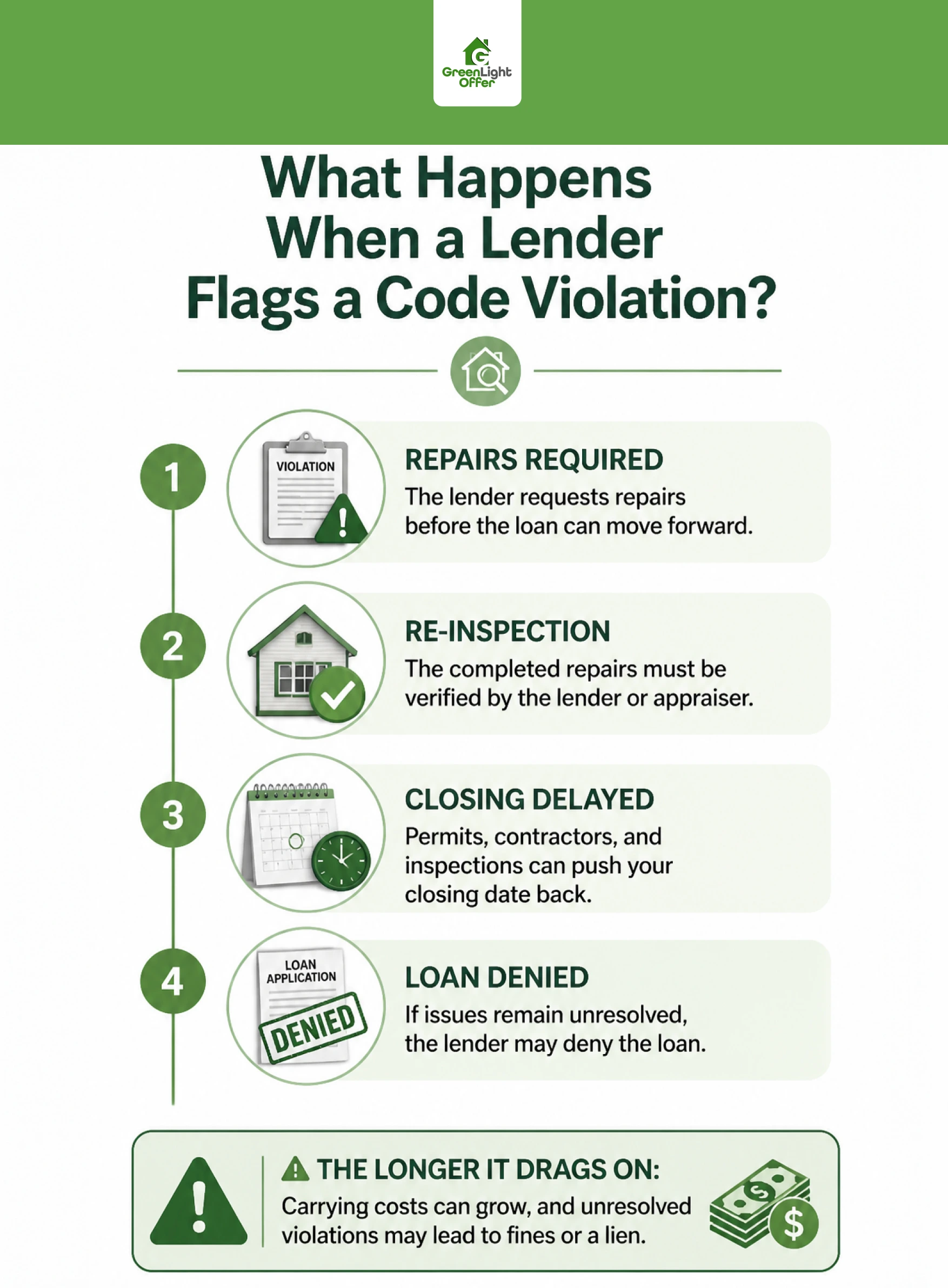
- The appraiser reports the condition. The appraisal identifies visible deficiencies that may affect the property’s safety, soundness, structural integrity, value, or eligibility.
- The lender reviews the findings. The lender determines whether the condition can remain as-is or whether repairs, additional documentation, or a qualified professional inspection is required.
- Repairs or verification may be required. If repairs are necessary, the lender may require evidence that the work has been completed before the loan can proceed.
- The closing may be delayed. If the condition is not resolved in the required timeframe, the transaction may be delayed, or the loan may not meet the applicable eligibility requirements.
Not every item on a repair list carries the same weight. A curable item, like a missing handrail or a smoke detector, is usually cheap and quick to fix. A non-curable item, like active structural movement, can require an engineer’s report and a licensed contractor before the lender moves forward. That difference is what actually determines whether you are looking at a one-week delay or a two-month one, and it is worth asking your buyer’s lender directly which category your citation falls into before you agree to any repair timeline.
Many appraisals in this situation come back subject to repairs, meaning the appraiser will not certify the final value until they, or another licensed appraiser, confirm the work is done. Lenders typically require a follow-up inspection report before they will fund, which is an extra step and an extra fee that was not part of the original plan.
There is also a shelf life on the appraisal itself. If repairs and re-inspection drag past the point the lender considers the appraisal still valid, the whole thing may need to be reordered from scratch, at your buyer’s expense, with no guarantee the value comes back the same. That risk alone is enough to push some financed buyers toward renegotiating instead of waiting it out.
Every day this process drags on, carrying costs keep accruing on the seller’s side, and unresolved violations can escalate into fines if they sit long enough. Our page on how code violation fines can turn into a lien covers that escalation path in detail.
The most serious cases do not stop at a lien. If a structural or safety citation goes uncorrected long enough, the city can move toward a dangerous building order, which is a different and more urgent process than a standard citation. Our guide to Houston’s dangerous building process walks through what that escalation actually looks like.
FHA vs. Conventional vs. Cash: Who Can Still Buy a Cited House?
Buyer type determines how much tolerance exists for an open code violation, and the gap between loan types is wider than most sellers expect.
| Buyer Type | Code Violation Tolerance | Typical Outcome |
| FHA / HUD-backed | Loan-specific and generally sensitive to conditions affecting required property standards | Repairs, documentation, or additional verification may be required before closing |
| VA / USDA | Depends on the applicable program and lender requirements | Affected properties may require repairs, documentation, or additional review |
| Conventional | Varies by lender and investor requirements | Minor conditions may be accepted as-is, while significant safety, soundness, or structural issues may require repairs or professional documentation |
| Cash / investor | No mortgage lender is underwriting the property | Mortgage financing and lender-specific repair requirements generally do not apply, although the buyer may still inspect or negotiate repairs |
VA loans follow a similar path to FHA. VA minimum property requirements exist for the same reason FHA’s do, to protect the buyer and the loan itself. Sellers should not assume VA financing will be more forgiving than FHA just because it is a different program.
This is a large part of why unpermitted work is such a common sticking point. Anyone weighing whether to close an open permit before listing should read our guide on selling with an open permit in Houston before deciding either way.
Why a Cash Sale Sidesteps the Lending Problem Entirely
A cash sale can remove the mortgage-lending process from the transaction because the buyer is not relying on a lender to approve a loan secured by the property. That means there is generally no mortgage underwriter reviewing the property for loan-program eligibility and no lender-required repair list standing between the offer and closing. The buyer may still choose to conduct an inspection, request repairs, or make the offer subject to other conditions, so a cash sale does not automatically eliminate every property-related issue.
That does not mean the violation disappears or that it stops mattering. It means the one party most likely to walk away over it, a mortgage lender, is not part of the transaction. You can read more about how our home buying process works if you want the full picture before deciding.
A financed buyer rarely walks away outright over a violation. More often, they come back asking you to lower the price, cover the repair cost, or both, after you have already accepted their offer and started planning your move. We are not going to tell you a cash sale always beats that negotiation. Sometimes it does not. If you want the full financial comparison, our page on repair costs versus selling as-is walks through real numbers.
Why Homeowners Insurance Can Complicate the Loan Too
A lender will not fund a mortgage without proof of hazard insurance, and some of the same issues behind a code violation can also make a property harder to insure. An outdated electrical panel, an aging roof, or unresolved structural movement can lead an insurer to deny coverage or quote a higher premium than your buyer expected.
If the buyer cannot get insurance at a price their lender accepts, the loan stalls even if the appraisal eventually clears. This runs on its own timeline, separate from the appraisal process. A cash sale does not require a hazard insurance policy in place before closing, so this obstacle does not apply the same way.
Stack the appraisal contingency, the repair verification, and the insurance underwriting together, and a financed sale on a cited property can easily take twice as long as a clean one. None of those three steps exist in a cash sale. That is the real reason cash transactions close faster on properties like this, not just because there is less paperwork.
Three Things to Check Before You List With a Financed Buyer in Mind
If you are not selling to us and plan to list traditionally, a little homework up front can save you from losing a buyer mid-contract.
- Pull your own permit history first. The Houston Permitting Center lets you search past permits on your address, so you know what the appraiser might find before they find it.
- Get a repair estimate before you accept an offer, not after. A number in hand lets you negotiate from a position of knowledge instead of reacting to whatever the lender’s list says.
- Disclose the violation upfront, in writing. A citation that surfaces during the appraisal reads very differently to a buyer than one you told them about on day one. Texas Property Code §5.008 requires this anyway, so there is no upside to waiting.
What This Means If You’re Selling to a Family, Not Just an Investor
This matters just as much if your buyer turns out to be a family looking to move in, not an investor. Some properties we buy are not right for investors at all. They are better suited to a retail buyer, meaning a family purchasing a home to live in, and those homes still come with equity built in.
Novations and Retail Buyers: Why Financing Sometimes Still Applies
We also structure some purchases as novations, which lets a property move toward the right kind of buyer instead of forcing every home into the same investor mold. After we buy a property, we usually resell it on the open market. That happens after your closing and has no effect on your sale, your price, or your timeline.
Financing can still come into play on that resale, since a retail buyer often uses a mortgage. But by the time that happens, your part of the transaction is finished. Your sale to us was already cash, already closed, and already off your plate. That is the honest distinction worth understanding: what happens with the property after your closing is a separate story from what you experience before it.
We have been buying Houston houses this way for 10 years, and we carry a 4.7-star Google rating along with BBB A+ accreditation dating back to 2018. You can read real seller reviews from people who went through this exact situation.

Frequently Asked Questions About Mortgage Lenders and Code Violations
Can a buyer still get a loan on a house with a minor violation?
Sometimes, yes. A minor, clearly correctable issue, like a missing handrail or a smoke detector, is often something the lender will let a buyer address quickly. Structural, electrical, or safety-related citations are far less likely to get that flexibility.
Does the seller have to make repairs for the appraisal to pass?
Not always the seller specifically, but someone has to. In many financed deals, the seller and buyer negotiate who pays for the repair before the lender will fund the loan, and that negotiation itself can add weeks to the timeline.
Will my violation show up on every lender’s appraisal?
Not necessarily. An appraisal is based on the appraiser’s observations, available information, and the requirements applicable to the assignment and loan program. A visible condition may be reported by multiple appraisers, but lenders and loan programs can differ in how they respond to the finding. Minor conditions may be treated differently from deficiencies that affect safety, soundness, or structural integrity.
Does selling for cash mean I never have to deal with the violation at all?
No. Selling for cash removes the lender’s appraisal contingency from the equation, but you still need to be upfront about any known violation. Texas Property Code §5.008 requires sellers to disclose known conditions like unpermitted work regardless of how the sale is financed.
Do VA and USDA loans face the same code violation risk as FHA?
VA and USDA loans have their own property-condition and eligibility requirements, so the result is not necessarily the same as an FHA appraisal. Whether a particular code violation affects financing depends on the loan program, the property’s condition, the appraisal, and the lender’s requirements. Sellers should not assume that a violation will automatically produce the same result across FHA, VA, USDA, and conventional financing.
What if my violation is tied to a foundation issue, not electrical or structural framing?
Foundation citations get extra scrutiny because most lenders require a licensed structural engineer’s letter before they will fund the loan, not just a repair invoice or a contractor’s word. That step alone can add several weeks beyond a typical repair verification.
Selling a House With a Mortgage Lender Code Violation Problem, As-Is
A mortgage lender code violation problem does not have to mean months of repairs, re-inspections, and a buyer who might still walk away. Selling as-is takes the lender, the appraisal contingency, and the repair negotiation out of the picture entirely. You are not waiting on an underwriter to decide whether your home clears a standard you may not have even known existed.
If you have questions about a specific citation, you can also check our frequently asked questions page or reach out directly. We buy houses across the Houston area, including through our Houston home buyers page, and we have worked through unpermitted additions, structural citations, and everything in between. If repairs make more sense for your situation, our page comparing repair costs to selling as-is, linked earlier in this article, can help you run the numbers honestly before you decide.
When you are ready, reach out, and we will put together a written cash offer within 24 hours, with no obligation and no credit pull. Get your free cash offer and see where you stand before you spend another dollar on repairs.
