
A foundation code violation in Houston can come back even after a homeowner repairs the original problem and passes reinspection. Homeowners may fix a crack, only to receive another citation months or years later when the foundation moves again. The reason is often the expansive clay soil beneath Houston homes, which swells when wet and shrinks when dry. Understanding code violations in Houston more broadly helps explain why foundation-related citations can recur and what homeowners can do about them.
The problem often starts beneath the house. Houston’s expansive clay soil can shift as moisture levels change, causing foundation movement, cracks, uneven floors, and sticking doors. Drainage issues, large trees, leaking gutters, and poor grading can make that movement worse.
Knowing why foundation violations recur can help you decide what to do next. You may need another repair, want to challenge the citation, or decide that selling the property as-is makes more financial sense. Understanding the cause and potential costs gives you a clearer picture before spending more money.
Why Do Foundation Code Violations Keep Coming Back in Houston? (Quick Answer)
Foundation code violations can recur in Houston when soil movement, drainage conditions, moisture changes, or other underlying factors continue to affect the structure after a repair. Expansive soils shrink and swell as their moisture content changes, which can contribute to foundation movement and damage. A repair may address the existing structural condition without eliminating every factor that can cause future movement, so a repeat problem does not automatically mean the original repair was improperly performed.
A few things are worth knowing before you decide what to do next.
- A passed foundation repair is not a permanent fix for the soil underneath it, so a second citation does not mean the first repair failed.
- Houston code inspectors cite the visible symptom, meaning a crack, a gap, or a sticking door, not the soil movement causing it.
- Selling a home with an open or repeat foundation citation is legal, but it narrows your buyer pool to cash buyers once a lender gets involved.
- The cost of chasing a permanent fix on expansive clay can run well past the cost of the citation itself.
- A licensed foundation engineer, not a general contractor, is the right person to confirm whether a repair will actually hold.
The Root Cause Of Expansive Clay Soil In The Houston Area
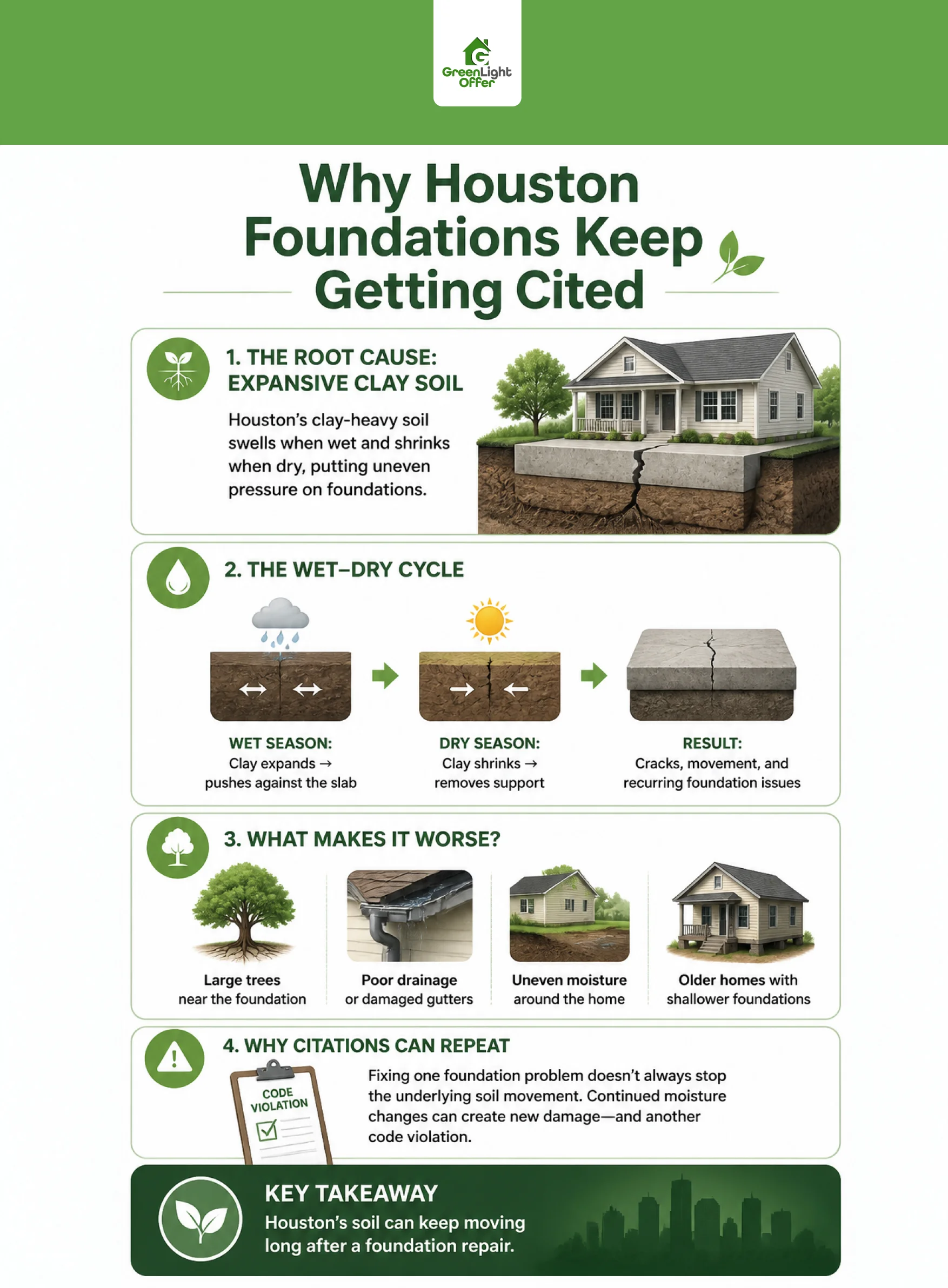
Expansive soil is one important cause of foundation problems because it can shrink and swell as its moisture content changes. The Texas Department of Licensing and Regulation notes that expansive soils are a very common cause of foundation problems and recommends NRCS soil survey information to help identify where expansive soils are present. Soil conditions can vary by location, so a property-specific soil review is more reliable than assuming every Houston-area property has the same soil profile.
According to a Texas Department of Licensing and Regulation technical bulletin, foundation damage tied to expansive soils accounts for an estimated 25 percent of damage to structures across the country, with total losses exceeding those from earthquakes, floods, hurricanes, and tornadoes combined. That is a national figure, but Houston’s clay-heavy soil profile puts the metro squarely inside that risk zone.
How Expansive Clay Soil Cycles Trigger a Foundation Code Violation in Houston
A foundation code violation in Houston often traces back to a wet-dry cycle rather than a single event. During a wet season, clay soil absorbs water and swells, pushing up on parts of a slab unevenly. During a drought, the same soil dries out and shrinks, pulling support away from other parts of the same slab. A foundation that looked stable in spring can develop new stress cracks by late summer, and an inspector who cited the home once may end up citing it again after the next dry stretch.
This cycle is also why homes on the same street, built by the same builder in the same year, do not always fail the same way. Drainage, tree root placement, gutter condition, and even how much a homeowner waters their foundation in summer all change how the soil under that specific slab behaves.
Large trees planted close to a foundation make the pattern worse. A mature tree can pull enough moisture from the soil on its side of the house to create a permanent dry zone, while the opposite side of the slab stays wet and swollen. That uneven moisture split is one of the more common causes of a foundation that cracks on one side of a home but not the other, and it is also why a repair on one side does not always prevent a crack on the other side later.
The age and design of a home can also affect how a foundation responds to changing soil conditions. Foundation performance depends on factors such as the foundation system, soil characteristics, drainage, moisture conditions, construction, and previous repairs. Because those factors vary from property to property, the age of a Houston home alone does not establish whether it is more likely to experience recurring foundation movement.
How Foundation Movement Triggers a Code Violation
Foundation-related problems can become a code issue when the condition of the building does not meet applicable structural or property-maintenance standards. Houston’s Building Standards Code requires owners to maintain floors, supporting walls, ceilings, and other supporting structural members in a sound and safe condition capable of safely bearing imposed loads. The specific condition and applicable code provision determine whether a citation is appropriate.
Common Foundation-Related Citations Houston Inspectors Issue
- Visible cracking in the slab, foundation wall, or exterior brick veneer wider than a hairline.
- Doors and windows that no longer close or latch properly due to frame misalignment.
- Sloped or uneven interior floors detectable with a level or a rolling ball test.
- Separation at the point where an interior wall meets the ceiling or floor.
- Plumbing or drainage issues caused by shifted pipe connections under the slab.
Several of these can overlap with other violation categories in our structural and other violation types overview, since a foundation issue can also trigger an electrical or plumbing citation if shifting pipes or wiring create a separate hazard. Unpermitted foundation repairs from a previous owner add another layer, since selling a house with an open permit tied to earlier slab work is a common discovery during a title search.
How a foundation-related code case begins can vary. Houston’s Building Standards Code allows enforcement officials to issue a criminal citation or an administrative citation after discovering a violation, but the article should not assume that every foundation case begins with the same type of complaint, inspection, or permit review. The applicable enforcement process depends on the specific property condition and code provision involved.
Why a “Fixed” Foundation Can Get Cited Again
A “fixed” foundation can get cited again because most repairs address the crack, not the soil movement that caused it. Piers, mudjacking, and slab leveling all correct the position of the structure at the time of the repair. None of them stop clay soil from expanding and contracting in future seasons.
This is not a sign that the repair company did poor work. It is a limitation built into repairing a structure that sits on soil the repair itself cannot control. A homeowner who installs piers under one section of a slab may see a new crack open somewhere else on the same foundation two or three years later, simply because the soil moved differently in that spot.
Left unaddressed long enough, a repeat structural citation can escalate. Houston’s dangerous building process applies to severe, uncorrected structural cases, though most foundation citations never reach that level if the homeowner responds to the notice.
Homeowners sometimes ask why the city does not simply require a permanent, soil-proof foundation the first time. The honest answer is that no repair method fully engineers around expansive clay at a cost most homeowners can absorb. Even new construction on the same soil uses foundation designs meant to tolerate a certain amount of movement, not eliminate it, which is part of why this issue keeps showing up in Houston code enforcement data year after year.
Signs Your Houston Home May Have a Foundation-Related Violation Risk

Watch for these signs before a citation ever arrives.
- Cracks in drywall near door frames or windows that reappear after patching.
- A noticeable gap between the baseboard and the floor in one or more rooms.
- Doors that used to close easily now sticking or dragging on the frame.
- Visible exterior cracks in brick or siding, especially in a stair-step pattern.
- Standing water near the foundation after normal rainfall, which accelerates soil movement.
None of these signs guarantee a citation is coming, but they are the same symptoms Houston inspectors look for. Catching them early gives you more options, including time to decide whether repair is worth pursuing before fines or a lien enter the picture. Unresolved citations that sit too long can turn into a real financial problem, since unresolved violations can turn into a lien against the property under the city’s abatement process.
A simple test many Houston homeowners use is the door check. Walk through the house and try every interior door, not just the ones you use daily. A door in a guest room or hallway closet is often the first place a foundation shift shows up, since it gets opened less often and a new drag or gap goes unnoticed longer than one on a bedroom or bathroom door used every day.
Foundation Repair Costs vs. Selling As-Is
Foundation repair costs vary widely by the type and extent of the damage, and selling as-is avoids that cost entirely in exchange for a lower gross offer. The table below shows typical ranges reported across Houston-area contractors, not a quote for any specific property.
| Repair Type | Illustrative Houston Cost Range | What Can Affect Cost |
| Crack repair | $600 to $3,200 | Crack severity, cause, and repair method |
| Slab leveling | $1,100 to $3,100 | Area being leveled and method used |
| Piering or stabilization | $2,100 to $7,700 | Number of piers, movement, and foundation type |
| Differential settlement repair | $9,000 to $28,000 | Extent of settlement and stabilization required |
| Extensive structural repair | Can exceed $20,000 | Scope of underpinning, drainage, plumbing, and restoration |
These are broad published Houston-area estimates, not quotes for a specific property. Actual costs depend on the foundation type, extent of movement, repair method, soil and drainage conditions, number of affected areas, and any related plumbing or structural work. Get a property-specific evaluation and written estimate before deciding whether repair makes financial sense.
Can You Sell a House With a Foundation-Related Code Violation?

You can sell a house with a foundation-related code violation, but the effect on the transaction depends on the property’s condition, the buyer, the lender, and the specific citation. A financed buyer may face additional appraisal, inspection, underwriting, or repair requirements when significant structural problems are identified. A cash buyer does not have a mortgage lender requiring the same underwriting process, which can make an as-is transaction more straightforward, although the buyer can still evaluate the property’s condition before closing.
For homeowners considering a sale, understanding the actual scope of the foundation problem is important before assuming that repair is required or that financing is impossible. Our guide on why lenders reject homes with structural violations covers the financing side in more detail.
We buy foundation-cited homes as they sit, without asking the seller to bring in a structural engineer or start a repair project first. You can read more of what past sellers have said about that approach on our testimonials page.
When Repairing the Foundation Actually Makes Sense
Repairing the foundation actually makes sense when you plan to stay in the home for years, the damage is isolated, and a licensed engineer confirms the repair will address the specific cause of movement, not just the visible crack. If your home sits in a strong Houston pocket, has no other pending violations, and you are not on a tight timeline, a properly engineered repair can restore full value and buyer confidence.
Repair is a weaker choice when the citation is one of several issues on the property, when you need to sell within a few months, or when the cost of a permanent fix would exceed what the repair adds back in resale value. If you disagree with how a citation was written or believe it overstates the actual damage, you also have the option to appeal a code violation citation before committing to either repair or a sale.
There is no single right answer here. The honest version is that repair and an as-is sale solve different problems, and the choice depends on your timeline and how much soil-related risk you are willing to carry going forward.
A simple way to think about it: ask a licensed foundation engineer, not the contractor selling the repair, whether the cause of movement on your specific property has been addressed or just the symptom. An engineer’s written assessment also becomes useful documentation if you decide to sell later, since it can reassure a future buyer or their lender that the repair was done to a defensible standard rather than a quick patch.

Frequently Asked Questions About Foundation Code Violations in Houston
Does every foundation crack count as a code violation?
No. Hairline cosmetic cracks in a slab or drywall are common in Houston and do not automatically trigger a citation. A code violation typically requires a crack or defect wide enough, or a structural symptom clear enough, to affect safety or habitability under the city’s structural violation category.
How do I know if my soil is expansive clay?
You can use the USDA NRCS Web Soil Survey to research the soil characteristics around your property. The official NRCS site provides access to soil maps and information, and the Web Soil Survey lets users define an area of interest to view available soil data. Because soil conditions can vary by location, use the survey as a starting point rather than treating it as a substitute for a property-specific engineering evaluation.
Will a foundation repair guarantee I won’t be cited again?
No repair can guarantee that, since the soil movement causing the original crack does not stop because the crack was fixed. A well-engineered repair, paired with proper drainage and consistent foundation watering, lowers the odds of recurrence but does not eliminate them on expansive clay.
Can I sell my house if it already has an open foundation citation?
Yes, a property with a foundation-related citation can still be sold, but the citation may affect buyer interest, negotiations, inspections, or financing. Sellers should also review their applicable disclosure obligations and disclose known material property conditions as required by Texas law. The specific disclosure requirements can depend on the property and transaction, so a seller should not assume that the same rule applies to every sale.
Does a foundation citation show up in a title search?
The citation itself is a city code enforcement record, not always a title record, but it can surface during a title company’s municipal lien search, especially if fines went unpaid long enough to create an abatement lien on the property.
Selling a Houston Home With a Foundation Code Violation, As-Is
Selling a Houston home with a foundation code violation as-is means you skip the engineer, the contractor bids, and the reinspection cycle entirely. We buy homes with active or repeat foundation citations in the condition they are in today, cracks included, and we handle what comes next.
If you are weighing a permanent repair against a faster exit, we can walk you through both sides honestly, including when listing after a repair might actually net you more. Either way, you do not have to decide alone or guess at what a citation means for your options. You can also browse our page for Houston home buyers if you want to see how we work across the wider metro, or start with your own property.
Get My Free Cash Offer at Get My Free Cash Offer and we will send a written cash offer within 24 hours, with no obligation and no credit pull. If your home has a foundation code violation, we would rather give you a straight answer than have you guess.
