
A code violation in Houston does not necessarily mean you have to accept the citation without question. If the notice appears incorrect, outdated, or relates to work you believe was already corrected, the appropriate hearing or review process may give you an opportunity to present evidence and challenge the violation.
Houston gives property owners a real path to contest a citation. You document the property’s condition, request a hearing under the city’s building code, and present your evidence to a hearing officer or the Building Standards Commission. The outcome depends on your case, not on how loudly you disagree with the inspector.
Most owners never see this process explained anywhere except a citation letter that is written for compliance, not for someone trying to figure out their options. A few things about this process rarely make it into that letter.
- An appeal moves through a hearing, not a phone call. A verbal explanation to the inspector rarely reverses a citation by itself.
- A scope-of-work plan presented at the hearing can extend your compliance period beyond the standard deadline, if the reviewing officer accepts it.
- A successful hearing can affect the citation or compliance order. Whether previously assessed fines, penalties, or other costs are affected depends on the applicable order and case procedure.
- Selling the house is a legitimate alternative to appealing, especially when the repair cost outweighs anything an appeal could realistically change.
- Missing the response deadline printed on the citation can forfeit your right to a hearing, so the calendar matters more than the paperwork.
Can You Appeal a Code Violation Citation in Houston?
Houston provides different administrative hearing procedures depending on the type of code case. For some proceedings, a hearing officer hears the evidence and issues a written order, while certain dangerous-building matters involving dwellings can proceed before the Building Standards Commission. The Houston Code of Ordinances Chapter 10 sets out these procedures, so check your citation or notice to determine which process applies.
A dangerous-building case can involve additional procedures under Texas Local Government Code Chapter 214. For example, Houston’s dangerous-building materials provide for a scope-of-work plan to be presented at the hearing when additional time may be needed for compliance.
An appeal is not a guarantee. Some citations get dismissed because the violation was already fixed or documented incorrectly. Others get upheld with a longer timeline attached because the property owner presented a workable repair plan. Either way, showing up with evidence changes the outcome far more often than staying silent.
It also helps to know who you are dealing with. Houston’s code enforcement staff are not trying to force a sale or a fine on you personally. They are following a caseload of citations across the city, and a well-documented response usually moves faster through that caseload than a disputed one with no paperwork attached.
Not every code case goes through the same hearing process. Houston provides administrative violation hearings for property code violations, where a hearing officer reviews the case. A citation that has escalated toward a dangerous building or substandard structure determination goes instead to the city’s Building Standards Commission. Ask the code enforcement office which hearing process applies to your specific case before preparing your evidence.
6 Steps to Appeal a Code Violation Citation in Houston
Here is what the appeal process actually looks like, from the day the citation arrives to the day a hearing officer makes a decision.
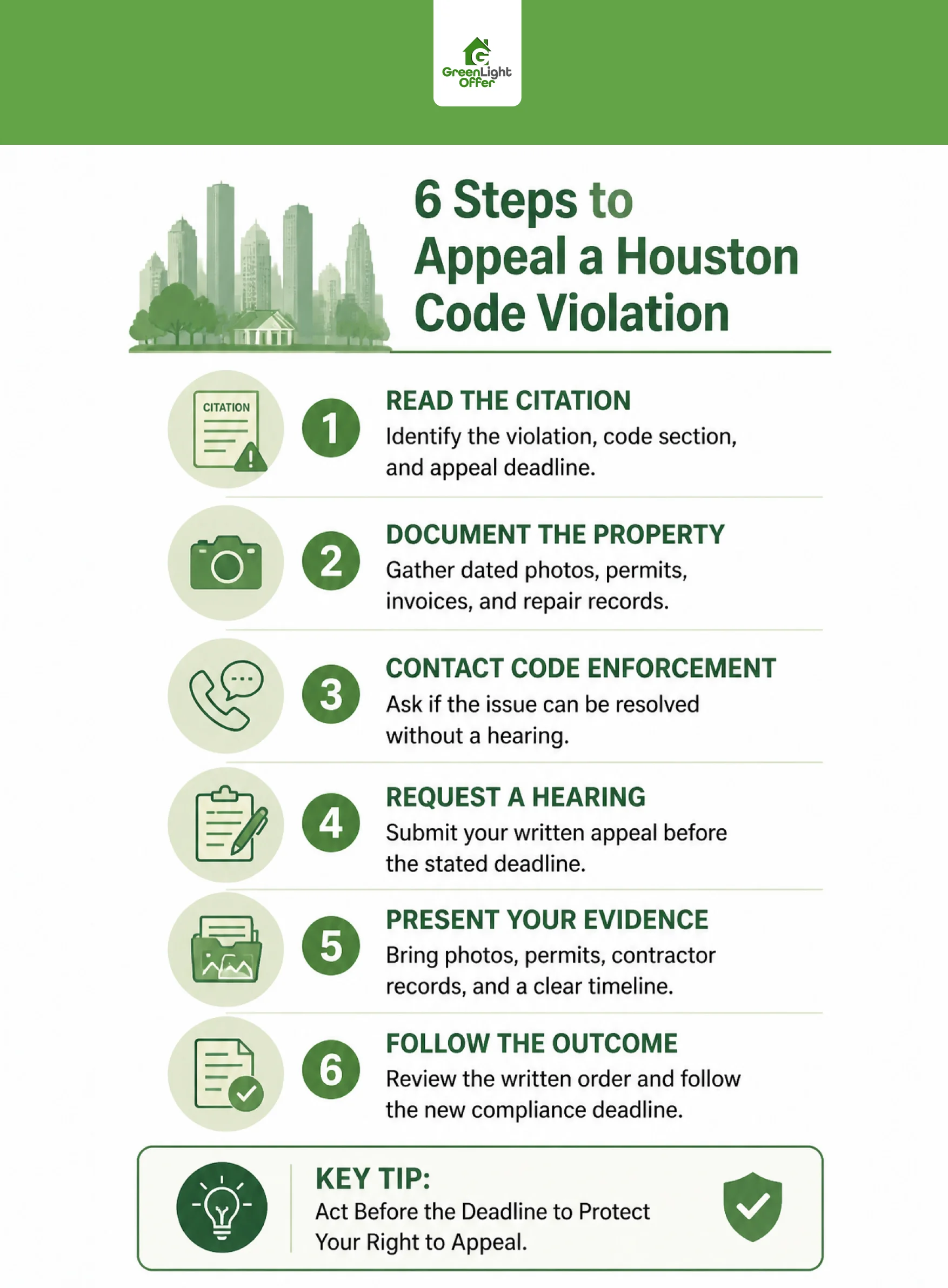
Step 1: Read the Citation Carefully
Start by identifying exactly what the citation says. Every notice names a specific code section, a correction deadline, and an inspector’s contact information. Some citations cover a single item, such as an unpermitted addition or an overgrown lot, while others list several types of code violations at once. Knowing the exact section cited tells you what you actually have to disprove or correct, instead of guessing.
Write down the correction deadline somewhere you will actually see it again. That single date drives everything else in the process, including how much time you have to request a hearing before your right to one closes.
Step 2: Document the Property’s Actual Condition
Take dated photos of the cited area from multiple angles the same week you receive the notice. Pull together any past repair records, contractor invoices, or permit documents that show the work was already done or done correctly. If a prior owner made the change, gather whatever paperwork exists from that transaction. A hearing officer weighs documentation far more heavily than a verbal account.
If the citation involves electrical, plumbing, or structural work, ask the original contractor for a copy of the closed permit if one exists. A closed permit on file with the city is usually the single strongest piece of evidence you can bring to a hearing.
Step 3: Contact the Code Enforcement Inspector or Office
Call or email the inspector listed on the citation before the deadline. Ask what specifically triggered the notice and whether the issue can be resolved by correction alone, without a hearing. Some citations close out once you submit proof of an existing permit or a completed repair. This step costs you a phone call and can save weeks.
Keep a short written record of who you spoke with and what they said, including the date. If your case does end up in front of a hearing officer later, that record shows you tried to resolve the issue in good faith before escalating.
Step 4: Request a Hearing to Appeal the Citation
If the issue cannot be resolved informally, follow the hearing instructions on your citation or notice. Houston uses different administrative hearing procedures depending on the type of violation. Administrative citations may be heard by a hearing officer, while dangerous-building matters can proceed through the Building Standards Commission. You can review the city’s current administrative hearing procedures to confirm which process applies to your case. A scope-of-work plan is specifically relevant to certain dangerous-building compliance proceedings, so confirm the applicable procedure and deadline directly with the city before submitting your request.
Ask the code enforcement office directly what format they require for the request and where it needs to be sent. Requirements shift from time to time, and confirming with the office directly beats relying on secondhand advice from a forum or a neighbor’s experience.
Step 5: Present Your Evidence at the Hearing
Bring your photos, permits, contractor statements, and a written timeline of what happened and when. If full repairs are not realistic before the deadline, present a specific scope-of-work plan instead of a vague promise to fix it soon. A concrete plan, with a contractor named and a start date attached, carries far more weight than a general assurance.
Stick to facts about the property, not frustration with the process. Hearing officers see a lot of citations. The ones that move fastest are the ones backed by a clear paper trail, not the ones argued the loudest.
Step 6: Follow the Hearing Outcome
The result depends on the type of proceeding and the evidence presented. A hearing officer may issue a written order sustaining or dismissing allegations, and a dangerous-building proceeding may result in an order requiring corrective action within a specified compliance period. Read the written order carefully because it will state the requirements, deadlines, and any available next steps for your case.
What If Your Appeal Doesn’t Succeed?
If the hearing officer upholds the citation, you have three realistic paths forward: complete the repair within the new deadline, request judicial review in qualifying cases under Local Government Code 214.0012, or sell the property instead of carrying the compliance burden yourself. Uncorrected violations that continue past a hearing order can escalate toward the dangerous building process, which carries real legal weight and, eventually, demolition risk if nothing changes.
Before committing to a full repair, it helps to actually run the numbers. Our repair vs. sell as-is cost comparison walks through typical repair ranges next to what an as-is sale nets, so you are deciding with real figures instead of a guess.
Texas Local Government Code §214.0012 allows an owner, lienholder, or mortgagee of record who is aggrieved by a municipal order issued under §214.001 to seek judicial review in district court. The petition generally must be filed within 30 calendar days after the required delivery of the municipality’s final decision. This is a separate court proceeding from the administrative hearing, so anyone considering judicial review should consult a Texas attorney about the applicable deadline and procedure.
Appeal Timeline at a Glance
Every case moves at its own pace, but the general shape of a Houston code violation appeal looks like this.
| Step | Typical Timeframe | Who’s Involved |
| Citation or notice issued | Day 0 | City/code enforcement |
| Informal resolution | Depends on the case | Property owner and city staff |
| Hearing request | Follow the deadline stated on the citation or notice | Property owner and applicable city office |
| Hearing | Depends on case type and city scheduling | Hearing officer or Building Standards Commission |
| Written order | After the hearing | Applicable hearing body |
| Compliance period | Depends on the order and case type | Property owner and city |
Treat this as a general shape, not a promise. Confirm the exact dates on your own citation and hearing notice, since scheduling varies by caseload and violation type.
Common Mistakes That Sink a Houston Code Violation Appeal
A few patterns come up again and again in cases that do not go the homeowner’s way.
- Missing the written deadline. A late request can forfeit the right to a hearing entirely, no matter how strong the underlying case is.
- Showing up without documentation. Photos, permits, and contractor records carry weight. A verbal explanation alone rarely does.
- Treating an open permit issue the same as a general repair citation. Unpermitted work has its own process and often needs a permit closed, not just a physical repair.
- Letting fines pile up while deciding what to do. Unpaid, uncorrected violations can convert into a municipal abatement lien on the property, which follows the house even if you eventually sell.
- Assuming a dismissed appeal means the property is now clean for financing. A dismissal removes the citation. It does not automatically satisfy what a lender’s appraiser will require later.
- Waiting until the hearing date to start gathering evidence. Photos, permits, and contractor statements take time to collect, and a rushed folder assembled the night before rarely tells a complete story.
What Happens If You Ignore the Citation Instead of Appealing
Ignoring a code violation citation does not make it go away. The correction deadline on the notice still applies whether you respond or not, and the city does not need your participation to move the case forward.
The consequences of missing a deadline depend on the type of citation or order. The city may continue enforcement through the applicable administrative or dangerous-building process, and additional penalties, orders, or costs may apply under the governing code. For dangerous-building cases, Houston has specific administrative hearing and compliance procedures that can lead to further enforcement if the required corrective action is not completed.
Depending on the violation and enforcement action, unpaid penalties or city-incurred abatement costs may result in a lien or other claim against the property under applicable Houston procedures. That can create an issue when you later sell or refinance the property. Check the specific citation or order to determine whether a lien has actually been assessed.
When Appealing Isn’t the Right Move

An appeal makes sense when the citation is genuinely wrong, already resolved, or correctable within a reasonable timeframe. It makes less sense when the underlying repair is large, the property has multiple stacked violations, or you simply do not want to manage a hearing process while also managing everything else going on.
Think about what winning the appeal actually buys you. If the best outcome is a longer deadline on a repair you were never going to make anyway, the appeal has bought time, not a solution. Some owners find that time useful for planning a sale instead of scrambling for a contractor. Others find it just delays a decision they had already made.
If financing is part of your exit plan, a pending code-related issue may create additional appraisal, underwriting, or repair requirements depending on the property and loan program. You can read more about why lenders may reject or delay financing for homes with code violations before deciding whether to repair, appeal, or sell.
We buy Houston houses with active code violations as-is, which means you are not choosing between an appeal and a repair project you cannot take on right now. We did not build Greenlight Offer to close deals. We built it to help people, and to treat every family the way we would want our own family treated. You can read more about how we work on our sell my house page or hear directly from past sellers on our testimonials page.

Frequently Asked Questions About Appealing a Code Violation Citation in Houston
Do I need a lawyer to appeal a code violation?
No, you are not required to hire an attorney for a standard code compliance hearing. Some owners handle straightforward cases themselves. For a citation with significant financial exposure, a large repair scope, or a dangerous building determination attached, a real estate or municipal law attorney is worth the cost of a consultation.
What if I can’t complete repairs within the deadline?
Present a scope-of-work plan at your hearing instead of asking for an open-ended extension. A specific plan, naming a contractor and a start date, gives the hearing officer something concrete to approve. Without a plan on the table, the standard compliance period generally applies.
Can I sell the house instead of appealing?
Selling may be an option before or after a hearing, depending on the property’s circumstances and the terms of the transaction. A cash buyer may be willing to purchase a property in its current condition without requiring the seller to complete the same lender-related repairs that a financed buyer might require. However, the citation, any outstanding order or lien, and the terms of the purchase agreement still need to be addressed as part of the sale.
Does an appeal stop fines from accruing while I wait for a hearing?
Not necessarily. Whether penalties continue, are suspended, or are otherwise affected depends on the type of citation and the applicable hearing procedure. Check the citation and ask the appropriate Houston office how the hearing affects penalties in your specific case.
Will an appeal show up on the property’s title?
The citation itself is a public code enforcement record, not a title encumbrance, unless it escalates into an unpaid abatement lien. A title company researching the property may still surface the citation history during a standard title commitment search. If you plan to sell soon, it helps to know that before a buyer’s title company finds it first.
How long does a typical appeal hearing take to get scheduled?
Scheduling varies with the city’s current caseload, but several weeks between the written request and the actual hearing date is common. If your compliance deadline falls before your hearing date, contact the code enforcement office directly to ask how the two timelines interact for your specific citation.
Is there a fee to request a hearing?
Fee schedules for code enforcement hearings can change and vary by case type, so we will not quote a number here that might already be outdated. Contact the Houston code enforcement office directly, or check with the Houston Permitting Center, to confirm whether a fee applies to your specific citation before you submit your request.
Appeal Your Code Violation Citation in Houston, or Sell As-Is Instead
Whether you appeal a code violation citation in Houston or decide the repair simply is not worth taking on right now, you have real options on both sides. An appeal can dismiss a mistaken citation or buy you a longer compliance window. Selling as-is skips the hearing, the repair bill, and the waiting entirely. If you would rather talk through your specific Houston property than sit through a hearing, we are ready to help. We send a written cash offer within 24 hours, with no obligation and no credit pull, so you can compare it against the cost of fighting or fixing the citation yourself. Get your free cash offer and see where you stand.
