
If you got a notice in the mail and are not sure whether it came from the City of Houston or your homeowners’ association, it can be hard to know what the notice means for your property. A code violation notice in Houston and an HOA violation notice come from different authorities and follow different rules, so identifying which one you received is the first step toward knowing what to do next.
A code violation is issued by the City of Houston under municipal ordinance, while an HOA violation is issued by a private homeowners’ association under its own governing documents. One is government enforcement backed by Texas law. The other is a private contract between you and your neighbors’ association. They can overlap on the same property, but they do not follow the same rules, the same fines, or the same path to resolution.
A few things are worth knowing before you dig into either notice:
- The city can eventually place a lien tied to unresolved code violations, while an HOA usually has to follow its own assessment and lien process spelled out in its governing documents.
- HOA violations are more common for cosmetic issues, like paint color, fence height, or an unapproved shed, while code violations tend to involve safety, structure, or permits.
- A property can carry both notices at once, especially when unpermitted work also breaks HOA architectural rules.
- Buyers using a mortgage react differently to each. A code violation can stall an appraisal. An HOA violation rarely does, unless it comes with a large unpaid assessment.
- Texas gives HOAs specific notice requirements under the Texas Residential Property Owners Protection Act, and the city follows its own ordinance and hearing process for code enforcement.
Who Enforces Each One?
The City of Houston enforces code violations, and your homeowners’ association enforces HOA violations, and that single fact explains almost every other difference between the two.
City Code Enforcement vs. HOA Board: Legal Basis
Code violations fall under the city’s own ordinances, mainly Chapter 10 of the Houston Code of Ordinances, and the enforcement arm sits inside Houston Public Works. HOA violations, on the other hand, come from your community’s recorded deed restrictions and bylaws, enforced by a volunteer or professionally managed board, not a government office.
| Aspect | Code Violation | HOA Violation |
| Issuing authority | City of Houston, Public Works Code Enforcement | Homeowners’ association board or management company |
| Legal basis | Houston Code of Ordinances, Chapter 10 | Recorded deed restrictions and HOA bylaws |
| Notice method | Written notice from a city inspector | Written notice, often certified mail, under Property Code Chapter 209 |
| Hearing process | Administrative hearing tied to Chapter 10 or Local Government Code 214 | Board hearing, per the association’s own governing documents |
| Fine destination | Paid to the city | Paid to the homeowners’ association |
| Ultimate escalation | Repair order, demolition order, or municipal lien | Suspension of privileges, HOA lien, or foreclosure in rare cases |
Who Is Responsible for Fixing the Violation?
In both situations, the property owner is usually the person responsible for bringing the property back into compliance. The important difference is what the owner has to comply with.
With a city code violation, the owner must address whatever condition violates the applicable Houston ordinance. That could mean obtaining a missing permit, correcting an unsafe electrical condition, repairing a structural problem, removing an illegal addition, or addressing another condition identified by code enforcement. The city is concerned with whether the property meets the applicable legal and safety requirements.
An HOA violation works differently. The owner must follow the community’s recorded restrictions and rules. A violation might require repainting a home, removing an unapproved structure, changing a fence, maintaining the yard, or getting architectural approval for a modification.
This distinction matters when the same project violates both sets of rules. Fixing the HOA violation does not automatically fix the city violation, and fixing the city violation does not automatically satisfy the HOA. If an addition was built without a city permit and also lacked HOA approval, for example, the owner may have to deal with both authorities separately.
Before spending money on repairs, identify exactly what each notice requires. A repair that satisfies one authority may still leave you with an unresolved violation from the other.
How Notice and Hearings Work for Each
The city delivers notice through a code inspector and gives you a set correction window, while an HOA has to follow the certified-mail and hearing rules written into Texas law before it can fine you.
Texas Residential Property Owners Protection Act Notice Rules
Under Texas Property Code Chapter 209, a property owners’ association generally must provide written notice by certified mail before taking certain enforcement actions, including levying a fine or suspending an owner’s use of common areas. The notice must describe the violation and, for qualifying curable violations, provide an opportunity to cure and information about the owner’s right to request a hearing. The exact requirements depend on the type of property, violation, and enforcement action.
You can read the full requirements in the Texas Residential Property Owners Protection Act, which lays out notice, cure periods, and hearing rights for homeowners in a mandatory HOA.
The city’s process looks different. A code enforcement inspector issues a written notice that cites a specific section of Chapter 10, sets a correction deadline, and explains what has to change. If you disagree with the citation or need more time, you generally have the right to request a hearing, which we cover in detail in our guide on how to appeal a code violation citation in Houston.

Which One Is Harder to Resolve Before Selling?
The difficulty depends on the violation and the stage of enforcement. A city code violation can create significant repair, enforcement, or financing issues, particularly when it involves structural or safety conditions. An HOA violation may be easier to resolve when the issue is straightforward and curable, but unpaid assessments, fines, or other enforceable amounts can also create lien and sale complications.
HOA violations are typically resolvable with payment or compliance, and most boards would rather see the issue fixed than escalate. That said, an HOA violation is not always minor. Large unpaid assessments can turn into an HOA lien, and in rare cases that lien can lead to foreclosure if it goes unaddressed for long enough. A code violation involving structural, safety, or other significant property-condition issues can create additional appraisal or underwriting requirements for a financed sale. Whether the issue prevents closing depends on the property, the loan program, the appraisal findings, and the lender’s requirements.
If your notice touches unpermitted work or a structural issue, it is worth understanding the types of code violations Houston inspectors commonly cite, since the resolution path depends heavily on which category you are dealing with.
There is one more wrinkle worth knowing. HOA violations tied to unpaid assessments can, in rare and extreme cases, lead to foreclosure under the association’s own recorded lien rights, separate from anything the mortgage lender does. That outcome is uncommon, but it is why an unpaid HOA balance should never be treated as a minor paperwork issue just because it did not come from the city.
What Happens If You Ignore a Code or HOA Violation?
Ignoring either type of violation usually makes the situation harder and more expensive to resolve. The difference is in how the problem escalates.
With a city code violation, continuing to ignore the notice can lead to additional enforcement action, hearings, repair requirements, or other municipal remedies depending on the violation. In serious cases, the city can take action involving dangerous or unsafe buildings, and municipal costs can eventually become a lien-related issue.
An HOA generally follows a different escalation process. The association may send additional notices, assess fines when permitted, suspend certain privileges, or pursue a lien for qualifying unpaid amounts. The exact process depends on the association’s governing documents and applicable Texas law.
The practical takeaway is simple: do not assume that an old notice has disappeared just because nobody has contacted you recently. Before listing a property, find out whether the violation is still active, whether fines or assessments have accumulated, and whether any lien or other enforcement action has been recorded.
If you are already planning to sell, resolving the uncertainty early can prevent a last-minute problem during title review, the HOA resale process, or negotiations with a buyer.
Can You Have Both at the Same Time?
Yes, a property can carry both a code violation and an HOA violation at the same time, and this happens more often than most sellers expect.
The most common overlap is unpermitted work. An owner builds a shed, adds a room, or fences in a yard without pulling a city permit and without HOA architectural approval. The city cites the work as unpermitted construction. The HOA separately cites it as a violation of the community’s architectural guidelines. The two processes run independently, on their own timelines, with their own fines, even though they are triggered by the same physical change to the property.
Fines and liens work differently for each authority, and it helps to understand how code violation fines become a lien if you want the full mechanics of how the city’s side can escalate. For a broader look at liens on a Houston property, including tax, mortgage, mechanic’s, and HOA liens, see our guide to property liens.
How Each One Affects a Home Sale
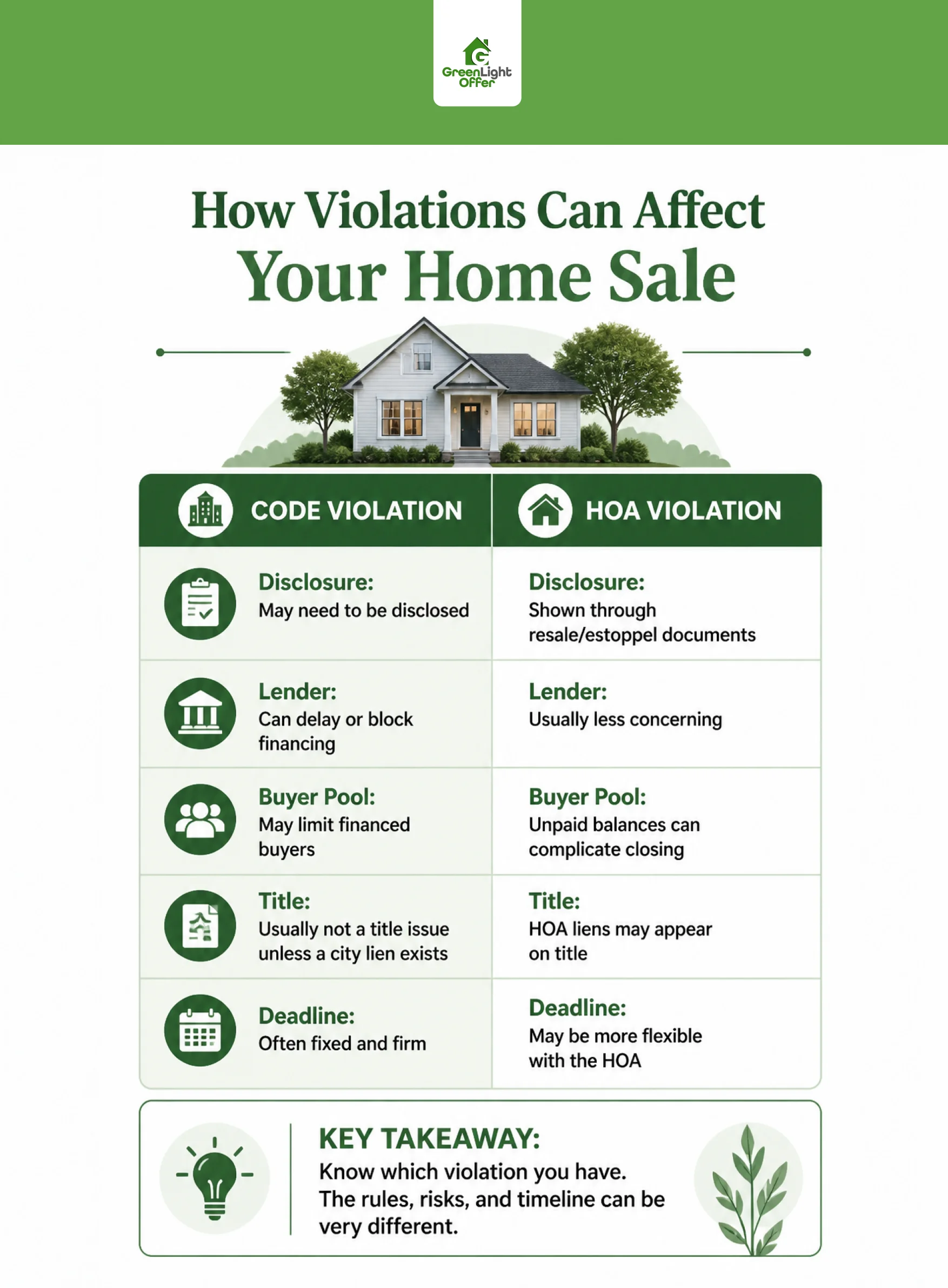
Both violation types can slow down a sale, but they affect a transaction in different ways and at different points in the process.
- Disclosure obligations differ. Known code violations generally fall under the disclosure duty in Texas Property Code 5.008, while HOA violations are typically addressed through the HOA resale certificate and estoppel documents rather than the standard seller’s disclosure.
- Lender concerns center on code violations far more than HOA notices, since an appraiser is evaluating the physical condition and safety of the structure, not the community’s rule book.
- Buyer pool impact is real for both. A financed buyer’s lender may require a code violation to be resolved before closing, while an HOA violation with an unpaid balance can show up on the resale certificate and complicate closing costs.
- Title issues only apply cleanly to one side. An HOA lien for unpaid assessments can show up in a title search much like any other lien, while an open code violation itself typically will not appear on a title report unless the city has already filed a lien for its own costs.
We did not build Greenlight Offer to close deals. We built it to help people, and to treat every family the way we would want our own family to be treated. That mindset shapes how we talk sellers through violations of either kind, without judgment about how the notice happened in the first place.
The timing matters too. A code correction deadline is usually set in a fixed number of days from the notice date and tends to be firm. An HOA cure period is often written into the association’s own bylaws and can sometimes be extended informally if you are in communication with the board. Knowing which clock is less forgiving helps you decide where to spend your time first.
What Happens to the Violation at Closing?
A violation does not necessarily prevent a property from being sold, but it can change who pays, what gets negotiated, and whether the buyer can obtain financing.
For an HOA violation, the title company and closing parties may need to account for unpaid assessments, fines, or other amounts shown through the HOA’s resale documentation. The buyer and seller may negotiate who will bring the account current, but the exact treatment depends on the circumstances and the documents involved.
A city code violation can create a different problem when the buyer is using a mortgage. If the violation involves an unsafe condition, unpermitted construction, or a repair that affects the property’s condition, the buyer’s lender or appraiser may require the issue to be addressed before closing. That can reduce the number of financed buyers willing to move forward.
This is why two homes with similar-looking notices can have very different sale outcomes. An HOA violation may primarily become a closing-cost or negotiation issue, while a serious code violation can become a financing issue.
If you are selling with either type of violation still open, determine the status early rather than waiting for the title company, lender, or buyer to discover it during the transaction.

What to Do First If You Have Both Notices at Once
Start with the code violation first if you are working against a sale timeline, because it is the one most likely to stop a financed buyer’s loan from closing.
- Read both notices closely and note the deadline on each. The city’s correction window and the HOA’s cure period rarely line up.
- Call the code enforcement inspector listed on the city notice to confirm exactly what needs to happen and whether a hearing option exists.
- Contact your HOA management company or board to ask about their cure period and whether a payment plan is available for any fine.
- Get a written cost estimate for the code repair before deciding whether to fix it, sell as-is, or pursue an appeal.
- If you plan to sell, tell your buyer or your cash buyer about both notices early. Surprises at closing cost everyone time.

Frequently Asked Questions About Code Violation vs HOA Violation Situations
Can an HOA violation turn into a lien like a code violation can?
An HOA may have lien rights for qualifying unpaid amounts, but the specific lien and enforcement rights depend on Texas law and the association’s governing documents. Texas law also places restrictions on an association’s ability to foreclose certain assessment liens, so an HOA lien should not be treated as identical to a municipal code-enforcement lien.
Do I have to disclose HOA violations when selling?
HOA-related amounts and property information can appear in the resale certificate or other association documents provided during a sale. Texas Property Code Chapter 207 governs property owners’ association resale certificates and addresses information such as amounts owed and other required association information. Whether a separate HOA issue must also be disclosed through the seller’s property disclosure depends on the facts and the applicable disclosure requirements. For code-violation disclosure specifics, see our guide on whether you have to disclose code violations when selling in Texas.
Which one shows up in a title search?
An HOA lien for unpaid assessments will generally show up in a title search the same way other liens do. An open code violation itself usually will not appear unless the city has already filed a lien for its own enforcement costs, which is one more reason to resolve or disclose it early.
Is a code violation worse than an HOA violation?
There is no single answer because the consequences depend on the violation. A serious city code issue can involve safety, repair, enforcement, or financing concerns, while an HOA violation can create fines, assessments, restrictions, or lien-related issues. The specific notice, governing documents, property condition, and stage of enforcement matter more than the label alone.
Can I sell my house if I have an open HOA violation?
Yes, you can sell a house with an open HOA violation. Most buyers and title companies work through the resale certificate process, and any unpaid balance is typically settled at closing out of the sale proceeds. If the property has escalated to a city dangerous-building order rather than a standard citation, that is a separate track, and our guide to Houston’s condemned property process explains how that timeline works.
Sell Your Houston House With a Code or HOA Violation, As-Is
Whether you are dealing with a code violation, an HOA violation, or both at once, you do not have to resolve either one before you get an offer. We buy Houston houses as-is, including properties with open city citations, HOA fines, or both sitting on the same address. You can also read real seller stories or check our FAQ page for more on how the process works.
We put together a written cash offer within 24 hours, with no obligation and no credit pull, so you can weigh your options without pressure. If you are ready to see what your property is worth as-is, get your free cash offer, and we will walk you through both the city and HOA sides of your situation.
