
If you are selling a house with a code violation in Houston, you may be wondering whether Texas law requires you to disclose it to the buyer. In most sales of a single-family residential property, the answer depends on what you know about the property’s condition and whether the transaction falls within one of the statutory exemptions.
Yes. Texas Property Code Section 5.008 generally requires a seller of residential real property consisting of no more than one dwelling unit to provide a written Seller’s Disclosure Notice. The notice must be delivered to the purchaser on or before the effective date of the contract. The required disclosure addresses the seller’s knowledge of the property’s condition, including certain alterations or repairs made without necessary permits or not in compliance with applicable building codes.
The requirement is based on what the seller actually knows. If information required by the disclosure is unknown, the statute allows the seller to indicate that it is unknown. However, certain transactions are exempt from the statutory disclosure requirement, so sellers should confirm whether an exemption applies before relying on one.
- Known code-related issues may need to be disclosed through the Seller’s Disclosure Notice.
- The statutory notice is generally due on or before the effective date of the purchase contract.
- The requirement applies to sellers of residential property consisting of no more than one dwelling unit, subject to statutory exemptions.
- An as-is sale does not itself appear among the exemptions listed in Section 5.008.
- If the disclosure is delivered late, the buyer may have a statutory right to terminate within seven days after receiving it. If the required notice is never delivered, the buyer may have a right to terminate before closing.
What Texas Property Code §5.008 Actually Requires
Texas Property Code §5.008 generally requires a seller of residential real property consisting of no more than one dwelling unit in Texas to provide the purchaser with a written Seller’s Disclosure Notice containing the information required by the statute. The notice must be delivered on or before the effective date of the contract.
The current TREC Seller’s Disclosure Notice addresses code-related issues through a question asking whether the seller is aware of room additions, structural modifications, or other alterations or repairs made without necessary permits or not in compliance with building codes in effect at the time. The form also asks about notices of violations of deed restrictions or governmental ordinances affecting the condition or use of the property. TREC currently lists Form 55-1 as the Seller’s Disclosure Notice used for voluntary compliance with Texas Property Code §5.008.
This matters just as much if your violation traces back to selling a house with an open permit rather than a citation from an inspector. Unpermitted work and open permits are two of the most common reasons Houston sellers end up filling out this section of the form for the first time.
The law exists because a buyer’s earnest money and option period only give them a short window to walk away for any reason. Once that option period ends, a buyer’s remaining exit routes narrow to the disclosure form and whatever their own inspection turns up. Texas lawmakers built Section 5.008 so a seller’s personal knowledge does not stay hidden behind a clean-looking appraisal or a fast option period.
This is also why the form asks about your knowledge, not a professional inspection. You are not expected to know things a licensed inspector would need specialized equipment to find. You are expected to say yes if you have a citation letter in a drawer, a permit application you never finished, or a conversation with an inspector you would rather forget.
What Counts as a “Known” Code Violation for Disclosure Purposes?
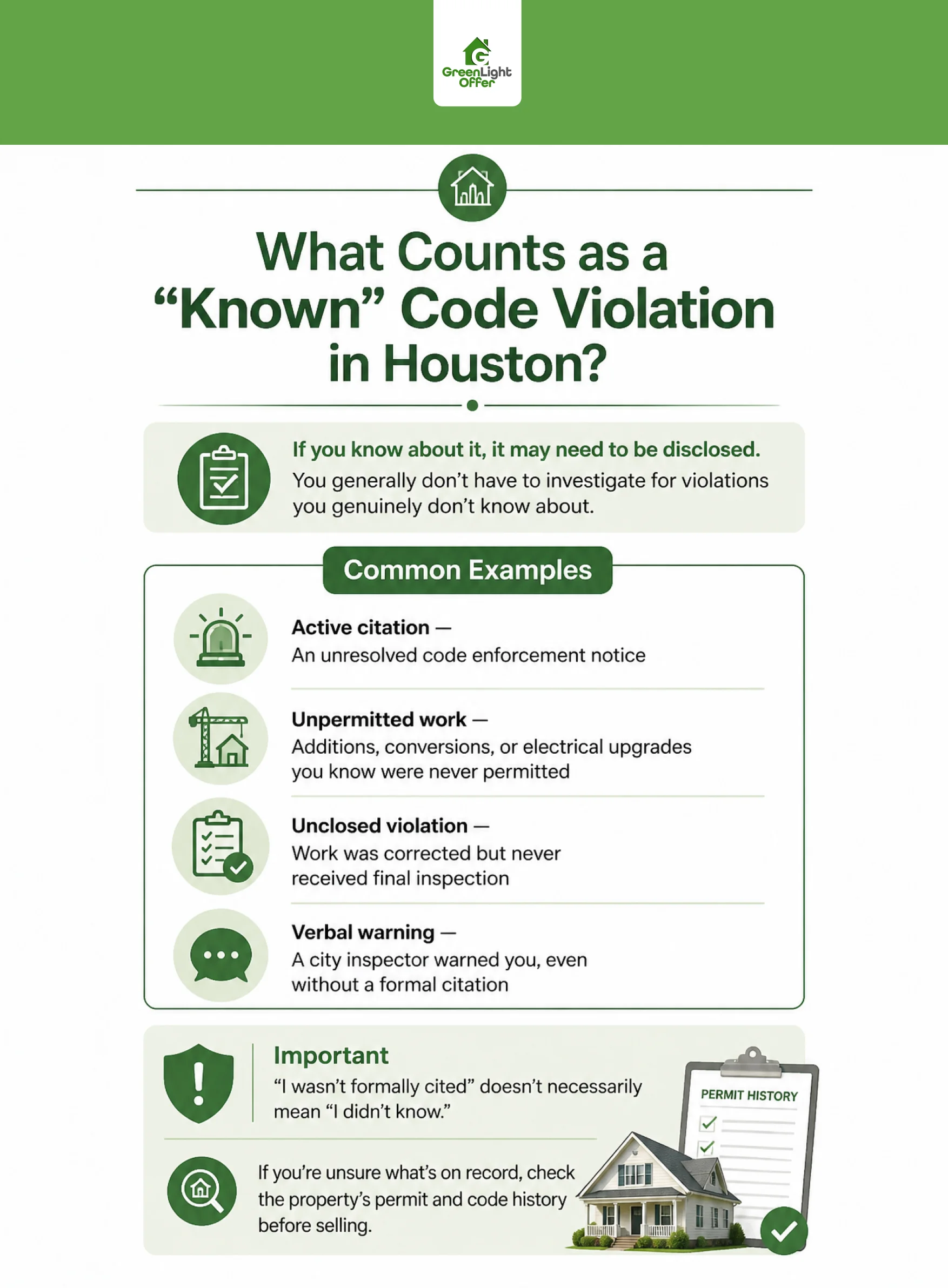
A known code violation is any citation, notice, or unresolved code issue you are personally aware of, whether the city has already cited you or you simply know that work was done without a permit. This is a personal knowledge standard, not a duty to investigate.
In practice, this covers several situations we see often in Houston:
- An active, unresolved citation from Houston Public Works code enforcement.
- An addition, garage conversion, or electrical panel upgrade you know was never permitted.
- A prior violation you corrected but never closed out with a final inspection on record.
- A verbal warning or courtesy notice from a city inspector, even if no formal citation followed.
If you are not sure what qualifies, start with our overview of the types of code violations Houston enforces most often, or, if the notice you received mentions a dangerous building order, read our guide to the dangerous building and condemned property process.
What you do not know does not have to be disclosed. But a violation you learned about verbally, then chose to ignore hoping it would not come up, still counts as known for disclosure purposes.
If you inherited the house, bought it years ago, or simply are not sure what is on record, a quick records check can settle the question before you fill out the form. The Houston Permitting Center keeps permit history and open code cases tied to a property address, and most title companies will pull a similar record as part of preparing the title commitment for your sale. Checking early means you disclose from a position of knowledge rather than guessing.
Are There Exemptions to the Disclosure Requirement?

Yes. Texas law exempts a short, specific list of transactions from the Seller’s Disclosure Notice requirement under Property Code Section 5.008(e).
- New construction that has never been occupied.
- A transfer under a foreclosure sale, a deed in lieu of foreclosure, or a trustee’s sale.
- A transfer between co-owners of the property, or to a spouse or a lineal descendant.
- A transfer resulting from a court order, including a divorce decree.
- A transfer by a trustee in bankruptcy.
- A transfer by a personal representative during probate administration in the course of settling an estate.
- A sale to or by a governmental entity.
If none of these apply to you, the disclosure requirement applies, regardless of whether you are selling to a retail buyer, an investor, or a cash home buyer.
Most of these exemptions exist because the transaction itself already carries its own disclosure structure. A foreclosure sale, for example, does not involve the same negotiated purchase contract a traditional sale does, and a transfer between family members is not the kind of arm’s length deal Section 5.008 was written to protect. Do not assume an exemption applies just because your situation feels unusual. Read the list carefully, and when in doubt, fill out the form.
What Happens If You Don’t Disclose a Known Code Violation?
If a seller does not provide the required disclosure on or before the effective date of the contract, Texas Property Code §5.008 gives the purchaser a right to terminate the contract for any reason within seven days after receiving the late notice. If the required notice is never delivered, the buyer may have a right to terminate before closing. Separate legal claims may also be available depending on the facts, but those claims should not be presented as automatic consequences of every disclosure mistake.
An undisclosed violation can also turn into a bigger financial problem than most sellers expect, especially once you understand how code violation fines turn into a lien against the property itself. A municipal lien does not disappear at closing. It has to be resolved through title, the same way any other lien on a Houston property does, and a title commitment will usually surface before you ever reach the closing table.
Beyond the legal exposure, a surprise violation found late in a deal tends to cost sellers money twice. First through a renegotiated price once the buyer’s lender flags it, and again through the carrying costs of a delayed closing while everyone figures out next steps. Disclosing early keeps both of those costs off your net-to-seller number instead of surfacing them after you thought the sale was final.
Disclosure Timeline: When the Notice Must Be Delivered
The Seller’s Disclosure Notice is due on or before the effective date of your contract, and how late it arrives determines what rights the buyer has. Delivering it during your first conversation with a buyer, rather than waiting until a contract is drafted, removes the timing question entirely.
| Scenario | Deadline | Buyer’s Remedy if Missed |
| Notice delivered before contract signed | On or before the contract’s effective date | None needed. This is the standard, compliant path. |
| Notice delivered late, before closing | Any point before closing | Buyer may terminate within seven days of receiving the late notice. |
| No notice ever delivered | Not applicable | Buyer may terminate the contract at any time before closing. |
| Exempt transaction (see exemptions above) | No notice legally required | Not applicable. The exemption controls. |
Because the seven-day window starts running the moment the buyer actually receives the notice, delivering it early protects you far more than delivering it fast right before closing.
Does Selling “As-Is” Remove Your Disclosure Duty?
No. Selling your house as-is changes who pays for repairs, not whether you have to disclose known code violations.
An as-is sale tells the buyer you will not fix anything before closing and you will not negotiate repair credits. It does not exempt you from Property Code Section 5.008. The disclosure notice and the as-is condition of the sale operate on two completely separate tracks.
For a broader look at how as-is sales work in Houston beyond code violations specifically, see our general as-is disclosure requirements in Houston guide, which covers foundation, roof, flood, and other defect categories on the same TREC form.
If you are weighing whether to fix a violation before selling or disclose it and sell as-is, comparing repair costs to selling as-is breakdown walks through the carrying costs, contractor pricing, and net-to-seller math side by side.
How the Seller’s Disclosure Notice Handles Code Violations Line by Line

The TREC form does not have a single box labeled “code violation.” Instead, it asks about alterations or repairs made without necessary permits or not in compliance with building codes, as well as notices of violations of governmental ordinances affecting the property.
The Permits and Alterations Question
This line asks whether you are aware of any alterations, modifications, or repairs made without necessary permits. Check yes if you know about an addition, converted garage, or electrical work that never went through the Houston Permitting Center, even if the work itself looks fine today.
The Code Compliance Question
This separate line asks whether you are aware of any non-compliance with building codes. Check yes here if you have an active citation, a past citation you resolved, or a known structural or safety issue an inspector flagged, whether or not it overlaps with the permits question above.
Both questions matter to a financed buyer’s lender, which is part of why mortgage lenders reject homes with code violations in the first place. A cash buyer skips the appraisal contingency entirely, but the disclosure obligation itself does not change based on how the buyer is paying.
Why Full Disclosure Usually Works in Your Favor
Providing accurate information can help reduce disputes over what the seller knew about the property before the sale. It does not, however, guarantee that a seller will have no legal exposure after closing. The effect of a disclosure depends on the information provided, the circumstances of the transaction, and the claims a buyer may later assert.
If you know about a code-related issue, give an accurate answer on the disclosure notice and provide relevant details when the form calls for an explanation. Whether the issue should be repaired, addressed through the purchase price, or sold as-is is a separate transaction decision. For a situation involving a significant violation or potential legal dispute, a Texas real estate attorney can explain the risks based on the specific facts.

Frequently Asked Questions About Disclosing Code Violations in Texas
Do I have to disclose a violation I already fixed?
Not necessarily just because the violation existed in the past. Texas courts have recognized that knowledge of a previous repair or past condition does not, by itself, establish that the seller knows the same defect still exists when the disclosure is completed. If the seller knows that a current code-related condition remains, or knows of facts that the current disclosure form asks about, the seller should answer the applicable questions accurately and explain the situation as appropriate.
Do cash buyers still require a disclosure notice?
Selling to a cash buyer does not, by itself, create an exemption from Texas Property Code §5.008. If the transaction is subject to the statute, the seller’s disclosure obligation generally remains the same regardless of whether the buyer is using cash or financing. The important questions are whether the property and transaction fall within the statute and whether one of the statutory exemptions applies.
Can I be sued after closing for an undisclosed violation?
A buyer can raise a claim after closing if they discover a violation you knew about and did not disclose. Whether that claim succeeds depends on the specific facts, including what you knew and when. This is general information, not a prediction of how any particular case would turn out. Talk to a Texas real estate attorney if you are concerned about a specific situation.
What if I inherited the house and never lived there?
You still have to disclose any code violation you know about once you own the property, even if you inherited it and never occupied it. The probate administration exemption covers certain transfers by a personal representative settling an estate, not a later sale by the heir who now holds title.
Does an exemption apply just because I never received a formal citation?
No. The exemptions under Section 5.008(e) are tied to the type of transaction, such as a foreclosure sale or a transfer between co-owners, not to whether the city has formally cited you. If your sale does not match one of the listed exemptions, the disclosure duty applies regardless of citation status.
Disclose Code Violations When Selling a House in Texas
Disclosing code violations when selling a house in Texas is not optional, but it also does not have to derail your sale. Once you have filled out the form honestly, you have real options for what happens next.
We have bought Houston houses with active and past code violations since 2016, and we are BBB A+ accredited with a 4.7-star Google rating. Sean Zavary, our founder, has said he did not build a company to close deals. He built it to help people, and to treat every family the way he would want his own treated. You can read real seller stories from families we have worked with, and browse our frequently asked questions for more on how we handle situations like yours.
If you have a known code violation and want to sell without repairing it first, disclose it, then get your free cash offer. We will send you a written cash offer within 24 hours, with no obligation and no credit pull, so you can decide what makes sense for your house and your timeline.
